Friday, February 24, 2012

An editorial board is not a scholarly community

A couple nights ago I spent the better part of an hour talking with a family friend who is a lawyer that works in the trenches of intellectual property and copyright. He was interested in the Research Works Act and was trying to find out exactly why this one sentence act is so troubling to scholars and librarians.

I probably got more out the exchange than he did because there's nothing like being grilled by a lawyer to force you to articulate how and where you stand on a issue. In the end, we were able to pinpoint what is egregious in this act: it gives all rights to "network dissemination" to the publisher instead of the copyright holder

But before we reached that point, I had to answer a lot of difficult questions about scholarly publishing, and I found that, to my lawyer friend, all the stories that I was telling about The Big Deal, the intractable pricing levels based on the historic spend and the entrenchment of citation impact factors as a measure of merit in the advancement and tenure processes ... well, they were all very interesting but off-topic.  Again and again, he pressed me with this: "If scholars continue to submit their work to  journals provided by commercial publishers, then clearly the publisher provides additional value, no?"

It may not have been the best answer, or even my best answer, but this was my answer I gave to him:

Yes, I concede that there are commercial publishers, like Nature, who have, over the years, invested in their publication to justify their standing as an important journal. But most commercial publishers have not made this type of investment. You see, journals historically were produced by scholarly societies for themselves with prices largely set as cost-recovery. But after World War II, it was recognised that scholarly communication was a viable commercial product and commercial publishers made attractive offers to scholarly societies to sell their journals so they wouldn't have to worry about the costs of the distribution, editorial communication and co-ordination any more. But now with the Internet, the costs of distribution and co-ordination have come down to almost zero, which is why this act is in place: to prevent scholars from building new systems of "network dissemination."

And so here we are.  I've signed the petition not to publish in, not to referee, or not to do editorial work for Elsevier.  Now what?

Well, I think we are not as far from a post-Elsevier world than some may think. We are already developing new forms of practice to recognize "non-traditional" evaluation of scholarly work.  It was at last year's Great Lakes THATCamp when I heard about a great way to evaluate the scholarly merit of a scholar's blog: you ask other scholar bloggers to evaluate the work. It's called peer review! How novel!

By the way, the opportunity to share and learn from these kind of stories and strategies is just one of many good reasons to join us at this year's Great Lakes THATCamp.

And while I'm shilling unconferences, I'd like to mention that I will be helping host the next code4lib North that is tentatively scheduled for May 24/25.

Actually, I think that this announcement just might relate to this post in a more more ways than one...


That exchange led to this...

Sunday, February 19, 2012

Too long ; Don`t read

Librarians, has this ever happened to you?

Have you ever introduced a student to a particular search interface, pointed out the various ways to how one can narrow one's search results by type of publication, subject matter, peer-review, author, language and various other facets, only to be stumped by the request, "So, how can I find a five page paper? All the articles I have already found are, like, twenty pages long."

What we have on our hands here is particular form of teal deer, otherwise known as "too long; didn't read" - a phrase in itself is considered too long to bother with so it's frequently shortened to tl;dr.

I thought of all the times this particular scenario had unfolded before me as I was reading Aimée Morrison's post "They still hate the textbook" which I personally read less as an indictment against textbooks and more of a confirmation of my own hunch that even our best students find long-form and/or scholarly reading difficult to do.

I'm beginning to think that this might be an issue that libraryland should be concerned about.  If our students can't read articles that are twenty pages long, then our buildings filled with books may as well be filled with teal deer.

And while I don't think I should have to say to this, I will: I (still) think the kids are alright. This post is not a diatribe about how kids today lack moral fibre. I just think they just have poor reading habits.

And I distinctly remember having the same.

I'm not sure what this says about my own higher education experience but immediately after I had graduated from library school, I know my ability to concentrate on long form reading was dismal.  I distinctly remember one of these first nights without schoolwork or sports practise and without room-mates or TV.  I found myself staring at the ceiling because I was too tired to read any further but not tired enough to go to sleep. I finally had time to read only to find that couldn't even get through a single Harper's Magazine folio article.

But, in time, I did become a person able to read an entire issue of Harper's Magazine in one sitting. And then some. And then a lot more. I became a voracious reader.

So I believe that it's not right to say that the Internet, video games and texting have destroyed the brains of our students but I think it's quite apparent that these particular technologies do, on an almost hourly basis, set and reinforce the particular habit to pursue and experience instant gratification. But the good news is that reading is a just a habit of mind and habits can be changed if the will and the work is there.

I've been thinking about how librarians could take on the cause of long, slow and deliberate reading and how to make its case to our students. I know one way not to go about it. I remember being in my second year of my undergraduate program and being assigned a particular dense scholarly article called something along the lines of  "How to read (a dense scholarly article)." I remember this episode clearly because I felt insulted that our professor didn't think we knew how to read. So, yeah, I missed the point. But years later I did learn this: assigning a long dense article on the merits of reading long dense articles is setting yourself up for fail.

Do I have any better ideas? Not at this point. But if I was to look into the matter seriously, I'd start with a couple avenues of thought to explore as leads.

The first would be encouraging the development of deep reading through  peer-sharing of reading improvement strategies. I doubt YoungMe would listen to NowMe lecture on good reading habits, but maybe, just maybe she would listen to what sage advice reddit, LifeHacker, AskMefilter, or even Wikipedia would have to say about improving one's reading skills. Maybe students would make use of a self-tracking applications like Level Me Up as they try to improve their reading stamina. Introducing them to tools like Instapaper might be fruitful as well, if just to demonstrate that most of us require being in 'another state of mind' before doing long form reading and these 'read later' apps are generally used to separate out this reading for us while we are caught in the undertow of status updates and tweets.

The other tact I'd pursue would be through the use of tools - like highlighters, post-it notes and whatever their digital equivalent are - to mark-up and take apart, destroy and reassemble a text as a means to force an engagement with words.

Before I finish this post - which I admit is beginning to feel like a forced engagement, I want to address something that seems tangential, but I believe relates somehow.

Recently I attended a library conference where I listened to a colleague speak editorially on the very delicate matter of labour issues within librarianship and, as such, had decided to read her statement. A twitter response that floated up during her talk was that it was 'too dense to follow.' This, I guess, shouldn't have been too surprising because at library conferences it is generally frowned upon to read one's presentation to an audience. And I understand the reasons why: the lecture is now generally understood to ill-suited to the retention of facts - if that is, indeed, the purpose of the talk.

But recently, I've come to understand that at many scholarly conferences, it is accepted practice that papers are read out loud because conference papers are presented as a means to workshop one's argument before peers before an the piece has been strengthened and refined enough for publication. And while the attentive listening of conference papers is challenging, this activity is understood to be the difficult and necessary work of scholars. What does it mean when this sort of presentation is actively discouraged at library conferences?

Long form reading takes concentration and scholarly reading is difficult work but the challenging work through challenging works can and does make it all worthwhile. 

So says the woman who writes blog posts? Ummm....  Look! A teal deer!

Monday, January 16, 2012

my top tech lens

you don't need a weatherman
to know which way the wind blows

The chosen few are set to announce their lists of the top tech trends that we should all be embracing or bracing for.  The following isn't such a list. Mine is more of a list of things that I hope more people will pay more attention to.  Which is why I wrote this list.

MY TOP TECH BENDS

1. Free as in library

If you are part of a library or other not-for-profit that takes historical material and then places that material behind a paywall or makes the works available but with copyright restrictions, be prepared to feel a little less gratitude and a little more wrath for your labour.  Better have an answer ready to this question: why didn't you add the material to the Internet Archive or to Wikimedia instead?


2. More is different

Regular folk have been reading books on their e-readers for a handful of years now. How much longer will it be before these e-readers start adding new features that take fuller advantages of what digital text is capable of?  I'm thinking of strange new features like  Amazon's Daily Review.

I was talking with a friend last week about music and he told me a story about how he uses his iPad for his collection of music scores. Not only does it store and makes available all this music collection, the software act as a metronome, can transcribe a score into a different key, offer hands-free page turning, and even play the score so you can know what the piece is supposed to sound like. Paper scores no longer sound so wonderful to me.


3. Make Everything Digital

If you are reading this blog post then you are probably old and if you are old then you probably have much of your own work and past reading material written in ink, embedded in paper, and sitting on shelves. The amount of effort required for the digitizing of your artifacts is probably too daunting to consider seriously. But if you were starting your scholarly career all over again, would you take the time to make just one corpus of material and make everything digital? When scanning a document more often than not requires a camera or even just a camera phone, why wouldn't you?

Academic library systems are able to acquire and make available access to a large number of ebooks - largely because they have accepted many of the publishers' conditional terms for access: DRM, pdf format, and very strict downloading and printing limits. With these restrictions in place, scholars can read works but are not able to copy significant amounts of text for analysis or to manipulate the texts digitally. This raises the question: how soon will it be before we will regularly see scholars scanning their screens with their iPhones in order to make a copy of text?


4. Adding a layer over the web

Discovery layers are a cargo cult for library administrators: build something that looks like Google (but is not Google) and the good times will return as our communities will leave the internet for the promised land of the library website. At my place of work, the use of Web of Science is an order of magnitude over most other databases. Why? Web of Science presents a small, understandable set of the most important journals that cover a long period of time, along with strong linking to full-text, meaningful connections between items, and adds the ability to download, sort and parse results sets. Discovery Layers do the opposite in every way.

NCSU recently presented the results of a study of How Users Search the Library from a Single Search Box and the most frequent query of their library system- encompassing more than one percent of the total number of searches - was web+of+science.  Discovery Layers: qui bono?


5.   The network divide

map-of-a-tweet

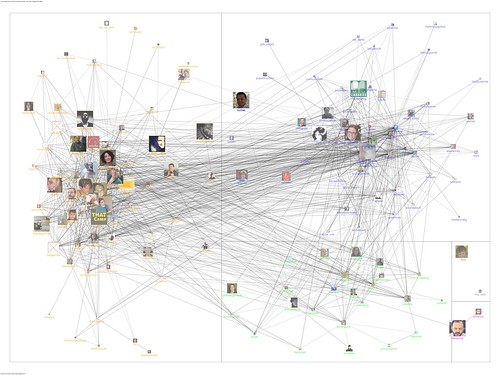
The image above is a map of all the metadata associated of just one tweet.  The image below is a map of the connections among the Twitter users who tweeted the word THATCamp, queried on April 30, 2011:

20110430-NodeXL-Twitter-THATCamp


Network analysis and visualizations are of great interest and importance because what they can reveal goes far beyond what we can intuit without machines. Network analysis and visualizations requires a whole set of new competencies that I have not seen much of in libraryland, with the exception of those on Team LODLAM, who enjoyed a breakthrough season last year.

My message here is that we need to be creating data, not records, and that we need to create the data first, then build records with it for those applications where records are needed. Those records will operate internally to library systems, while the data has the potential to make connections in linked data space.


Meanwhile, librarians are still teaching Boolean logic. That's a disconnect that I'm finding difficult to ignore.


Speaking of disconnecting, I need to that now. There is much work to be done. This is what we can all agree on.

Wednesday, January 11, 2012

A glut. A library. A flood. A review.

I've started reading again.

I try to put in a chapter before bed and it's done wonders, not only for all the good things associated with what learning news things bring, but doing so settles my monkey-mind down so that I've been sleeping better.

I read three related books in succession: one about the history of categorization, one about the history of libraries and the last about the history of information.


While reading these particular books in quick succession will no doubt mess up my ability to recall which particular book contained which particular antidote, the upside is that I've had the opportunity to notice where they contradict each other and where they tell the same story but from different perspectives.
The first categories may have emerged as outward expressions of existing social relationships: an attempt to make visible otherwise invisible relationships like “parent,” “sibling,” or higher-level abstractions like “family.” As Hobart and Schiffman write, “Genealogy provides the ideal classificatory tool, for it narrates a sequence of actions. It thus sustains the tradition while, at the same time, subjecting it to a hierarchical ordering that clarifies the nature of various figures. When gods are considered, genealogy becomes a means of understanding the cosmos … when mortals are considered, it becomes an encyclopedic framework for historical and geographical as well as social information.”9
Highlighted by Mita in Glut

Or as a more eloquent writer like James Gleick puts it:
For the Yaunde, the elephant is always “the great awkward one.”♦ The resemblance to Homeric formulas—not merely Zeus, but Zeus the cloud-gatherer; not just the sea, but the wine-dark sea—is no accident. In an oral culture, inspiration has to serve clarity and memory first. The Muses are the daughters of Mnemosyne.
Highlighted by Mita in The Information: A History, a Theory, a Flood


Glut (a horribly named book; a book about food is not called Stomach Pangs) - is the weakest in terms of scholarship, but just like the work of Howard Bloom which he cites frequently in the early chapters, it is still very interesting...
We do not have to accept Bloom’s theory as hard science, however, to appreciate it as a metaphor. As Alfred North Whitehead put it, “It is more important that a proposition be interesting than that it be true. But of course a true theory is more apt to be interesting than a false one.”
Highlighted by Mita in Glut

Information: A History, A Theory, a Flood is a drier read, largely because it is a history of information that has nothing to do with meaning. As such, there is scarce mention of libraries in Gleick's book. For that, you will have to read Mathew Battle's work. Be warned: Library: An unquiet history mostly reads as a history of the destruction of libraries over the course of civilization. It's hard not to conclude the cost of centralizing texts in one space is that you've created a single point of failure. It is just a matter of time before that price is paid; libraries fall with the empires that built them.

But I recommend the book just for it's fifth chapter "Books for all" alone. It is the best encapsulation I've read of the inherent conflicts within the profession of librarianship. I would re-type it in it's entirety if I could. This excerpt will have to do instead:

These images of the librarian bring to mind Prometheus, the Titan who presented mankind with the gift of fire. Two things are worth remembering about Prometheus: first, that he is moved by one emotion, pity, and his gift ultimately inspires another emotion, hubris, in the hearts of human beings. The tragic flaws of the Promethean impulse, pity and hubris, are the emotional poles of the librarian in the nineteenth century as well: pity for the low station of the reader, and hubris for the possibilities the library offers for the reformation of culture and society. The second thing to remember about the myth is the punishment of Prometheus. For his transgression against the power of the gods, Zeus chains the Titan to a wave-battered rock by the sea and sends down vultures to eat his immortal liver forever.
Highlighted by Mita in Library: An Unquiet History

Actually there's another passage I think I'd like to mention. Chapter five also contains a reading of the history of the first public libraries that I haven't read elsewhere: while the radical Chartists did much to start the public library movement through the creation of  reading rooms that were accessible to the working classes, it was actually the efforts of capitalist utilitarians who brought about the first public libraries paid by the state.
When the Manchester Public Library opened in 1852, it occupied a former Chartist hall, and speakers at the opening ceremony couched their comments in the language of class war and reconciliation. The library promoter Joseph Brotherton hoped that all classes “would learn how necessary they were to each other—how labour and capital were bound together by a link, and how the interests of all classes, rich and poor, were intertwined, like the ivy and the oak.” No less a light than Charles Dickens, who spoke as well, was confident that libraries would teach “that capital and labour are not opposed, but mutually dependant and mutually supporting.”
Highlighted by Mita in Library: An Unquiet History

While this particular history is fascinating in it's own right, I find it especially useful in understanding the current position of the public library in our society. For example, I think it helps me understand why hackerspaces in libraries are being so well received.

Like Chartist reading rooms, the original hackerspaces began in Europe and were established by anti-capitalist "radicals" (I'm still waiting for Fiacre to write the article that I need to cite here). In North America, the hackerspace or Maker Culture movement is much less grounded in politics, although it does have it's own manifesto. One of the reasons why I think the partnership of Public Libraries and Hackerspaces have been so well-received is that hackerspaces are now being re-cast as technology/business incubators. It's not exactly history repeating itself, but it does sound like a rhyme to me.

Actually, I'm not too worried about getting all the stories from these three books mixed up. I've got them all, indexed and searchable on my Kindle DX. I've got them backed up in my Calibre library, and I've got my favourite quotes on Amazon and in Readmill.

And I have these words here. Stories get stronger with their re-telling.

Friday, January 06, 2012

Academic publishers acting badly

Over the last two weeks, I've been following many worried online conversations about SOPA and the newly hatched Research Works Act. One place where I hadn't read much about it was from my place of work so just now, I uncharacteristically spammed all my colleagues about it.

If you would like to spam your own colleagues about these diabolical plans, feel free to use the text below as a starting or ending point.

I don't mean to spam you all, but there are two pieces of pending legislature in the US that I think should be of interest to all of us.

The first is SOPA, or the Stop Online Piracy Act, which is being described as having the power to "break the internet"
A number of academic publishers are on record supporting SOPA including: Macmillan (parent company of Nature Publishing), Pearson Educational, and Elsevier.

The second piece of legislation is "The Research Works Act" and it's backed by the American Association of Publishers. This act seeks to circumvent open access publishing guidelines from organizations such as the NIH. The AAP/PSP membership includes many scholarly societies: American Association for the Advancement of Science, American Geophysical Union... as well as The Library of Congress, Ithaka (JSTOR),  and the MLA.
The legislators supporting this act receive considerable campaign funding from Elsevier.

There are librarians working on trying to craft some sort of formal response to these acts. One activity in particular that I happen to support, is actively encouraging librarians to stop contributing their research and the labour to Elsevier titles such as the Journal of Academic Librarianship.

Saturday, December 24, 2011

A future, fast, cheap and out of control

The end of the year is upon us, and so, like Janus, it's time to take a look backward and take a look forward and see what we can see.

And as if on cue, this week I received two things in the mail that I would say are from our future.

quiet please uni bumpersticker and postcards

The first package contained a bumper sticker and postcards that I had received because I was a Kickstarter backer of The Uni: a portable, open-air reading room for public space.

One of the reasons why I happily supported Uni, was because those responsible for its being were the folks behind the Store Front Library experiment. Like Eric Hellman, also I think the future of public libraries are going to be found within smaller spaces. In fact, I already use my library as a point, instead of a space.

I frequently thought about the Uni this year as I followed the rise and fall (and rise and fall) of the Occupy Wall Street Library. I don't think it was coincidence that the first book to be catalogued in The People's Library was Hakim Bey's T.A.Z : The Temporary Autonomous Zone, Ontological Anarchy, Poetic Terrorism.

The book on The People's Library is still unwritten (but you can help publish it if you donate by the end of 2011) and while much can be said about libraries and the occupy movement, I just want to briefly touch on one particular aspect at the moment: the politics of self-archiving.

My personal interest in this topic is largely about the technology of self-archiving but since a good friend of mine is involved in a really interesting archive project, I'm becoming more aware of the politics of self-archiving and what it might mean in a larger context.

By 2006, there were already several substantial collections of girl zines that had been donated to university libraries, including the collections housed at Duke University and Barnard College . I decided to visit these collections. It was quite amazing to me that a zine produced by fifteen-year-old queer girl in 1994 in a print run of 30 or so copies could find its way, only a decade later, to a rare book library half way across the continent. There’s no history of such girls’ voices being remembered or valued, so how were their zines suddenly showing up in rare book libraries and archives? That’s where this project begins—I was interested in exploring why women of my generation, women who grew up during the second wave feminist movement—had not only carefully collected the documentary traces of their activism and cultural production but were, only a decade later, donating their collections to established archives (The Scholarly Feminist: Archiving with Kate Eichhorn).

After the OWS Library was destroyed by the NYPD, the question of how the library should re-build was raised. This concern was most pointedly raised by  this stream of tweets from Jason Scott of Textfiles, so I decided to capture it in a Storify stream:


I felt obligated to capture that conversation in the moment because I knew that if I didn't I'd never find those lines again due to Twitter's poor capacity to find particular tweets even in the very recent past.


My inability to find my own words prompted me to install a version of ThinkUp months back and I highly recommend it to all. Without it, I wouldn't be able to find the tweet that will lead us to the end of this post.


In July, I shared the fact that I have an affection for the game, Nine-Men's-Morris, otherwise known as Mill. That post was read by Josh Judkins, someone who I've never met, but I have worked with as we were both game-runners for Jane McGongial's Evoke. Mr. Judkins is a Community Manager at Ponoko, a site that hosts "host tens of thousands of user generated product designs, ready to be customized and made into real things with the click of a mouse."  This is the necessary context that explains Josh's response to my post:

(I was able to display this conversation using Aaron's Twitter Viewer. Thanks Aaron!)


Six months later, just in time for Yuletide, I received this in the mail:


nine mens morris


The postal service is transportation; 3-D printing is teleportation.

The future is here and it's in distribution.

Sunday, December 18, 2011

My Little Pony: Libraries are Magic

Here's my biggest #firstworldproblem I've experienced today: I accidentally deleted my daughter's favourite My Little Pony episode from our DVR which just happens to lack an undelete, recover from trash or undo option. The emotional fallout from this simple slip of the finger is going to be epic.

So this morning I had a little rant over coffee about how the User Design of this cable-company supplied DVR machine had deliberately made deleting shows easy to do because they really didn't want these machines to save shows forever.

My husband very gently challenged my conspiracy theory: "Then why does the DVR have so much memory and can store so many programs?"

And my reply was that while our DVR could sort of act like a family's library of favourite TV episodes and movies, we should remember that our DVR was really just a walled-garden of cable-company provided content. If it was something like a library (like Boxee) it would have the option to add shows from other sources, like from DVDs purchased elsewhere. And because it would put viewers needs first, it would have an undelete function.

Then, for a brief moment this morning, I curled up on the sofa with my Kindle DX and resumed my reading of The Information: A History, A Theory of Flood, happily highlighting passages that I would, late that day, synch up with my Readmill bookmarklet.

Can you see where I'm going with this?

The ebook services academic libraries offer up at the moment - MyiLibrary, SpringerLink, EBCSO eBrary - are just like my DVR - they possess some of the functionalities of a library, but they are really just a glorified subset of ebooks that never leave the confines of the parent company and are never joined by other books from other sources.

I'm convinced that libraries have to start making, or sponsoring, or commissioning library software for readers.

Because if don't, others will.
 

I'll tell you this, if I had to read and know fifty books, as Ph.D students are asked to do, I would seriously consider buying them all from Amazon just to make use of their Daily Review feature:


This a feature that puts the readers needs and personal goals first.

Not that such work is in my future. What's more likely is that I'm probably going to be getting My Little Pony on DVD from Amazon.

Sunday, December 11, 2011

The Internet is like Detroit

If you only know me from my blog, then I suspect it's not particular obvious to you that I am actually a person of the book.

Books have shaped me such a way that I'm unable to even imagine who I would be without them. On class trips to Toronto (during the eighties), when my classmates would disperse to record or clothing shops during our too-brief "free time", I would make my pilgrimage to Pages where I would stock up on books that our local bookstore, while admirable in its own way, would never carry. I bought graphic novels, Whole Earth Catalogs, zines, and books from RE/search.

Kids these days don't have to go to the Big City in order to experience thrilling and potentially dangerous ideas. They have the Internet. As David Bowie told Avi Lewis (in the nineties) during an interview: "The Internet is New York City."

Or, as Roger McNamee puts it: "The Internet is like Detroit. If you look hard there are really compelling things in there but if you're not careful, you'll get mugged."

The above quote is from his TED Talk, "Six Ways to Save the Internet" and I think it's worth watching if just for the point that he was making with that not nice thing he said about Detroit: the overwhelming popularity of the gated Apple app-iTunes experience exists because most people prefer safe licensed content from corporations than from the Weird Wild West of the Internet.

And I mention all this because I've been thinking a particular future of the library in which the Big Six media companies decide that they would rather not deal with libraries at all. Combine that future with our present when austerity budgets prompt politicians to challenge libraries on the matter of lending popular materials like magazines, video games, and first run movies and it looks like libraries of the future might have to operate at the edges of media, instead of from its centre.

I mention this all because I have realized that - for much of my reading life - I have felt most comfortable about the edges of our culture. I like the left-of-center and the fringes. I love the first-person weirdness of the Internet. And I don't want to be all hipster about it, but it's the local and "authentic" of the Web that moves me - as I know it moves many of us.

So, I just might be okay with this particular future of libraries. 

To beat my metaphor to death: Maybe the library can become the New York City of the small town. Maybe it can be the place that brings forward the most interesting aspects of Detroit to all of us.

That is, if we don't get mugged first.

Thursday, December 01, 2011

Who decides what a library should be? Those who use it or those who pay for it?

Within a week I've read that two our finest public library systems are confronting challenges to their very being by the very bodies that fund them.

On Tuesday it was reported that Toronto's Budget Chief questioned whether the the Toronto Public Library should be lending out movies or non-English materials and suggested that by cutting these collections, the TPL could maintain it's hours of service. Presumedly, the mission of the library is just to serve up books in English, because according to the budget chief, it's a bad thing if a library is a community centre.

This is how the City of Toronto rewards the TPL for being the second-most used library system in the world.

Meanwhile, the focus of the New York Public System is currently in flux as it appears that the board of trustees is investing in future that serves less books to scholars and provides more space to the public.

Here's the sad tale from my own backyard: the building that houses the central branch of the public library is deemed no longer "modern enough" for a library, but strangely, modern enough to host a call-center that was threatening to leave the City of Windsor if it's needs were not subsidized by the city.

Of course, it's all more complicated than that and I do recognize this. A building filled with books never read is a crypt, not a library. And on the other end of the spectrum, if you are spending all your time looking for sponsors for events and content that will attract the widest number of people, then you are probably in the entertainment business.

Still, there's a commonality to these three stores. Those who are paying for the library are trying to call the tune; what's inside the library is no longer the domain of the librarian.

I think I would prefer the library to be shaped by those who use it... if just for the reason that they are more likely to see us as a community centre than a cost centre... or call centre.

Wednesday, November 23, 2011

The future in one word: platforms

In this post, I'm going to expand a small piece that I had written in March entitled, What will be the iTunes of ebooks? (it's about what should be the platform for ebooks and why this decision is so very important).

One of the reasons why librarians don't talk very much about ebook platform choice is because, by and large, we've already decided the matter. Libraries have made their choice, voted with their dollars and their energies, and have overwhelmingly selected Overdrive as our platform.

Yes, we have outsourced ourselves with an ebook platform that betrays many of the values that the public admires us for in exchange for a user-experience that be described in any variation of the word horrific.

I don't think it's too late to change our minds. In fact, I think there will come a day when we will have to change our minds.

And that's because no platform can out-perform the Internet in terms of speed, participation, and innovation. And while is Amazon.com is very, very large, it will never contain all the reading material that you would like to read.

Like many, many people, I do a tremendous amount of reading all day (emails, activity feeds, blog posts, news articles, and - uh - journal articles) and most of my reading is material is done online. Only a fraction of my reading is deep, slow reading - and only if I have enough strength to read in the 20 minutes immediately before bed. As I have said before, the web is my reading platform and Zotero is my library.

But imagine this: instead of investing in Overdrive, what if libraries invested in Readbility instead?


I use Readability myself.  Most of the time I use it as just as a means to read long text on the screen in a less cluttered, more beautiful, more readable way.  Sometimes I use Readability as a means to get long text pieces from the web into my Kindle DX. And sometimes I use it as a way to easily clean up and import documents into my Zotero library.

Now, I understand that it's difficult to see where a library would interject itself between the reader, Readability, and the author and publisher.  To be honest, I'm not sure about it myself but I think it's worth thinking about because we need to start thinking about the entire health of the publishing / reading ecosystem before the entire thing crashes and Amazon re-builds on its disrupted remains.

I should say that I'm not entirely invested in Readability as our only hope. There are other options for corporation-agnostic personal libraries, like Calibre. The reader centric services of LibraryThing and Goodreads could develop into something more 'platform like' but it's more likely that a service like Readmill - with its open bookmarking and annotation services - is closer to what I hope could be the reading platform that a library could be proud to invest in.

Wednesday, November 16, 2011

How could we build a digital Peoples Library?

I had been planning to write this post earlier this week after I had provided some other posts for necessary context but I got the flu.

The flu is the enemy of the perfect and ... oh  who am I kidding the flu is going to be the enemy of the good here too... but... I just want to  show this now - the day after the NYPD destroyed the People's Library of the Occupy Wall Street movement because today is the the day that they start thinking about how they want to rebuild. That is, if they can rebuild.

That being said, I want to make it clear what follows isn't advice to the folks running The People's Library. Also, my forthcoming suggestion for the People's Platform for ebooks is suggested as only an augmentation of the library and not as a substitute for the whole.

Really, I'm just using the example of the OWS Library as a thought experiment, which is:

How can people build a digital Peoples' Library?

The catalogue of the OWSLibrary is online but, of course, not the actual books themselves. That's entirely reasonable since only corporations and institutions (who generally act as weak brokers to corporations) are allowed to "share" ebooks.

But I have an idea. It would be simple to set up and maintain. It would be legal. And, if extended, it could still dependent on a particular public space.

My suggestion is to load the available EPUB versions of the books in the people's library into Calibre (and back up that laptop regularly off-site in case of violent attack).

Now, if you use ebooks and you haven't heard of Calibre, you really should read this great introduction to software from Professor Hacker. Otherwise, here's the tl;dr summary: Calibre is an open-source corporation-agnostic platform of ebooks which allows the reader to add and correct metadata, tag and organise material, and allow the reader to convert ebooks from one format to another so they can enjoy ebooks that are exclusively sold to an e-reader that they don't own.

Oh yeah, it also has it's own webserver, so it can act as a book-server that deliver texts through the web, through a network, and through email.

Let me show you how could look like.  For this thought experiment, instead of a 5,000 item library, I have used as an example of, um, , a short "Occupy" reading list of 8 books. Actually, of only two books because of the eight, only two are available as public domain EPUBs (the rest are candidates to be unglued). Regardless! I have put them into the Calibre on my laptop in a library called Occupy Time!


Now, I turn on the web server function of Calibre that now serves up ebooks in this library to all those in my wifi network.  On my mobile device (in this case, an iTouch), I am running Stanza that is able to look for available OPDS servers on my home wifi network, and using it, I can find said books from the Occupy Time library, download them into my own personal library.


The bookserver standard that makes this all possible is The Open Publishing Distribution Standard and the folks largely responsible for it are from the Internet Archive. It's one of the key components of the their ebook lending work they do with a small group of public and academic libraries through the Open Library.  There are e-readers other than Stanza that support OPDS and they include Aldiko, QuickReader, FBReader, and Ibis Reader.

Now, I was hoping to get more into this but I'm still weak and only sleep can cure me.  So let me end with this: Calibre is open source and the OPDS is an open standard. We just need to Occupy our Time so people can share a library --- that has a backup.

Sunday, November 13, 2011

The Escape Velocity of Ebooks

I tend to share my viewing and reading recommendations passively through my delicious feed or actively through my Twitter feed, but today I’m going to make an exception. 

I think this talk by James Bridle of BookTwo does a very good job of revealing some important insights about the nature of book or specifically, on the natures of texts. It’s called Everything is the same only different  and the link will take you to the video and a brief outline summary for those who don't want to commit the 20 minutes it takes to watch it. I won’t spoil it for you, but James gives the best response I’ve seen to the surprisingly common complaint that ebooks just don’t smell like regular books


One the reasons why I am fond of Bridle’s work is that his thinking isn’t outlandish and speculative; it’s grounded in the present and the past. When he starts speaking about the velocity of books (at the 5:25 mark), he begins by introducing the viewer to Penguin Specials - a series of shorter books grounded in the issues of the day. 

There has always been interest in having books available to help the reader make sense of the latest chaos that has descended on her world. And I heartily endorse Bridle’s assertion that it not that ebooks has reduced our capacity to read long texts - we have always have had difficulty finishing long books. It’s just that now, companies such as Amazon have the data gleaned from Kindles that backs up and betrays this once secret shame.

As a personal interjection, I would like to point out that these days, this rapid-response market isn’t being served by print books publishers but through print magazines publishers instead. Go to the magazine section in your local grocery store and you’ll see lots of special commemorative issues, mini-cookbooks, and fairly up to date guides for buying technology or to help you buy Apps. It’s not surprising that the first book that I know of about the Occupy Movement is being published by YES! Magazine


While I can buy “This Changes Everything” for my library, I cannot buy Summer of Unrest: Kettled Youth for those trying to make sense of the UK students riots of 2010 and that is recommended by Bridle in his talk.

At least I don’t think I can. But even if I’m able to buy a DRM-free copy that the publisher will let me lend of an unlimited number of times, where would I put my library’s copy of Summer of Unrest? 

Which brings me to a topic that I think has not been explored enough in libraryland: What will be the library’s platform for ebooks? 

The time to address this thorny question is fast approaching. The velocity of books requires it.

Wednesday, November 09, 2011

Practice makes the profession

The word is out: the kids can't search.  This is something we librarians knew for a long time now. And we should know: librarians are experts at searching. That's what we tell ourselves. We're experts!

As those who have read Malcolm Gladwell's Outliers know, expertise is understood to come from 10,000 hours of dedicated practice.

And this is why I'm worried.

You see, I remember what it was like to work in a library *just* before the explosion of use of the World Wide Web. I had the privilege of working at the Periodicals Desk at the Toronto Reference Library in 1997. In those days, we would have two or three librarians working the desk and that desk would regularly have line-ups sometimes up to twenty people deep.

Now this is going to sound quaint and old-fashioned, but this was a time when you could develop a sense of a library's collection from working at a reference desk. A good reference librarian knew a library's treasures and the secrets it could bring up. Reference librarians were good and there were some among us who were maestros of reference work.

And for most libraries, that time has passed.

Over the last ten years, the traffic at our library's reference desk has dropped. Significantly.  In the past academic year, the library staff of my place of work answered half the questions at our desks compared to the levels of 2003/2004. In spite of being surrounded by students working away on library computers, I have spent a four hour desk shift at my library and in that time only answered three questions.

And this is why I am worried.

I would like to make the case that not only our search expertise came from the practice of the reference desk, I believe that the resulting tenets of information literacy also came from this labour. Because librarians were exposed to the common problems across the disciplines, they were able to see patterns that could not be seen by individual teachers. It has always been clear to librarians that students don't have an innate ability to understand genre, that they lack knowledge of the scholarly publishing cycle, and that they don't understand the importance of language choice in search.

Without the practice of regular searching, how will our expertise of search evolve?

This lack of practice is one of the reasons why I think many librarians have outdated concepts of regarding searching. Boolean searching makes sense when it can used to create a result set that is manageable and comprehensible by a reader. But nowadays, when even the complicated nested boolean field searches using defined vocabulary still results in sets of the hundreds of thousands of records, then our strategies (and perhaps our tools) need to change. It's time we take the time to understand how relevancy is generated.

When I started this post, I intended to end this piece with an argument that user-experience work could be seen as a possible extension of our practice to ground our work.  The connection came early this morning as I read this post and recognized some of my own motivations in my current UX web work.

Watching statistics behind the scenes of a website can be addictive. You don’t control them, directly, but you can endlessly tweak and investigate your data, experimenting with better and brighter strategies for luring visitors.

Playing with a website like this is a kind of game, made all the more compelling by how much you care about the outcome. You want your site to thrive. You want its numbers to go on increasing, for ever—one of the most universal and powerful of all the dynamics involved in digital play.

But, I'm personally dissatified with this line of thought. First, as important as it is to make accessible, understandable and useful library websites, reducing our  communities to just clicks and pings in aggregate cannot be an end unto itself. It's just too dehumanising a practice -- which is one of the reasons why SEOs always seem so scummy.

And I don't mean to be even more of a downer, but I'm afraid that even good user-experience work grounded in the values of librarianship is also under threat.

Why? I am of the opinion that libraries' continuing enthusiam for propietiary library systems and discovery layers, mean that we are removing our ability to change, test, develop, and improve how relevancy is defined in our search tools.

Why is this ability so important? Well, these propietary systems challenge some of our very values of our profession.  Why is it even acceptable that EBSCO Discovery Service returns results from their databases first before the results sets of their commercial competitors?  We would never allow this sort of promotional weighting in the print manifestation of these works - it would be unethical.  So why do libraries invest in such services when alternatives that allow transparency and even the ability to change the relevancy of search results exist? Sadly, I think it's because the mechanics of how searching works has already fallen out of most of the librarian's practice and their understanding.

The seed of this this post was planted sometime over the course of hours sometime this past this weekend as I was doing the physical labour of list making. I had given myself a challenge of creating a list of Massey Lectures in a format that could be reused by other librarians. By doing so, I created a list of almost fifty books using Evergreen, Bibliocommons, Amazon, RefWorks, Zotero, the Open Library, and a text editor. I probably spent too time on this particular project but when I finally finished this work, I found that had a much stronger understanding of about these services and could feel their relative strengths and weaknesses. The work itself taught me.

I finished that project this Monday. On Tuesday, yesterday, I met up with a faculty member in the History Department who asked me questions about how best to present the work of over 1500 citations on a web site.  I am getting more of these types of questions. Other librarian colleagues are now meeting and working with faculty who are suddenly recognising that preparing, preserving, organizing, and presenting collections and other digital work requires a professional understanding that they lack.

Sometimes when you tell a person that you are a librarian, they respond in a very odd way. They say, "wow, I'd love to read books all day". I used to think (but never say) "what a stupid comment" but now I don't think that comment is quite so dumb anymore. I think that the people who say such things just think that the way to understand a library is through the reading of books.  Of course, that's not how a librarian makes sense of a library. But there is a truth in what's being said: the librarian makes sense of the collection by interacting with it.

With fewer and fewer questions being asked at desks, how are librarians going to make sense of our collections now? The future of our profession very well might depend on the answer.

Monday, November 07, 2011

Designing for sharing and then for re-sharing

About a month ago, we did a soft launch of our new A to Z list of indexes that we put together using Drupal 7. When we re-built this page, we had two specific design goals: the first was improve statistics collection and the second was to make our licensed resources easier to share among faculty, staff and students. And it ended up that our our two design criteria were both addressed by the same solution: to use URL shortening software that would embed cumbersome ez-proxy information while also tracking clicks on these new easy to share links.

Now that we have a month's worth of data, I thought I'd take a look to see how the new re-design was doing. What I was really hoping for was some evidence that folks were emailing links to each other. And on that count, my hopes were dashed. From our most popular link has received about 900 clicks, it appears that only one came from within an email (under "various")


But what was surprising to me was how many hits were 'direct' hits. If fact, almost 1 in 10 click were done without coming from the A to Z list at all. It's particularly odd because you can't easily bookmark the link in question led.uwindsor.ca/web-of-science (although you can bookmark http://leddy.uwindsor.ca/web-of-knowledge ... but no one has seems to have done so yet). I've been trying to figure out what's happening here and I *think* that some folks are now accessing databases by typing its name into the URL field aka The Awesome Bar. If that's right, that was completely unexpected and totally cool.

Right now, these short urls are only available on our A to Z page and in some of 'library news' items that come from our blog which are re-transmitted to the library's Twitter and Facebook accounts. While no where obsessed as much as a SEO, I have been keeping an eye about how our little promos have been received by our campus community.

I don't have enough information to do any sort of generalization at the this point, but I can tell you that last week's campaign to promote our Cochrane Collections were pretty much a bust while our Reading List for Future Journalists was much better received, being retweeted a couple of times to over 700 potential readers in addition to our own existing 280 Twitter followers and 900 or so folks who "like" us on Facebook. "Likes", however, don't mean that they've opted to read the updates. According to Facebook, the reading list gained over 300 "impressions" while our "Evidence based reviews: trials, error and the God-complex" received about half those views.

Now, making up book lists is much more time consuming than it seems it should be. I should know. This week, in honour of the 50th Anniversary of the Massey Lectures, I thought I would create a blog post promoting our library's available Massey Lectures in a way that could be re-used by other librarians and other readers for their own use.

I've have been a fan of the Massey Lectures for some years now and some of its books in its series have been influential to my own thinking. This is why my first list of Massey Lectures was started on Amazon.ca in 2007.  And so I thought I would take this opportunity to create not just a shopping list - but reading lists promoting the Massey Lectures. To start off, this weekend I made a list for my local library using Bibliocommons.

My own library makes use of the Evergreen OPAC and it allows users to easily add items into 'book-bags' that can be made for public viewing, generate an RSS feed, and can be exported into RefWorks. And just for kicks, after creating my collection of Massey Lectures, I exported my RefWorks collection to create this public Zotero library.

But I wanted to do more. I wanted to create a list that could not be used, but could be re-used in ways that I couldn't forsee. This recent post on Drupal4Lib was foremost on my mind:


I mean, just think of how many libraries are out there and how many hours are spent having to cull together the same raw materials for lists like the Massey Lectures or annual award winners. Or more sobering, how many lists are not created and shared with our communities because they take too long to make. We could do better!

So I have been slowly working through this particular list of Massey Lectures on the Open Library. Unfortunately, Open Library's ability to export lists as HTML, JSON, and BibTex isn't functioning properly at the moment. So I've created this text file of Massey Lectures names, with links to cover images to the corresponding sections on the CBC Massey Lectures website. Trust me, it will save you a lot time if you are so inclined to make a blog post similar to like the one that I just published on the Leddy Library New Blog.

And even though the list export function isn't likely to be fixed by the time that Adam Gopnik reads his first Massey Lecture tonight at 9pm on Radio One, I'm still going to work on my Open Library Massey Lectures list.  I have come to really enjoy working on it during the moments when I'm too tired to move and too tired to read. I add descriptions to these books, add tags, clean up author entries and add cover images. And it's very gratifying work. The cover of Inscape and Landscape that I scanned and added last week already appears in our own library catalogue and presumably in every Evergreen library catalogue that opts to use Open Library as a source for cover images. And all the detailed records I'm creating in Open Library may one day also be found in many Evergreen library catalogues -- and maybe even in Koha ones too.

I would be very happy if someone ends re-using any one of the lists mentioned above. I'd be delighted if someone is inspired to make a similar list on a completely different topic. Sometimes I think that the possibility of surprise and delight is a great measure of what work is worth doing.

Friday, October 07, 2011

Finding Ada is is Losing Loneliness

And in answer to the question "How does it feel to be be the only woman on the court?" she answers simply, "Lonely."

With the exception of spending two hours at the reference desk, I spent my working day trying to figure out how to add missing user information to a staff directory I was building in Drupal. By the time I had to leave work so I could pick my daughter up from daycare, I still hadn't figured it out. Once home and the kids were settled, I flipped open my laptop and kept searching for answers. About a half-hour later, I happen to stumble upon a workaround that just might work...

I don't have a computer science degree - I'm just learning as I go. It's hard work that is mostly insanely frustrating punctured with brief feelings of feeling supremely gratified. I'm lucky because I know that I have friends and an community that I can go to if I really get stuck. And I'm very grateful for this.

Still, the work is... well, it's lonely.

I'm not really up to unpacking that statement so I'm going leave it as it is.

Today is Ada Lovelace Day and I want to introduce you to two women that I recently heard speak at DrupalCamp Montreal.

Jen Simmons starting designing websites in 1996 and is best known for designing the default theme of Drupal 7. Her presentation -- "It's Not Your Father's Web Anymore" -- about HTML5 melted my brain. She is 42. I am 40. I mention this because it's hard for me to explain how profoundly re-assuring it was for me to hear her to give a brief history of the web that was filled with personal and historical touchstones that resonated with my own past.

The other woman I'd like to introduce you to is webchick aka Angie Byron. Her presentation "Getting Started in the Drupal Community" was the kick in the ass I needed to actually get involved in the do-ocracy of the open-source community. To hear that from the person who now is the co-maintainer of Drupal 7 admit that it took her ten years to go from 'open source cheerleader' to 'open source contributor' and that she herself couldn't explain why it took her so long... well, it made my own ten year journey to getting to the same point -- feel much less lonely.

Wednesday, September 14, 2011

A commitment to librarians is a commitment to scholarship

I have seen the Enemy of the Library. I have seen it up close. And I have just seen it claim a victim.

The Enemy of the Library goes by different names. It takes on several forms. But you can recognize The Enemy by what it says, as each manifestation always says the same thing:  ideas are a form of property that can be brought and sold by private corporations. The Enemy opposes all those - even America's Founding Fathers - who suggest otherwise: that the field of knowledge is the common property of mankind.

There is a particular manifestation of this enemy who's movements I have been following with particular interest as of late. It goes by the name of Access Copyright.

Access Copyright exists in Canada as a legal body that collects payments from institutions that offer photocopying. These collected payments are then redistributed to publishers and to a pool of authors. Digital titles only represent only slightly more than 1% of the body of works that Access Copyright represents - but that hasn't stopped this organization for demanding a non-negotiable tariff be set upon universities at $45 per student.

This tariff is especially egregious because academic libraries have already negotiated and paid for many of the rights for digital works to be used in secured course management systems, library course reserve systems, and online course packs in support teaching and research. No matter, says The Enemy - only we can negotiate with publishers about how digital works can be used - not libraries.

I am very proud of the libraries and the administrations of the universities of Canada who have stood up against the heavy-handedness of Access Copyright.

I am especially proud of these institutions because opting out of Access Copyright does admittedly require more labour in the securing and communicating of the permitted licensed rights of the digital texts being used on campus. But this is work that can be done and it is work that is being done (I'm getting back to it as soon as this post is done).

I am particularly disappointed in the University of  Western Ontario for signing on to Access Copyright's terms. At 29,000 FTE (2010), it appears that by doing so, the university has committed to pay $1,305,000 annually for many of the digital publishing rights that had already been negotiated by its librarians and material already designated as Open Access. It is particularly disappointing because the librarians and archivists at UWO are currently on strike for equitable wages.

To commit to librarians is to commit to making available knowledge for all. It is a commitment to scholarly communication. It is a commitment to scholarship itself.

The Board of Governors of UWO has decided that it would rather spend $1.3 million dollars rather than pay their librarians and archivists a fair wage. This gives the impression that this was a decision that was made for ideological reasons rather than for being fiscally sound.

I call on the The President and the Board of Governors of UWO to make a sound investment in its commitment to research excellence and to negotiate a fair wage with their librarians and archivists so their work of collecting, organizing, preserving, communicating, and sharing the record of human knowledge can continue.