Showing posts with label talks and papers. Show all posts
Showing posts with label talks and papers. Show all posts
Monday, May 02, 2016
The City As Classroom vs. The City As Advertising Platform
Normally I post my talks here but last night I struggled so much with Blogger that I decided to post today's presentation The City As Classroom vs. The City As Advertising Platform that I gave at York University Libraries on Medium instead.


Friday, February 13, 2015
Teach for America. Code for America. Librarianing for America
On Friday the 13th, I gave the morning keynote at the Online Northwest Conference in Corvallis, OR. Thanks so much to the organization for inviting me.

Last October, I was driving home from a hackathon when I heard something extraordinary on the radio. Now, as human beings, we tend to get over-excited by coincidence - it’s a particular cognitive bias called the frequency illusion - you buy a gold station wagon and suddenly you see gold station wagons everywhere (yes, that’s my gold station wagon behind me). But that being said, I still contend that there was something special about what I heard and when I heard it. Because you don’t hear people talking about Open Data on the radio very often.

So here’s the brief backstory. The local technology incubator in partnership with the local hackerspace that I’m involved with was co-hosting a week long hackathon to celebrate Science and Technology Week. I was just returning from its kick-off event where I had just given a presentation on the role of licensing in Open Data. This particular hackathon was a judged event, with the three top prizes being a smart watch, admission to an app commercialization seminar, and an exclusive dinner with an expert in the commercialization of apps -- which was kind of odd since the data sets that were provided for the event were sets like pollution monitoring data from the Detroit River, but hey - that’s the part of the challenge of making commercial apps out of open data.

While it has been said that we are now living in the age of Big Data, only the smallest subset of that data is explicitly licensed in such a way that we the citizen can have access and can make use of it without having to ask permission or buy a license. I’m the lead of Open Data Windsor Essex and much of my role involves explaining what Open Data is because it’s not largely understood. Because I’m talking to my fellow librarians, I’m going to give you a very abbreviated version of my standard Open Data explainer:
One of the most common definitions of Open Data comes from the Open Knowledge Foundation: Open data is data that can be freely used, reused and redistributed by anyone - subject only, at most, to the requirement to attribute and sharealike.
So, using this definition, a creative commons license of CC-BY : which means that the work has been designated in the creative commons as free to use without requiring permission as long as there is attribution is given is considered Open Data. But CC-NC which stands for Creative Commons Non-Commercial is not considered Open Data because the domain of use has been restricted.
We in librarianship talk a lot about open source, and open access, but even we don’t talk about open data very much. So that’s why I was so surprised when there was a conversation coming from my car radio on the importance of Open Data. Granted, I was listening to campus Radio - but still, I think I reserve the right to be impressed by how the stars seemed to have aligned just for me.

The show I was listening to was Paul Chislett’s The Shake Up on CJAM and he was interviewing Paula Z. Segal, the lead executive of a Brooklyn-based organization called 596 Acres. Her organization builds online tools that makes use of Open Data to allow neighbours to find the vacant public land hidden in plain sight in the city as the first step in the process of turning them into shared resources, such as community gardens. Perhaps not surprising to you now, but in 2011 there was 596 acres of such empty lots in Brooklyn alone.

Segal was telling the radio host and the listening audience that many communities make data - such as data that describes what land is designated for what purpose - open and accessible to its residents. However, most citizens don’t know that the data exists because the data is contained in obscure portals, and if even if they did find the data, they generally do not understand how to handle the data, how to make sense of it and how to make it meaningful to their experiences.
Now when I heard that and whenever I hear similar complaints that the promise of Open Data has failed because it tends to add power to already powerful, I keep thinking the same thing - this is a job for librarians.
It reminds me of this quote from open government advocate, David Eaves:

This brings us to the theme of this morning’s talk- which is not Open Data - although I will express today's theme through it largely because I’m back from a year’s sabbatical immersed in the topic and it’s still difficult for me to not talk about it. No, today I would like to make a case for a creating a nationwide program to put more librarians into more communities and into more community organizations. I have to warn you that I'm not going to give you any particulars about what shape or scope of what such a program could be; I'm just going to try to make a case for such an endeavor. I haven't even thought of a good name for it. The best I can come up with is Librarianing for America. On that note, I would like to give a shout-out to Chris Bourg for - if not coining the word librarianing - for at least, bringing to my attention.
And I very much hope that perchance the stars will align again and this theme will complement the work that I am very much looking forward to hearing today at Online Northwest : about digitally inclusive communities, about designing and publishing, about being embedded, about sensemaking through visualization, about enhancing access and being committed to outreach.

Before I continue I feel I should disclose that I’m not actually American. I grew up across the river from Port Huron, Michigan and I now live across the river from Detroit, Michigan. I literally can see Detroit from my house.
And Detroit is the setting for my next story.
A quick aside first - my research interest in open data has been largely focused on geospatial data as well as the new software options and platforms that are making web mapping much more accessible and viable for individuals and community groups when compared to the complex geographic information systems commonly known as GIS - that institutions such as city governments and academic libraries tend to exclusively support.

I mention this as a means to explain why I decided to crash the inaugural meeting of Maptime Detroit that happened in early November last year.
Maptime is time designated to making maps. It is the result of kind volunteers who find a space, designate a time, and extend an open invitation to anyone who is interested to drop in and learn about making maps. It started in San Francisco a couple of years ago and now there are over 40 Maptime Chapters around the world.
Now, when I went to the first Maptime Detroit event, there wasn’t actually any time given to make maps. For this inaugural meeting, instead there was a set of speakers who were already using mapping in their work.

Not very many people know that Detroit has an amazing history of citizen mapping initiatives - the map behind me is from The Detroit Geographical Expedition from their work Field Notes Three from 1970. I think you could make a case that another kind of community mapping outreach work is starting to emerge again through the many community initiatives that are supported by mapping that is happening in Detroit today.

Many of the organizations who are doing community mapping work were presenting at Maptime Detroit including Justin Wedes, an organizer from the Detroit Water Brigade.
As you might already know, the city of Detroit declared bankruptcy in 2013 with debts somewhere between $18 to $20 billion dollars. The city is collapsing upon itself at a scale that’s very difficult to wrap one’s mind around.
The Detroit Water and Sewage Department is currently conducting mass water shut offs in the city which will affect over 120,000 account holders over an 18 month period at a rate of 3,000 per week. This will account for over 40% of customers who are using the Detroit Water system. As 70,000 of those accounts are residential accounts, it is thought that 200,000-300,000 people could be directly affected.
The Detroit Water Brigade coordinates volunteers efforts in the distribution of bottled water to affected neighbours as well as acts an advocate for the UN recognized human right to water on behalf of Detroiters.

But at Maptime Detroit, Justin Wedes didn’t begin his talk with his work in Detroit. Instead he began his presentation by speaking about of his experiences with Occupy Sandy. In October of 2012, while New York’s FEMA offices were closed due to bad weather, veterans from the Occupy Wall Street community came forward and used their organization skills to mobilize ground support for those who needed it most. At first, Occupy Sandy was using free online services such Google Spreadsheets and Amazon’s Web Registry to collect and redistribute donations but by the end of their work, they had started using the exact same software that the city of New York uses for dispatching resources during disasters.

Wedes described the work of the Detroit Water Brigade and as he did so, he also told us how very different his experiences were in Detroit as compared to his ones in New York after Superstorm Sandy. After Sandy hit, he told us, those New Yorkers who could help their more badly damaged neighbours did so with great enthusiasm and that help was well received. With the water shutoffs in Detroit, however, Justin feels there is an underlying sense of shame in accepting help and the response from the community at large is more restrained. When he said this, the first thing that came to my mind was an article I had read years ago by Rebecca Solnit in Harper’s Magazine. In that article, which was later expanded into a book called A Paradise Built in Hell: The Extraordinary Communities That Arise in Disaster, Solnit makes an observation humanity opens itself to great compassion and community when a disaster is brought on by weather but this capacity is strikingly less so when that disaster is man-made.

There are many reasons why this water shut-off situation in Detroit came about and I'm not going to go into them, largely because I don't fully understand how things got to become so dire. I just want to draw attention to the tragic dynamic at hand: as the problems of Detroit grow - due to less people being about to pay for an increasingly costly and crumbling infrastructure, the capacity of the city government to deal with the worsening situation in turn, is also reduced.

What I believe should be of particular interest to us, as librarians, is that there has been a collective response from the philanthropic, non-profit community organizations along with businesses and start-ups to help Detroit through the collection and sharing of city data for the benefit of the city as a whole. Data Driven Detroit does collect and host open data, but it also hosts datasets that are collected from public and private sources as a means to create “clear communication channels back and forth between the public, the government, and city service providers.”


Code for America believes it can help government be more responsive to its residents by embedding those who can read and write code into the city government itself. It formed in 2009 and it works by enlisting technology and design professionals to work with city governments in the United States in year long fellowships in order to build open-source applications that promote openness, participation, and efficiency in government.
In other words, it's a combination of service and app building that is paid for by the city, usually with the help of corporate sponsors. Each year Code for America selects 8-10 local government partners from across the US and 24-30 fellows for the program through a competitive application process.
In 2012, the Knight Foundation and Kellogg Foundation funded three Code for America fellows for a residency in Detroit. These Code for America fellows worked with the Detroit Department of Transportation to release a real-time transit API and build the TextMyBus bus notification system which launched in September of that year.
In addition to TextMyBus, the fellows also built an app called Localdata to standardize location-based data collected by data analysts and community groups. "Localdata offers a mobile collection tool with a map interface as well as a paper collection option that can be scanned and uploaded for data syncing." This particular project joined the Code for America Incubator and has since expanded into a civic tech startup company.

In my mind, Code for America can be thought of as a scaled up version of a civic hackathon. If you aren't familiar with hackathons, they are a generally weekend affair in which participants work solo or in groups to code a website or app that ostensibly solves a problem. Sometimes there are prizes and sometimes the event is designed as a means to generate the first concept of a potential start-up. Hackathons can be a good thing - you might remember from the beginning of my talk that I sometimes help out with them which I means that I endorse them - but I do admit that that have their limits (many of which are described in this blog post behind me). For one, it’s simply not reasonable to expect that a weekend of hacking is going to result in a wonderful app that will meet the needs of users that the programmers have likely not even met. But, with good event design that strives incorporates mentorship, workshops, and opportunities to meet with potential users of said apps, hackathons can be a great start towards a future collaborations.

Code for America also incorporates mentorship and training into its process. Those selected for a fellowship begin at an institute in San Francisco where fellows receive training about how local government and agencies work, how to negotiate and communicate as well as how to plan, and focus their future code work. That being said, Code for America has its own limitations as well. This particular article gently suggests that Code for America may - in some instances - seem to benefit the fellows involved more than the cities themselves. For one, it costs a city a lot of money - $440,000 - just to support a set of Code for America fellows for a year and then, after they leave, the city needs to be able to have the capacity to support the care and feeding of the open source apps that have been left behind.
Which makes me think.
If only... if only....

If only there were people who could also help cities help their communities who didn’t have to be flown in and disappear after a year. If there was only some group of people who could partner with cities and their residents who already had some experience and expertise in open data licensing, and who understood the importance of standardizing descriptors in datasets, who were driven to improve better user experience, and who understood that data use requires data literacy which demands both teaching and community outreach.
Friends, this is work that we - librarians can be doing. And our communities need us. Our cities need us.
Furthermore, I don't know whether you've noticed but every year emerges another an amazing class of passionate and talented freshly minted librarians and we are simply not building enough libraries to put them in.
So I think it’s time to work towards making our own Librarianing for America.
I don’t think it’s possible to model ourselves directly on Code for America. It’s not likely we are going to find cities willing to pay $440,000 for the privilege to host 3 librarians for a year. At least, not initially. Let’s call that our stretch goal.

We can start out small. Perhaps librarians could participate in one of the 137 Code for America Brigades that bring together civic-minded volunteers to work together via meetups. There are a variety of other organizations that also draw on civic minded volunteers to work together towards other goals including the Open Knowledge Foundation, hack4good, CrisisMappers, and the Humanitarian OpenStreetMap Team.


Last October, I was driving home from a hackathon when I heard something extraordinary on the radio. Now, as human beings, we tend to get over-excited by coincidence - it’s a particular cognitive bias called the frequency illusion - you buy a gold station wagon and suddenly you see gold station wagons everywhere (yes, that’s my gold station wagon behind me). But that being said, I still contend that there was something special about what I heard and when I heard it. Because you don’t hear people talking about Open Data on the radio very often.
So here’s the brief backstory. The local technology incubator in partnership with the local hackerspace that I’m involved with was co-hosting a week long hackathon to celebrate Science and Technology Week. I was just returning from its kick-off event where I had just given a presentation on the role of licensing in Open Data. This particular hackathon was a judged event, with the three top prizes being a smart watch, admission to an app commercialization seminar, and an exclusive dinner with an expert in the commercialization of apps -- which was kind of odd since the data sets that were provided for the event were sets like pollution monitoring data from the Detroit River, but hey - that’s the part of the challenge of making commercial apps out of open data.
While it has been said that we are now living in the age of Big Data, only the smallest subset of that data is explicitly licensed in such a way that we the citizen can have access and can make use of it without having to ask permission or buy a license. I’m the lead of Open Data Windsor Essex and much of my role involves explaining what Open Data is because it’s not largely understood. Because I’m talking to my fellow librarians, I’m going to give you a very abbreviated version of my standard Open Data explainer:
One of the most common definitions of Open Data comes from the Open Knowledge Foundation: Open data is data that can be freely used, reused and redistributed by anyone - subject only, at most, to the requirement to attribute and sharealike.
So, using this definition, a creative commons license of CC-BY : which means that the work has been designated in the creative commons as free to use without requiring permission as long as there is attribution is given is considered Open Data. But CC-NC which stands for Creative Commons Non-Commercial is not considered Open Data because the domain of use has been restricted.
We in librarianship talk a lot about open source, and open access, but even we don’t talk about open data very much. So that’s why I was so surprised when there was a conversation coming from my car radio on the importance of Open Data. Granted, I was listening to campus Radio - but still, I think I reserve the right to be impressed by how the stars seemed to have aligned just for me.
The show I was listening to was Paul Chislett’s The Shake Up on CJAM and he was interviewing Paula Z. Segal, the lead executive of a Brooklyn-based organization called 596 Acres. Her organization builds online tools that makes use of Open Data to allow neighbours to find the vacant public land hidden in plain sight in the city as the first step in the process of turning them into shared resources, such as community gardens. Perhaps not surprising to you now, but in 2011 there was 596 acres of such empty lots in Brooklyn alone.
Segal was telling the radio host and the listening audience that many communities make data - such as data that describes what land is designated for what purpose - open and accessible to its residents. However, most citizens don’t know that the data exists because the data is contained in obscure portals, and if even if they did find the data, they generally do not understand how to handle the data, how to make sense of it and how to make it meaningful to their experiences.
Now when I heard that and whenever I hear similar complaints that the promise of Open Data has failed because it tends to add power to already powerful, I keep thinking the same thing - this is a job for librarians.
It reminds me of this quote from open government advocate, David Eaves:
We didn’t build libraries for a literate citizenry. We built libraries to help citizens become literate. Today we build open data portals not because we have public policy literate citizens, we build them so that citizens may become literate in public policy.
This brings us to the theme of this morning’s talk- which is not Open Data - although I will express today's theme through it largely because I’m back from a year’s sabbatical immersed in the topic and it’s still difficult for me to not talk about it. No, today I would like to make a case for a creating a nationwide program to put more librarians into more communities and into more community organizations. I have to warn you that I'm not going to give you any particulars about what shape or scope of what such a program could be; I'm just going to try to make a case for such an endeavor. I haven't even thought of a good name for it. The best I can come up with is Librarianing for America. On that note, I would like to give a shout-out to Chris Bourg for - if not coining the word librarianing - for at least, bringing to my attention.
And I very much hope that perchance the stars will align again and this theme will complement the work that I am very much looking forward to hearing today at Online Northwest : about digitally inclusive communities, about designing and publishing, about being embedded, about sensemaking through visualization, about enhancing access and being committed to outreach.
Before I continue I feel I should disclose that I’m not actually American. I grew up across the river from Port Huron, Michigan and I now live across the river from Detroit, Michigan. I literally can see Detroit from my house.
And Detroit is the setting for my next story.
A quick aside first - my research interest in open data has been largely focused on geospatial data as well as the new software options and platforms that are making web mapping much more accessible and viable for individuals and community groups when compared to the complex geographic information systems commonly known as GIS - that institutions such as city governments and academic libraries tend to exclusively support.
I mention this as a means to explain why I decided to crash the inaugural meeting of Maptime Detroit that happened in early November last year.
Maptime is time designated to making maps. It is the result of kind volunteers who find a space, designate a time, and extend an open invitation to anyone who is interested to drop in and learn about making maps. It started in San Francisco a couple of years ago and now there are over 40 Maptime Chapters around the world.
Now, when I went to the first Maptime Detroit event, there wasn’t actually any time given to make maps. For this inaugural meeting, instead there was a set of speakers who were already using mapping in their work.
Not very many people know that Detroit has an amazing history of citizen mapping initiatives - the map behind me is from The Detroit Geographical Expedition from their work Field Notes Three from 1970. I think you could make a case that another kind of community mapping outreach work is starting to emerge again through the many community initiatives that are supported by mapping that is happening in Detroit today.
Many of the organizations who are doing community mapping work were presenting at Maptime Detroit including Justin Wedes, an organizer from the Detroit Water Brigade.
As you might already know, the city of Detroit declared bankruptcy in 2013 with debts somewhere between $18 to $20 billion dollars. The city is collapsing upon itself at a scale that’s very difficult to wrap one’s mind around.
The Detroit Water and Sewage Department is currently conducting mass water shut offs in the city which will affect over 120,000 account holders over an 18 month period at a rate of 3,000 per week. This will account for over 40% of customers who are using the Detroit Water system. As 70,000 of those accounts are residential accounts, it is thought that 200,000-300,000 people could be directly affected.
The Detroit Water Brigade coordinates volunteers efforts in the distribution of bottled water to affected neighbours as well as acts an advocate for the UN recognized human right to water on behalf of Detroiters.
But at Maptime Detroit, Justin Wedes didn’t begin his talk with his work in Detroit. Instead he began his presentation by speaking about of his experiences with Occupy Sandy. In October of 2012, while New York’s FEMA offices were closed due to bad weather, veterans from the Occupy Wall Street community came forward and used their organization skills to mobilize ground support for those who needed it most. At first, Occupy Sandy was using free online services such Google Spreadsheets and Amazon’s Web Registry to collect and redistribute donations but by the end of their work, they had started using the exact same software that the city of New York uses for dispatching resources during disasters.
Wedes described the work of the Detroit Water Brigade and as he did so, he also told us how very different his experiences were in Detroit as compared to his ones in New York after Superstorm Sandy. After Sandy hit, he told us, those New Yorkers who could help their more badly damaged neighbours did so with great enthusiasm and that help was well received. With the water shutoffs in Detroit, however, Justin feels there is an underlying sense of shame in accepting help and the response from the community at large is more restrained. When he said this, the first thing that came to my mind was an article I had read years ago by Rebecca Solnit in Harper’s Magazine. In that article, which was later expanded into a book called A Paradise Built in Hell: The Extraordinary Communities That Arise in Disaster, Solnit makes an observation humanity opens itself to great compassion and community when a disaster is brought on by weather but this capacity is strikingly less so when that disaster is man-made.
There are many reasons why this water shut-off situation in Detroit came about and I'm not going to go into them, largely because I don't fully understand how things got to become so dire. I just want to draw attention to the tragic dynamic at hand: as the problems of Detroit grow - due to less people being about to pay for an increasingly costly and crumbling infrastructure, the capacity of the city government to deal with the worsening situation in turn, is also reduced.
What I believe should be of particular interest to us, as librarians, is that there has been a collective response from the philanthropic, non-profit community organizations along with businesses and start-ups to help Detroit through the collection and sharing of city data for the benefit of the city as a whole. Data Driven Detroit does collect and host open data, but it also hosts datasets that are collected from public and private sources as a means to create “clear communication channels back and forth between the public, the government, and city service providers.”
One of the more striking datasets that's both explorable through a map as well as available for download as open data, is Detroit Property Information through the Motor City Mapping project. In In the fall of 2013, a team of 150 surveyed the entire city and took photos and captured condition information for every property in the city of Detroit. According to their information at this given moment, of Detroit's 374,706 properties surveyed, 25,317 are publicly owned structures. Of those, 18,410 are unoccupied, 13,570 require boarding up, and the condition of 2511 of these buildings are so poor that demolition is suggested.
Now, I can only speak for myself, but when I see these kind of projects it makes me want to learn the computer based wizardry that would allow me to do similar things. Because while I do enjoy the intellectual work that's involved with computer technology, what really inspires me is this idea that through learning to program, I can gain superpowers that take masses amount of data and do some good with them at the scales of a city.
In short, I want to have to the powers of Tiffani Ashley Bell. Tiffani heard about the plight of water-deprived Detroiters last July and after being urged on by a friend, she sat down and came up with the core of The Detroit Water Project in about four hours. The Detroit Water Project pairs donors with someone in Detroit with an outstanding water bill and makes it possible for these donors to directly contribute to their water bill. Since the project started in July, over 8000 donors have paid $300,000 directly towards water bills.
Now, while I think this project is incredibly valuable and very touching as allows donors to directly improve the situation of one household in Detroit, the project admittedly does not change the dynamics involved that gave the grievous situation at hand.
So what is to be done? How can we combine the power of open data, computer code, and the intention to do good to make more systematic changes? How can we support and help the residents and the City of Detroit doing the good work that they already do?
This where I think another organization comes in: Code for America.
Code for America believes it can help government be more responsive to its residents by embedding those who can read and write code into the city government itself. It formed in 2009 and it works by enlisting technology and design professionals to work with city governments in the United States in year long fellowships in order to build open-source applications that promote openness, participation, and efficiency in government.
In other words, it's a combination of service and app building that is paid for by the city, usually with the help of corporate sponsors. Each year Code for America selects 8-10 local government partners from across the US and 24-30 fellows for the program through a competitive application process.
In 2012, the Knight Foundation and Kellogg Foundation funded three Code for America fellows for a residency in Detroit. These Code for America fellows worked with the Detroit Department of Transportation to release a real-time transit API and build the TextMyBus bus notification system which launched in September of that year.
In addition to TextMyBus, the fellows also built an app called Localdata to standardize location-based data collected by data analysts and community groups. "Localdata offers a mobile collection tool with a map interface as well as a paper collection option that can be scanned and uploaded for data syncing." This particular project joined the Code for America Incubator and has since expanded into a civic tech startup company.
In my mind, Code for America can be thought of as a scaled up version of a civic hackathon. If you aren't familiar with hackathons, they are a generally weekend affair in which participants work solo or in groups to code a website or app that ostensibly solves a problem. Sometimes there are prizes and sometimes the event is designed as a means to generate the first concept of a potential start-up. Hackathons can be a good thing - you might remember from the beginning of my talk that I sometimes help out with them which I means that I endorse them - but I do admit that that have their limits (many of which are described in this blog post behind me). For one, it’s simply not reasonable to expect that a weekend of hacking is going to result in a wonderful app that will meet the needs of users that the programmers have likely not even met. But, with good event design that strives incorporates mentorship, workshops, and opportunities to meet with potential users of said apps, hackathons can be a great start towards a future collaborations.
Code for America also incorporates mentorship and training into its process. Those selected for a fellowship begin at an institute in San Francisco where fellows receive training about how local government and agencies work, how to negotiate and communicate as well as how to plan, and focus their future code work. That being said, Code for America has its own limitations as well. This particular article gently suggests that Code for America may - in some instances - seem to benefit the fellows involved more than the cities themselves. For one, it costs a city a lot of money - $440,000 - just to support a set of Code for America fellows for a year and then, after they leave, the city needs to be able to have the capacity to support the care and feeding of the open source apps that have been left behind.
Which makes me think.
If only... if only....
If only there were people who could also help cities help their communities who didn’t have to be flown in and disappear after a year. If there was only some group of people who could partner with cities and their residents who already had some experience and expertise in open data licensing, and who understood the importance of standardizing descriptors in datasets, who were driven to improve better user experience, and who understood that data use requires data literacy which demands both teaching and community outreach.
Friends, this is work that we - librarians can be doing. And our communities need us. Our cities need us.
Furthermore, I don't know whether you've noticed but every year emerges another an amazing class of passionate and talented freshly minted librarians and we are simply not building enough libraries to put them in.
So I think it’s time to work towards making our own Librarianing for America.
I don’t think it’s possible to model ourselves directly on Code for America. It’s not likely we are going to find cities willing to pay $440,000 for the privilege to host 3 librarians for a year. At least, not initially. Let’s call that our stretch goal.
We can start out small. Perhaps librarians could participate in one of the 137 Code for America Brigades that bring together civic-minded volunteers to work together via meetups. There are a variety of other organizations that also draw on civic minded volunteers to work together towards other goals including the Open Knowledge Foundation, hack4good, CrisisMappers, and the Humanitarian OpenStreetMap Team.
Or perhaps we can follow the lead of libraries such as the Edmonton Public Library, York University Libraries, The Chattanooga Public Library, and the University of Ottawa, who have all hosted hackathons for their communities.
This is a slide that’s admittedly out of context. I took it from a Code for America presentation and I'm not sure how precise this statistic of 75% is to their project and even whether it can be widely applied to all projects. But, I do think it is safe to say that programming code is only as good as its data is clean and meaningful.
And I say this because I don't believe that librarians have to know how to program in order to participate in Librarianing for America. I believe our existing skillset lends itself to the cause. Our values and our talents are greatly under appreciated by many, many people including librarians themselves.
And I say this because I don't believe that librarians have to know how to program in order to participate in Librarianing for America. I believe our existing skillset lends itself to the cause. Our values and our talents are greatly under appreciated by many, many people including librarians themselves.
But it appears that that the talent of librarians is starting to be recognized. The City of Boston recently was awarded a Knight Foundation grant for the specific purpose of hiring a librarian as part of a larger team to turn the City of Boston’s many Open Datasets into something findable, usable, and meaningful by its residents.
And perhaps we can learn and expand on the work of ILEAD USA.
ILEAD stands for Innovative Librarians Explore, Apply and Discover, and it is a continuing education program that is supported by grant funding from the Institute of Museum and Library Services and has librarians from ten states who are involved in this program
ILEAD USA gathers librarians together with the goal to develop a team projects over a nine month period through a combination of intermittent face-to-face meetings and online technology training sessions. At the end of nine months, each team presents their project to the entire ILEAD USA audience, with the goal of either sustaining these projects as ongoing library programs or directly applying the knowledge gained from ILEAD USA to future collaborative projects.
Now when I first proposed this talk, I was unaware of the work of the ILEAD program. And since then I’ve had the pleasure to speak with the its project director on the phone. I asked her if she was familiar with Code for America and she told me no, although she did know about Teach for America.
I don’t know about you, but to me, ILEAD sounds a little bit like Librarianing for America to me. Or at least it sounds like what one possible form that it could take.
Or it could be that Librarianing for America could be a placement service that matched and embedded librarians with non-profits. The non-profits could gain from the technical and material experiences of the librarian and the librarian would be able learn more about the needs of the community and form partnerships that can only occur when we step outside of our buildings.
I don't think it's so far-fetched. Last year, my local hackerspace received three years of provincial funding to hire a staff coordinator to run a number of Open Data hackathons, host community roundtables and pay small stipends to community members who help in our efforts to making open data from the non-profit community more readily available to the community they serve.
Now it just might be the Frequency Illusion, but I prefer to think it is as if the stars are aligning for libraries and their communities.. At least they appear so when I look up towards our shared horizon.
Thank you all for kind attention this morning and I very much look forward to spending this day librarianing with everyone here at OnlineNorthwest..
Tuesday, December 09, 2014
From DIY to Working Together: Using a Hackerspace to Build Community : keynote from Scholars Portal Day 2014
On December 3rd, I gave a keynote for Scholars Portal Day. The slide deck was made using BIG and is available online. Thank you to Scholars Portal for inviting me to be with one of my favourite communities.

You can’t tell how many apples are in a seed.
In May of 2010, I, Art Rhyno, Nicole Noel and late and sorely missed Jean Foster hosted an unconference at the central branch of the Windsor Public Library.
Unconferences are seemingly no longer in vogue, so just in case you don’t know, an unconference is a conference where the topics of discussion are determined by those in the room who gather and disperse in conversation as their interests dictate.

The unconference was called WEChangeCamp and it was one several ChangeCamp unconferences that occurred across the country at that time.
At this particular unconference, 40 people from the community came together to answer this question: “How can we re-imagine Windsor-Essex as a stronger and more vibrant community?”

And on that day the topic of a Windsor Hackerspace was suggested by a young man who I later learned was working on his doctorate in electrical engineering. What I remember of that conversation four years ago was Aaron explaining the problem at hand: he and his friends needed regular infusions of money to rent a place to build a hackerspace so they needed a group of people who would pay monthly membership fees. But they couldn’t get paying members until they could attract them with a space.
Shortly thereafter, Aaron - like so many other young people in Windsor- left the city for work elsewhere. It’s a bit of an epidemic here. We have the second highest unemployment rate in Canada and it’s been said that youth unemployment rate in Windsor is at a staggering 20%.
In Aaron’s case, he moved to Palo Alto, California to do robotics work in an automotive R&D lab.

In the meantime back in Windsor, in May 2012, I helped host code4lib North at the University of Windsor. We had the pleasure to host librarians from many OCUL libraries over those two days as well as staff from the Windsor Public Library. Also in the audience was Doug Sartori. Doug had helped in the development of the WPL’s CanGuru mobile library application. He came to code4lib north because he was was curious about the first generation Raspberry pi that John Fink of McMaster had brought with him. You have to remember that in 2012 that the Raspberry Pi - the $40 computer card - was still never very new in the world.

A year later, in May 2013, Windsor got its first Hackerspace when Hackforge was officially opened. The Windsor Public Library graciously lent Hackforge the empty space in the front of their Central Branch that was previously a Woodcarver’s Museum.
When Hackforge launches, Doug Sartori is president and I’m on the board of directors.
In our 20 months of our existence, I’m proud to say that Hackforge has accomplished quite a lot for itself and for our community.
We’ve co-hosted three hackathons along with the local technology accelerator WETech Alliance.
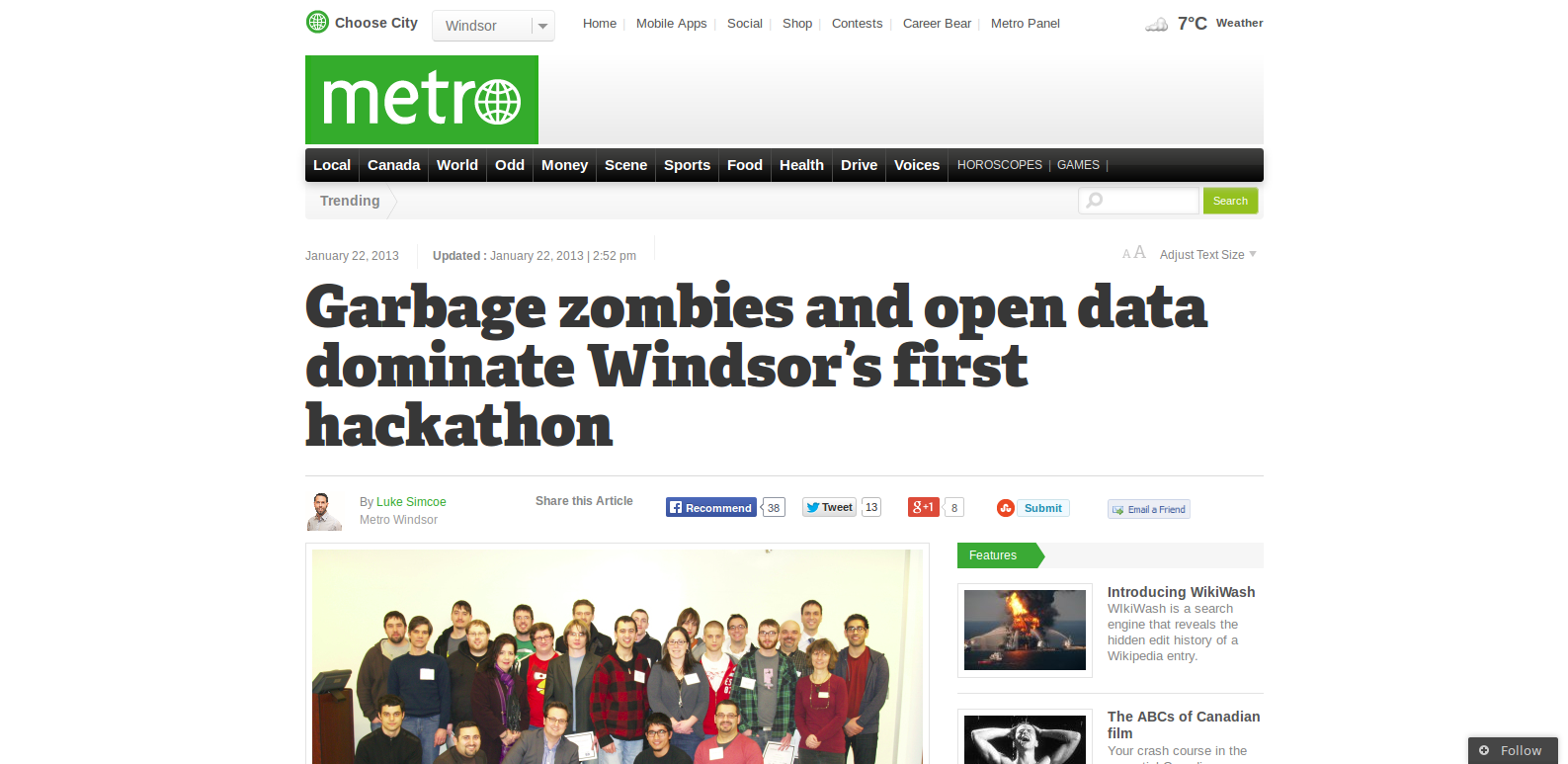
The first hackathon was called HackWE - and it lasted a weekend, was hosted at the University of Windsor and was based on the City of Windsor’s Open Data Catalogue.

HackWE 2.0 was a 24-hour hackathon based on residential energy data collected by Smart Meters and was part of a larger Ontario Apps for Energy Challenge.

And the third HackWE 3.0 - which happened just this past October - had events stretched over a week and based on open scientific data in celebration of Science and Technology week.

We’ve hosted our own independent hackathons as well. Last year Hackforge held a two week Summer Games event for people who wanted to try their hand at video game design. Everyone who completed a game won a trophy. My own video game won the prize for being the Most endearing.
But in general, our members are more engaged in the regular activities of Hackforge.

They include our bi-weekly Tech Talks that our members give to each other and the wider public, on such topics as Amazon Web Services, slide rules, writing Interactive fiction with JavaScript, and using technology in BioArt.
We have monthly Maptime events in the space. Maptime is an open learning environment for all levels related to digital map making but there is a definite an emphasis on support for the beginner.

This photo is from our first Windsor Maptime event which was dedicated to OpenStreetMap. There are Maptime chapters all around the world, and the next Maptime Toronto meeting is December 11th, if you are curious and if you near or in the GTA.

The Hackforge Software Guild meets weekly to work on personal projects as well as practicing pair programming on coding challenges called katas. For example, one of the first kata challenges was to write a program that would correctly write out the lyrics of 99 bottles of beer on the wall and one of more recent is how to code bowling scores.

We also have an Open Data Interest group and we are going to launch our own Open Data portal for Windsor’s non-profit community in 2015. We’re able to do this because this year we have received Trillium funding to hire a part-time coordinator and to small pay stipends to people to help with this work.

Our first dataset is likely going to be a community asset map that was compiled by the Ford City Renewal group. Ford City is one of several neighbourhoods in Windsor in which more than 30% of the population is have income levels that at poverty level. Average incomes of those from the the City of Windsor as a whole isn’t actually that much less than average for all of Canada - its just that we’re just the most economically polarized urban area in the country. That’s one of the reasons why, in January Hackforge is going to be working with Ford City Renewal to host a build your computer event for young people in the neighborhood.
As well, our 3 year Trillium grant also funds another part-time coordinator who matches individuals seeking technology experience with non-profits such as the Windsor Homeless Coalition who need technology work and support.

Hackforge has also collaborated with the Windsor Public Library to put on co-hosted events such as the Robot Sumo contest.

And we’ve worked with the City of Windsor to produce persistence of vision bicycle wheels for the their WAVES light and sound art festival. I know it’s difficult to see but in the photo on the screen is a bicycle wheel with a narrow set of lights that are strapped to three spokes on the wheel. When the wheel spins, the lights animate and give the impression that there’s an image in the wheel - it only works with the human eye - because of our persistence of vision - and it’s something that really come across in a photo very well.
[here's a video!]

Also, the City of Windsor commissioned us to build a Librarybox for their event which I thought was really cool!

And like most other Hackerspaces, we have 3D printers. We have robotic kits. We have soldering irons, and we have lots and lots of spare electronic and computer parts. But unlike most other hackerspaces who charge their members $30 to $50 a month to join and make use their space, our hackerspace is currently free to members who pay for their membership with volunteer work.
This brings us to today in the last days of 2014.

2014 is also the year that Aaron came back to us from California. He’s now my fellow board member at Hackforge. And, incidentally, so is Art Rhyno, who - if you don’t know - is a fellow librarian from the University of Windsor.

I was asked by Scholars Portal if I could share some of my experiences with Hackforge in light of today’s theme of building community. And that is what my talk will be about today: how to use a hackerspace to build community. And I will do so by expanding on five themes.
But as you know know - we are only 2 years old, and so - this talk is really about just the beginning steps we’ve been taking and those steps that we are still trying to take. We admittedly have a long way to go.
Helping out with Hackforge has been a very rich and rewarding experience and I’ve learned much from it. And it’s also been hard work and sometimes it has been very time consuming.
All those decisions we made as we started our hackerspace were the first ones we’ve ever had to make for our new organization. This process was exhilarating but it also was occasionally exhausting. Which brings us to our first theme:

Institutions reduce the choices available to their members
The reason why starting up an organization is so exhausting can be found in Ronald Coase’s work. Coase is famous for introducing the concept of transaction costs to explain the nature and limits of firms and that earned him the Nobel Prize in Economics in 1991. Now I haven’t read his Nobel prize winning work, myself. I was first introduced to Coase when I read a book last year called The org: the underlying logic of the office by Ray Fisman and Tim Sullivan.
I also read Coase being referenced in a blog post by media critic Clay Shirky that was about about the differences between new media and old media. It’s Shirky’s words on the screen right now:

Further on in his post Shirky explains what he means by this through an example of what happens at a daily newspaper:
When you are starting a new organization or any new venture, really, every small decision can sometime seem to bog you down. There is navel-gazing and random walks.
We got bogged down at the beginning of Hackforge. We actually received the keys to the space in the Windsor Public Library in October of 2012. Why the delay? We had decided that we would launch the opening of our space with a homemade keypass locking system for the doors because we thought it wouldn’t take much time at all.
And if we were considering how long it would take one talented person to build such a system by themselves, then maybe we would been right. But instead, we were very wrong. And looking back at it, now it seems obvious why this was the case:
We had a set of people who have never worked together before, who don’t necessarily even speak the same programming languages, working without an authority structure, in a scarcely born organization with no promise that we will succeed or survive, nor sure promise of reward.
Now it’s very important for me say that this so I'm absolutely clear - I am not complaining about our volunteers!!!

Hackforge would not have succeeded if it weren’t for those very first volunteers who made Hackforge happen in those early days when we were starting with nothing.
And the same holds to this day. When we say that Hackforge is made of volunteers, what we are really saying is that Hackforge = volunteers.

Our volunteers are especially remarkable because -- like all volunteers - they give up their own time that’s left over after their pre-existing commitments to work, school, family and friends. In volunteer work, every interaction is a gift. But, that being said, not every promise in a volunteer organization is one that is fulfilled. Sometimes you learn the hard way that first thing on Tuesday means 3pm.
But the delay wasn’t just from the building of the system. Once it was built, we then we had to make sure that the keypass system was okay with the library and that it was okay with the fire marshall. And we had to figure out how who was going to make the key cards, how they were going to be distributed and how we would use to decide who would get a keycard to the space and who would not. Ultimately, it took us 8 months to figure this all of this out.
I wanted to explicitly mention this observation because I’ve noticed that within our own institution of libraries that sometimes when a new group or committee is started up, there is the occasional individual who interprets the slow goings and long initial discussions of the first meetings as, at best, extreme inefficiency, and at worst, a sign of imminent failure.
When in fact, we should recognize that slow starts are normal.

Culture is to a organization as community is to a city
New organizations and new ventures happen slowly and furthermore, they should happen slowly because each decision made is one that further that defines the “how” of “what an organization is”. Are we, as an organization, formal or informal? Who takes the minutes at meetings? Do we need to give a notice of motion? Do we do our own books or do we hire an accountant? Do we provide food at our events? Do we sell swag or do we give it away? How should we fundraise? How do we deal with bad actors? Every decision further defines the work that we do.

It’s very important to take the time to take these steps slowly in order to make sure that the way you do things match up with the why you do things. As I think we can appreciate in libraryland, once institutions reduce choices of their members it is very difficult - although not impossible to open them up again for rethinking and refactoring.
One of reasons why Hackforge has been very successful in its brief existence - is that it was formed with clearly articulated reasons and clear guiding principles that continue to help us shape the form of our work. And I know this, because the vision of what Hackforge should be was told to be me when I was invited to serve of the board when Hackforge began and, I can attest to the fact, that it is the same the as the one we have now.

Now, there are many different types of hacker and makerspaces: some are dedicated to artists, others to entrepreneurs, while others are dedicated to the hobbyist. Hackforge - in less than 140 characters has been described as this: Hackforge supports capacity building in the community and supporting a culture of mentorship and inclusivity.
More specifically, we exist to help with youth retention in Windsor. We aim to be a place where individuals who work or want to work in technology can find support from each other.
I know it might sound strange to you that we believe that our local IT industry needs support, especially when we read about the excesses of Silicon Valley on a regular basis.
But in Windsor, there are not many options for those with a technology background to find work and so, despite of the impression we give to those pursuing a career in STEM, tech jobs in Windsor can be poorly paid and the working conditions can be very problematic.

Many of the provisions in the labour law - the ones that entitle employees to set working hours, to breaks between and within shifts, to overtime and even time to eat - have exemptions for those who work in IT. I’ve been told that the only way to get a raise while working in IT in this town is to find a better paying job.
The IT industry sometimes treats people as if they were machines themselves.
Hackforge was built as a response to this environment. It was build in hopes that it could help grow something better. At Hackforge we know our strength does not come from the machines that we have in our space, but our amazing members and the time and work that they give to others.
I mean, we love 3D printers because they are a honeypot that brings curious folks into our space, but the secret is we are not really about 3D printers.

And yet if you look at all of what our media coverage we receive, you would think we’re just another makerspace that loves 3D printers and robots.
This is why it is SO important to be visible with your values, which is our second theme.

Show your work
One of the challenges that we have at Hackforge is that we don’t have very many women in our ranks. Women make up half of our board of directors but our larger membership is not representative of the Windsor community and it’s likely not representative in the other aspects of identity, for that matter, either.

We know that if we wanted to change this situation, it would require sustained work on our part. And so when we had our official launch of Hackforge last year, we, as part of the event, hosted a Women in Technology Panel that featured four women who work in IT, including the very successful Girl Develop IT from Detroit, all of whom both shared their experiences and offer strategies to make the field of technology a more inclusive environment and better place for everyone.
In the audience for that panel discussion was a representative of WEST. WEST is a local non-profit group who works and stands for Women’s Enterprise Skills Training. Starting next year, with the support of another Ontario Trillium grant, Hackforge and WEST are going to be launching a project that will offer free computer skills training workshops for women as well as trying to create a community of support, and continue to advocate for women in the IT field.

So I can’t stress this enough. You have to do your work in public if you want your future collaborators to find you.
I have also another Women in Technology story to start our third theme.
So remember I told you about unconferences? Well, the Hackforge members who run the Software Guild do something similar. Sometimes instead of coding, the folks do something like this. They write down all thing the things they want to talk about, vote for the topics and then talk the most voted topics within strict time limits. But they don’t call it an unconference:

They call it LEAN COFFEE.
I love it. It’s so adorable.
Anyway, at one of these Lean Coffee sessions, our staff coordinator suggested the topic Women in Technology. And the response she received was this: We know there’s a problem because Hackforge doesn’t have enough women. But we are not sure how to fix this.
To me, I found this statement very encouraging.
Its sad, but in these these times, when people can admit that there’s a problem without any deflection or allocation of blame is actually very refreshing.
I mean, within librarianship - we have some organizations who consistently organize speaking events made up of mostly men. Whenever I raise this matter I usually told that if the speaking topic is not about gender, then it’s not about gender. In other words, they tell me that there is no problem.
But sometimes there is a problem.

Look at this photo: from this you would never guess that it was taken in a city that is over 80% African American. This photo from the first meeting of Maptime Detroit that I attended last month. One of the first things that was said during the evening’s introduction was a simple statement by the organizer. “I want to acknowledge who isn’t this in room” And what followed was a plan to hold the next Maptime meetings, not in the mid-town Tech Incubator, but within the various neighbourhoods in the city and alongside partner organizations already working with Detroiters where they live.
So before we can be more inclusive, we need to recognize when we are not.

We can start by acknowledging who isn’t in the room. It isn’t hard to do.
Quinn Norton wrote a lovely essay about this called Count. Speaking of counting, we are now at theme four.

A mailing list is not a community
What you might find surprising is that - for Hackforge being a gathering of people who generally love love love the Internet, is that we really don’t even have a strong online space for folks to hang out in, with the exception of our IRC channel. We used to have forum software, but is was so overwhelmed with spam on a daily basis it was almost immediately rendered unusable.
Also, Hackforge doesn’t even have a listserv mailing list.
And I would go as far to say that one of the reasons why Hackforge has been as successful as we have been is in part, because that we *don’t* have a mailing list.
There’s a website that’s called Running a Hackerspace that is a collection of animated gifs that metaphorically capture the essence of Running a hackerspace. I think it’s particularly telling that there are many recurrent topics that arise this Tumblr: like the complaints that folks don’t clean up after themselves.

(And this is when I confess that when I drop by Hackforge, I am also sometimes made sad).

But the most prevalent theme in the blog is mailing list rage.
You would think this would have been a solved problem by now: how do you support project work that is done asynchronously and dispersed over geography. Many open source communities are finding that the traditional tools of mailing lists, forum software, and IRC channels are not doing enough in helping their communities do good work together. More often than not, these technologies seem to be better than boosting the noise rather than the signal.

Distributed companies like Wordpress are moving from IRC to software platforms such as Slack. As I’ve mentioned before, I’m involved with a largely self-organized group called Maptime and we also make use of Slack, which is essentially user friendly IRC, chat, and messaging along with images, file sharing, archiving and social media capture.
At Hackforge, we’ve recently decided to use the Jira issue tracker to manage the hacking work that we need to do in the space and we will be switching to Nation Builder software to manage our members and member communications. When activists, non-profits, and political parties are using software like Nation Builder to manage the contact info, the interests, and the fundraising of tens of thousands of people, it makes me wonder when libraries are going to start using similar software to manage the relationships it has with its community.
And at a time when my neighbours who rent the skating rink for collective use, use volunteer management software to figure out who’s turn it is to bring the hot chocolate, I would like to suggest that libraries perhaps could start using similar software to - at least - manage our internal work and communications as well. Good tools make great communication possible within organizations and our communities. They are are worth the investment.

Invest in but do not outsource community management
Before I end my presentation with this last theme, I do want to offer a caveat to everything I’ve said. If you asked all of the people who have been involved in Hackforge - those who have come by our events, spent time in the space, or even volunteered some mentoring at an event - if you asked them if they felt they were part of a community, I think most people asked would probably say, no. I think we have a wonderful group of people who have contributed to Hackforge and I think we have a group of people who have even found friends at Hackforge, but I think we still can’t call the whole of what we do "a community" - at least not yet.
Hackforge is approaching its 2nd birthday and this talk has been a wonderful excuse to reflect on what we do well and what we still need to work on.
What works for us are regular events, contests and Hackathons. We are well aware of the limitations of hackathons and how they produce imperfect work but, for us, it seems to be that that pre-defined limits and deadlines produce more work and generate more interest and excitement than unstructured free time seems to.
Unlike many hackerspaces, we don’t tend to have many group projects. The door project - as you have learned - was one of few group projects, and that one took longer than expected. In our early months, we also had a LED sign project that was never completed and actually resulted in some people leaving Hackforge in frustration.

We are a volunteer organization and as such, by the process of evolution, we are a place for the patient and the forgiving. Sometimes we have gotten our first impressions wrong.
One of the largest challenges I think we have as an organization is to be more accessible to beginners. In fact, that the feedback that we’ve been getting.
Aaron recently had a tech talk about tech talks and the message he received was that Hackforge should provide more sessions for beginners. And this is a particular challenge that we haven’t really addressed yet. We’re luckily that Hackforge has people who are both generous with their time and not afraid of public speaking and give tech talks. But many of our speakers don’t preface their talks with an introduction that a newbie could understand. They are so excited to have fellow experts in the crowd and they jump right into the code or electrical specs or what have you.
Likewise, it’s amazing and wonderful that we have regular supportive events like our member’s coding katas in which those who work with software can practice and share their coding practice with others. But at the moment, we don’t really have anything for those who want to learn how to code. And you might not be shocked to hear this, but Hackforge’s machines like our 3D printers - lack even the most basic documentation on how to use the machines.
Without expanding the work of communicating, documenting, explaining, and teaching, Hackforge won’t be able to attract new members.
Hackforge started as a top down organization. Our job as board has been to the build the systems that will allow more of the day to day work of the Hackforge to move from the board to our community and program managers. We were able to hire our managers in the middle of this year and already, they have made wonderful contributions to Hackforge. Our next challenge will be how to move more of the operational work of the managers to the members themselves.
In other words, the challenge for Hackforge is to ensure that the work that needs to be done - all of that communicating, documenting, explaining, teaching - needs to be embraced by all of its members as a community of practice. And through this practice, it’s hoped we can build a community.
So, those are my five themes for building community with a hackerspace:

Institutions reduce the choices available to their members (so choose carefully)
Show your work (so future collaborators can find you).
Acknowledge who isn’t in the room (Count is only the start).
A mailing list is not a community (Invest in tools that do better).
Invest but do not outsource community management.
The work of figuring how to get a bunch of people to come together and face a shared challenge isn’t just the way the build a community. This is also how political movements begin. It’s also how a game begins. I would like to thanks to Scholars Portal for giving me the opportunity to begin Scholars Portal Day with you all.


You can’t tell how many apples are in a seed.
In May of 2010, I, Art Rhyno, Nicole Noel and late and sorely missed Jean Foster hosted an unconference at the central branch of the Windsor Public Library.
Unconferences are seemingly no longer in vogue, so just in case you don’t know, an unconference is a conference where the topics of discussion are determined by those in the room who gather and disperse in conversation as their interests dictate.
The unconference was called WEChangeCamp and it was one several ChangeCamp unconferences that occurred across the country at that time.
At this particular unconference, 40 people from the community came together to answer this question: “How can we re-imagine Windsor-Essex as a stronger and more vibrant community?”
And on that day the topic of a Windsor Hackerspace was suggested by a young man who I later learned was working on his doctorate in electrical engineering. What I remember of that conversation four years ago was Aaron explaining the problem at hand: he and his friends needed regular infusions of money to rent a place to build a hackerspace so they needed a group of people who would pay monthly membership fees. But they couldn’t get paying members until they could attract them with a space.
Shortly thereafter, Aaron - like so many other young people in Windsor- left the city for work elsewhere. It’s a bit of an epidemic here. We have the second highest unemployment rate in Canada and it’s been said that youth unemployment rate in Windsor is at a staggering 20%.
In Aaron’s case, he moved to Palo Alto, California to do robotics work in an automotive R&D lab.
In the meantime back in Windsor, in May 2012, I helped host code4lib North at the University of Windsor. We had the pleasure to host librarians from many OCUL libraries over those two days as well as staff from the Windsor Public Library. Also in the audience was Doug Sartori. Doug had helped in the development of the WPL’s CanGuru mobile library application. He came to code4lib north because he was was curious about the first generation Raspberry pi that John Fink of McMaster had brought with him. You have to remember that in 2012 that the Raspberry Pi - the $40 computer card - was still never very new in the world.
A year later, in May 2013, Windsor got its first Hackerspace when Hackforge was officially opened. The Windsor Public Library graciously lent Hackforge the empty space in the front of their Central Branch that was previously a Woodcarver’s Museum.
When Hackforge launches, Doug Sartori is president and I’m on the board of directors.
In our 20 months of our existence, I’m proud to say that Hackforge has accomplished quite a lot for itself and for our community.
We’ve co-hosted three hackathons along with the local technology accelerator WETech Alliance.
The first hackathon was called HackWE - and it lasted a weekend, was hosted at the University of Windsor and was based on the City of Windsor’s Open Data Catalogue.
HackWE 2.0 was a 24-hour hackathon based on residential energy data collected by Smart Meters and was part of a larger Ontario Apps for Energy Challenge.
And the third HackWE 3.0 - which happened just this past October - had events stretched over a week and based on open scientific data in celebration of Science and Technology week.
We’ve hosted our own independent hackathons as well. Last year Hackforge held a two week Summer Games event for people who wanted to try their hand at video game design. Everyone who completed a game won a trophy. My own video game won the prize for being the Most endearing.
But in general, our members are more engaged in the regular activities of Hackforge.
They include our bi-weekly Tech Talks that our members give to each other and the wider public, on such topics as Amazon Web Services, slide rules, writing Interactive fiction with JavaScript, and using technology in BioArt.
We have monthly Maptime events in the space. Maptime is an open learning environment for all levels related to digital map making but there is a definite an emphasis on support for the beginner.
This photo is from our first Windsor Maptime event which was dedicated to OpenStreetMap. There are Maptime chapters all around the world, and the next Maptime Toronto meeting is December 11th, if you are curious and if you near or in the GTA.
The Hackforge Software Guild meets weekly to work on personal projects as well as practicing pair programming on coding challenges called katas. For example, one of the first kata challenges was to write a program that would correctly write out the lyrics of 99 bottles of beer on the wall and one of more recent is how to code bowling scores.
We also have an Open Data Interest group and we are going to launch our own Open Data portal for Windsor’s non-profit community in 2015. We’re able to do this because this year we have received Trillium funding to hire a part-time coordinator and to small pay stipends to people to help with this work.
Our first dataset is likely going to be a community asset map that was compiled by the Ford City Renewal group. Ford City is one of several neighbourhoods in Windsor in which more than 30% of the population is have income levels that at poverty level. Average incomes of those from the the City of Windsor as a whole isn’t actually that much less than average for all of Canada - its just that we’re just the most economically polarized urban area in the country. That’s one of the reasons why, in January Hackforge is going to be working with Ford City Renewal to host a build your computer event for young people in the neighborhood.
As well, our 3 year Trillium grant also funds another part-time coordinator who matches individuals seeking technology experience with non-profits such as the Windsor Homeless Coalition who need technology work and support.
Hackforge has also collaborated with the Windsor Public Library to put on co-hosted events such as the Robot Sumo contest.
And we’ve worked with the City of Windsor to produce persistence of vision bicycle wheels for the their WAVES light and sound art festival. I know it’s difficult to see but in the photo on the screen is a bicycle wheel with a narrow set of lights that are strapped to three spokes on the wheel. When the wheel spins, the lights animate and give the impression that there’s an image in the wheel - it only works with the human eye - because of our persistence of vision - and it’s something that really come across in a photo very well.
[here's a video!]
Also, the City of Windsor commissioned us to build a Librarybox for their event which I thought was really cool!
And like most other Hackerspaces, we have 3D printers. We have robotic kits. We have soldering irons, and we have lots and lots of spare electronic and computer parts. But unlike most other hackerspaces who charge their members $30 to $50 a month to join and make use their space, our hackerspace is currently free to members who pay for their membership with volunteer work.
This brings us to today in the last days of 2014.
2014 is also the year that Aaron came back to us from California. He’s now my fellow board member at Hackforge. And, incidentally, so is Art Rhyno, who - if you don’t know - is a fellow librarian from the University of Windsor.
I was asked by Scholars Portal if I could share some of my experiences with Hackforge in light of today’s theme of building community. And that is what my talk will be about today: how to use a hackerspace to build community. And I will do so by expanding on five themes.
But as you know know - we are only 2 years old, and so - this talk is really about just the beginning steps we’ve been taking and those steps that we are still trying to take. We admittedly have a long way to go.
Helping out with Hackforge has been a very rich and rewarding experience and I’ve learned much from it. And it’s also been hard work and sometimes it has been very time consuming.
All those decisions we made as we started our hackerspace were the first ones we’ve ever had to make for our new organization. This process was exhilarating but it also was occasionally exhausting. Which brings us to our first theme:
Institutions reduce the choices available to their members
The reason why starting up an organization is so exhausting can be found in Ronald Coase’s work. Coase is famous for introducing the concept of transaction costs to explain the nature and limits of firms and that earned him the Nobel Prize in Economics in 1991. Now I haven’t read his Nobel prize winning work, myself. I was first introduced to Coase when I read a book last year called The org: the underlying logic of the office by Ray Fisman and Tim Sullivan.
I also read Coase being referenced in a blog post by media critic Clay Shirky that was about about the differences between new media and old media. It’s Shirky’s words on the screen right now:
These frozen choices are what gives institutions their vitality — they are in fact what make them institutions. Freed of the twin dangers of navel-gazing and random walks, an institution can concentrate its efforts on some persistent, medium-sized, and tractable problem, working at a scale and longevity unavailable to its individual participants.
Further on in his post Shirky explains what he means by this through an example of what happens at a daily newspaper:
The editors meet every afternoon to discuss the front page. They have to decide whether to put the Mayor’s gaffe there or in Metro, whether to run the picture of the accused murderer or the kids running in the fountain, whether to put the Biker Grandma story above or below the fold. Here are some choices they don’t have to make at that meeting: Whether to have headlines. Whether to be a tabloid or a broadsheet. Whether to replace the entire front page with a single ad. Whether to drop the whole news-coverage thing and start selling ice cream. Every such meeting, in other words, involves a thousand choices, but not a billion, because most of the big choices have already been made.
When you are starting a new organization or any new venture, really, every small decision can sometime seem to bog you down. There is navel-gazing and random walks.
We got bogged down at the beginning of Hackforge. We actually received the keys to the space in the Windsor Public Library in October of 2012. Why the delay? We had decided that we would launch the opening of our space with a homemade keypass locking system for the doors because we thought it wouldn’t take much time at all.
And if we were considering how long it would take one talented person to build such a system by themselves, then maybe we would been right. But instead, we were very wrong. And looking back at it, now it seems obvious why this was the case:
We had a set of people who have never worked together before, who don’t necessarily even speak the same programming languages, working without an authority structure, in a scarcely born organization with no promise that we will succeed or survive, nor sure promise of reward.
Now it’s very important for me say that this so I'm absolutely clear - I am not complaining about our volunteers!!!
Hackforge would not have succeeded if it weren’t for those very first volunteers who made Hackforge happen in those early days when we were starting with nothing.
And the same holds to this day. When we say that Hackforge is made of volunteers, what we are really saying is that Hackforge = volunteers.
Our volunteers are especially remarkable because -- like all volunteers - they give up their own time that’s left over after their pre-existing commitments to work, school, family and friends. In volunteer work, every interaction is a gift. But, that being said, not every promise in a volunteer organization is one that is fulfilled. Sometimes you learn the hard way that first thing on Tuesday means 3pm.
But the delay wasn’t just from the building of the system. Once it was built, we then we had to make sure that the keypass system was okay with the library and that it was okay with the fire marshall. And we had to figure out how who was going to make the key cards, how they were going to be distributed and how we would use to decide who would get a keycard to the space and who would not. Ultimately, it took us 8 months to figure this all of this out.
I wanted to explicitly mention this observation because I’ve noticed that within our own institution of libraries that sometimes when a new group or committee is started up, there is the occasional individual who interprets the slow goings and long initial discussions of the first meetings as, at best, extreme inefficiency, and at worst, a sign of imminent failure.
When in fact, we should recognize that slow starts are normal.
Culture is to a organization as community is to a city
New organizations and new ventures happen slowly and furthermore, they should happen slowly because each decision made is one that further that defines the “how” of “what an organization is”. Are we, as an organization, formal or informal? Who takes the minutes at meetings? Do we need to give a notice of motion? Do we do our own books or do we hire an accountant? Do we provide food at our events? Do we sell swag or do we give it away? How should we fundraise? How do we deal with bad actors? Every decision further defines the work that we do.
It’s very important to take the time to take these steps slowly in order to make sure that the way you do things match up with the why you do things. As I think we can appreciate in libraryland, once institutions reduce choices of their members it is very difficult - although not impossible to open them up again for rethinking and refactoring.
One of reasons why Hackforge has been very successful in its brief existence - is that it was formed with clearly articulated reasons and clear guiding principles that continue to help us shape the form of our work. And I know this, because the vision of what Hackforge should be was told to be me when I was invited to serve of the board when Hackforge began and, I can attest to the fact, that it is the same the as the one we have now.
Now, there are many different types of hacker and makerspaces: some are dedicated to artists, others to entrepreneurs, while others are dedicated to the hobbyist. Hackforge - in less than 140 characters has been described as this: Hackforge supports capacity building in the community and supporting a culture of mentorship and inclusivity.
More specifically, we exist to help with youth retention in Windsor. We aim to be a place where individuals who work or want to work in technology can find support from each other.
I know it might sound strange to you that we believe that our local IT industry needs support, especially when we read about the excesses of Silicon Valley on a regular basis.
But in Windsor, there are not many options for those with a technology background to find work and so, despite of the impression we give to those pursuing a career in STEM, tech jobs in Windsor can be poorly paid and the working conditions can be very problematic.
Many of the provisions in the labour law - the ones that entitle employees to set working hours, to breaks between and within shifts, to overtime and even time to eat - have exemptions for those who work in IT. I’ve been told that the only way to get a raise while working in IT in this town is to find a better paying job.
The IT industry sometimes treats people as if they were machines themselves.
Hackforge was built as a response to this environment. It was build in hopes that it could help grow something better. At Hackforge we know our strength does not come from the machines that we have in our space, but our amazing members and the time and work that they give to others.
I mean, we love 3D printers because they are a honeypot that brings curious folks into our space, but the secret is we are not really about 3D printers.
And yet if you look at all of what our media coverage we receive, you would think we’re just another makerspace that loves 3D printers and robots.
This is why it is SO important to be visible with your values, which is our second theme.
Show your work
One of the challenges that we have at Hackforge is that we don’t have very many women in our ranks. Women make up half of our board of directors but our larger membership is not representative of the Windsor community and it’s likely not representative in the other aspects of identity, for that matter, either.
We know that if we wanted to change this situation, it would require sustained work on our part. And so when we had our official launch of Hackforge last year, we, as part of the event, hosted a Women in Technology Panel that featured four women who work in IT, including the very successful Girl Develop IT from Detroit, all of whom both shared their experiences and offer strategies to make the field of technology a more inclusive environment and better place for everyone.
In the audience for that panel discussion was a representative of WEST. WEST is a local non-profit group who works and stands for Women’s Enterprise Skills Training. Starting next year, with the support of another Ontario Trillium grant, Hackforge and WEST are going to be launching a project that will offer free computer skills training workshops for women as well as trying to create a community of support, and continue to advocate for women in the IT field.
So I can’t stress this enough. You have to do your work in public if you want your future collaborators to find you.
I have also another Women in Technology story to start our third theme.
So remember I told you about unconferences? Well, the Hackforge members who run the Software Guild do something similar. Sometimes instead of coding, the folks do something like this. They write down all thing the things they want to talk about, vote for the topics and then talk the most voted topics within strict time limits. But they don’t call it an unconference:
They call it LEAN COFFEE.
I love it. It’s so adorable.
Anyway, at one of these Lean Coffee sessions, our staff coordinator suggested the topic Women in Technology. And the response she received was this: We know there’s a problem because Hackforge doesn’t have enough women. But we are not sure how to fix this.
To me, I found this statement very encouraging.
Its sad, but in these these times, when people can admit that there’s a problem without any deflection or allocation of blame is actually very refreshing.
I mean, within librarianship - we have some organizations who consistently organize speaking events made up of mostly men. Whenever I raise this matter I usually told that if the speaking topic is not about gender, then it’s not about gender. In other words, they tell me that there is no problem.
But sometimes there is a problem.
Look at this photo: from this you would never guess that it was taken in a city that is over 80% African American. This photo from the first meeting of Maptime Detroit that I attended last month. One of the first things that was said during the evening’s introduction was a simple statement by the organizer. “I want to acknowledge who isn’t this in room” And what followed was a plan to hold the next Maptime meetings, not in the mid-town Tech Incubator, but within the various neighbourhoods in the city and alongside partner organizations already working with Detroiters where they live.
So before we can be more inclusive, we need to recognize when we are not.
We can start by acknowledging who isn’t in the room. It isn’t hard to do.
Quinn Norton wrote a lovely essay about this called Count. Speaking of counting, we are now at theme four.
A mailing list is not a community
What you might find surprising is that - for Hackforge being a gathering of people who generally love love love the Internet, is that we really don’t even have a strong online space for folks to hang out in, with the exception of our IRC channel. We used to have forum software, but is was so overwhelmed with spam on a daily basis it was almost immediately rendered unusable.
Also, Hackforge doesn’t even have a listserv mailing list.
And I would go as far to say that one of the reasons why Hackforge has been as successful as we have been is in part, because that we *don’t* have a mailing list.
There’s a website that’s called Running a Hackerspace that is a collection of animated gifs that metaphorically capture the essence of Running a hackerspace. I think it’s particularly telling that there are many recurrent topics that arise this Tumblr: like the complaints that folks don’t clean up after themselves.
(And this is when I confess that when I drop by Hackforge, I am also sometimes made sad).
But the most prevalent theme in the blog is mailing list rage.
You would think this would have been a solved problem by now: how do you support project work that is done asynchronously and dispersed over geography. Many open source communities are finding that the traditional tools of mailing lists, forum software, and IRC channels are not doing enough in helping their communities do good work together. More often than not, these technologies seem to be better than boosting the noise rather than the signal.
Distributed companies like Wordpress are moving from IRC to software platforms such as Slack. As I’ve mentioned before, I’m involved with a largely self-organized group called Maptime and we also make use of Slack, which is essentially user friendly IRC, chat, and messaging along with images, file sharing, archiving and social media capture.
At Hackforge, we’ve recently decided to use the Jira issue tracker to manage the hacking work that we need to do in the space and we will be switching to Nation Builder software to manage our members and member communications. When activists, non-profits, and political parties are using software like Nation Builder to manage the contact info, the interests, and the fundraising of tens of thousands of people, it makes me wonder when libraries are going to start using similar software to manage the relationships it has with its community.
And at a time when my neighbours who rent the skating rink for collective use, use volunteer management software to figure out who’s turn it is to bring the hot chocolate, I would like to suggest that libraries perhaps could start using similar software to - at least - manage our internal work and communications as well. Good tools make great communication possible within organizations and our communities. They are are worth the investment.
Invest in but do not outsource community management
Before I end my presentation with this last theme, I do want to offer a caveat to everything I’ve said. If you asked all of the people who have been involved in Hackforge - those who have come by our events, spent time in the space, or even volunteered some mentoring at an event - if you asked them if they felt they were part of a community, I think most people asked would probably say, no. I think we have a wonderful group of people who have contributed to Hackforge and I think we have a group of people who have even found friends at Hackforge, but I think we still can’t call the whole of what we do "a community" - at least not yet.
Hackforge is approaching its 2nd birthday and this talk has been a wonderful excuse to reflect on what we do well and what we still need to work on.
What works for us are regular events, contests and Hackathons. We are well aware of the limitations of hackathons and how they produce imperfect work but, for us, it seems to be that that pre-defined limits and deadlines produce more work and generate more interest and excitement than unstructured free time seems to.
Unlike many hackerspaces, we don’t tend to have many group projects. The door project - as you have learned - was one of few group projects, and that one took longer than expected. In our early months, we also had a LED sign project that was never completed and actually resulted in some people leaving Hackforge in frustration.
We are a volunteer organization and as such, by the process of evolution, we are a place for the patient and the forgiving. Sometimes we have gotten our first impressions wrong.
One of the largest challenges I think we have as an organization is to be more accessible to beginners. In fact, that the feedback that we’ve been getting.
Aaron recently had a tech talk about tech talks and the message he received was that Hackforge should provide more sessions for beginners. And this is a particular challenge that we haven’t really addressed yet. We’re luckily that Hackforge has people who are both generous with their time and not afraid of public speaking and give tech talks. But many of our speakers don’t preface their talks with an introduction that a newbie could understand. They are so excited to have fellow experts in the crowd and they jump right into the code or electrical specs or what have you.
Likewise, it’s amazing and wonderful that we have regular supportive events like our member’s coding katas in which those who work with software can practice and share their coding practice with others. But at the moment, we don’t really have anything for those who want to learn how to code. And you might not be shocked to hear this, but Hackforge’s machines like our 3D printers - lack even the most basic documentation on how to use the machines.
Without expanding the work of communicating, documenting, explaining, and teaching, Hackforge won’t be able to attract new members.
Hackforge started as a top down organization. Our job as board has been to the build the systems that will allow more of the day to day work of the Hackforge to move from the board to our community and program managers. We were able to hire our managers in the middle of this year and already, they have made wonderful contributions to Hackforge. Our next challenge will be how to move more of the operational work of the managers to the members themselves.
In other words, the challenge for Hackforge is to ensure that the work that needs to be done - all of that communicating, documenting, explaining, teaching - needs to be embraced by all of its members as a community of practice. And through this practice, it’s hoped we can build a community.
So, those are my five themes for building community with a hackerspace:
Institutions reduce the choices available to their members (so choose carefully)
Show your work (so future collaborators can find you).
Acknowledge who isn’t in the room (Count is only the start).
A mailing list is not a community (Invest in tools that do better).
Invest but do not outsource community management.
The work of figuring how to get a bunch of people to come together and face a shared challenge isn’t just the way the build a community. This is also how political movements begin. It’s also how a game begins. I would like to thanks to Scholars Portal for giving me the opportunity to begin Scholars Portal Day with you all.
Subscribe to:
Posts (Atom)