Showing posts with label games. Show all posts
Showing posts with label games. Show all posts
Monday, May 02, 2016
The City As Classroom vs. The City As Advertising Platform
Normally I post my talks here but last night I struggled so much with Blogger that I decided to post today's presentation The City As Classroom vs. The City As Advertising Platform that I gave at York University Libraries on Medium instead.


Friday, March 25, 2016
Knight News Challenge: Library Starter Deck: a 21st-century game engine and design studio for libraries
Last week, Ken Eklund and myself submitted our proposal for the 2016 Knight News Challenge which asks, How might libraries serve 21st century information needs?
Our answer is this: The Library Starter Deck: a 21st-century game engine and design studio for libraries. We also have shared a brief on some of the inspirations behind our proposal (pdf).
Two years ago I reviewed the 680+ applications to the 2014 Knight News Challenge for Libraries entries and shared some of my favourites. It was, and it is still a very useful exercise because there are not many opportunities to read grant applications (if you are not the one handing out the grant) and this particular set offer applications from both professionals and those from the public.
You can also review the entries as an act of finding signals of the future, as the IFTF might put it. That's what I've chosen to do for this year's review. What this means is that I've chosen not to highlight here what I think are the best or most deserving to win applications (that's up to these good people) but instead, I made note of the applications that, for lack of a better word, surprised me:
- Digital Book Intellectual Property Rights that Make Sense for the 21st Century: By partnering with libraries, we are creating a collection of high-quality ebooks with the IP rights needed for a global digital world.
- Finding Hidden Histories in African American (Digital) Archives: Pairing artists, writers, and students with African American archives to inspire new works and find materials that may be shared online.
- Rap Research Lab: Mining the Archive: Using the Hip-hop Word Count database to re-contextualize the library collection for Hip Hop relevance.
- KCResearch: Educate, Inform, Engage: KCPL will curate a reference-based, online portal bringing all points of view, comparative info and studies to important community issues.
- Future-Proofing Civic Data: We'll explore ways libraries can support preservation & long-term access to Open Civic Data from community portals like OpenDataPhilly.
- Building DALE – the Data Analyzation Library Explorer: The Charlotte Mecklenburg Library will create a digital librarian as the first AI enabled search portal within a public library setting
- Councilmatic - action alerts for local library issues in city governments: Councilmatic and a national librarians network will demystify the process of funding and budget process for libraries in city governments.
- National Novel Writing Month and Come Write In: Building Hybrid Digital-Physical Creative Communities: Come Write In provides programmatic resources, promotional materials, and collaborative tools to help libraries build robust communities.
- Adaequatio: art and libraries to improve the capacity to know: By turning library spaces into art spaces, this project will increase the sensibility that promotes a library patron's capacity to learn.
- Evolving the Book in the Browser (Using Semantic Web technologies and HTML5): Reworking HTML to create indexable, archival book objects to establish the library as publisher and the library in the life of the reader.
- Read/Write Library: Open Source Tools for Libraries to Replace Community Outreach with Community Ownership: Adaptable digital and IRL tools that help libraries meet communities’ needs for collections that reflect their lived experience.
- Library-to-Jail Video Visitation: Connecting Children to Incarcerated Parents: Connect children and families with their incarcerated loved ones through free, easily accessible community-based video visitation services.
- Sharing Rare Materials: Building a Participatory Community Around Archival and Special Collections on Social Media and the Semantic Web: Give librarians, archivists, museum professionals, scholars, Web developers, and the public a platform to collaboratively expand access
- Collaborative Libraries: P2P knowledge sharing by allowing the public to take on various roles as librarians using Zotero to create reading playlists.
- Building community resilience: local libraries as online/offline crisis hubs: Demonstrating the potential of local libraries to provide critical information and digital access in times of crisis and disaster.
- The Phantom Databooth: The Phantom Databooth creates mobile data experiences for library users to empower a more data conscious citizenry.
- The Database: Big Data to Support Libraries: To develop a shareable, data enriched, and well-segmented national database of library supporters, allies, organizations and advocates.
- Archiving and Disseminating Scientific Maker Projects: We propose to develop and pilot documentation standards for curating and disseminating scientific projects using open-source “maker” tech.
- MUSICat: Open-Source Software for Libraries to Create Digital Collections of Local Music: We build software that empowers libraries to license local music and share it with their communities via streaming and downloads.
- The Reading List for Life: Reading List for Life is a simple online tool that will help adult library users create and customize reading lists for continued learning.
- Free Library of Philadelphia Cultureshare: Redefining the delivery of library content, one inbox at a time.
- One Book 2.0: We seek to upgrade our One Book program with mobile technologies that will fulfill the promise of stronger civic ties through culture.
- The Time Browser Project: The Time Browser Project enlivens our record of past events and interactions, turning them into immersive flexible compelling experiences.
I'd like to add there are many other deserving submissions that I have given a 'heart' to on the Knight News Challenge website and if you are able to, I'd encourage you to do the same.
Tuesday, December 09, 2014
From DIY to Working Together: Using a Hackerspace to Build Community : keynote from Scholars Portal Day 2014
On December 3rd, I gave a keynote for Scholars Portal Day. The slide deck was made using BIG and is available online. Thank you to Scholars Portal for inviting me to be with one of my favourite communities.

You can’t tell how many apples are in a seed.
In May of 2010, I, Art Rhyno, Nicole Noel and late and sorely missed Jean Foster hosted an unconference at the central branch of the Windsor Public Library.
Unconferences are seemingly no longer in vogue, so just in case you don’t know, an unconference is a conference where the topics of discussion are determined by those in the room who gather and disperse in conversation as their interests dictate.

The unconference was called WEChangeCamp and it was one several ChangeCamp unconferences that occurred across the country at that time.
At this particular unconference, 40 people from the community came together to answer this question: “How can we re-imagine Windsor-Essex as a stronger and more vibrant community?”

And on that day the topic of a Windsor Hackerspace was suggested by a young man who I later learned was working on his doctorate in electrical engineering. What I remember of that conversation four years ago was Aaron explaining the problem at hand: he and his friends needed regular infusions of money to rent a place to build a hackerspace so they needed a group of people who would pay monthly membership fees. But they couldn’t get paying members until they could attract them with a space.
Shortly thereafter, Aaron - like so many other young people in Windsor- left the city for work elsewhere. It’s a bit of an epidemic here. We have the second highest unemployment rate in Canada and it’s been said that youth unemployment rate in Windsor is at a staggering 20%.
In Aaron’s case, he moved to Palo Alto, California to do robotics work in an automotive R&D lab.

In the meantime back in Windsor, in May 2012, I helped host code4lib North at the University of Windsor. We had the pleasure to host librarians from many OCUL libraries over those two days as well as staff from the Windsor Public Library. Also in the audience was Doug Sartori. Doug had helped in the development of the WPL’s CanGuru mobile library application. He came to code4lib north because he was was curious about the first generation Raspberry pi that John Fink of McMaster had brought with him. You have to remember that in 2012 that the Raspberry Pi - the $40 computer card - was still never very new in the world.

A year later, in May 2013, Windsor got its first Hackerspace when Hackforge was officially opened. The Windsor Public Library graciously lent Hackforge the empty space in the front of their Central Branch that was previously a Woodcarver’s Museum.
When Hackforge launches, Doug Sartori is president and I’m on the board of directors.
In our 20 months of our existence, I’m proud to say that Hackforge has accomplished quite a lot for itself and for our community.
We’ve co-hosted three hackathons along with the local technology accelerator WETech Alliance.
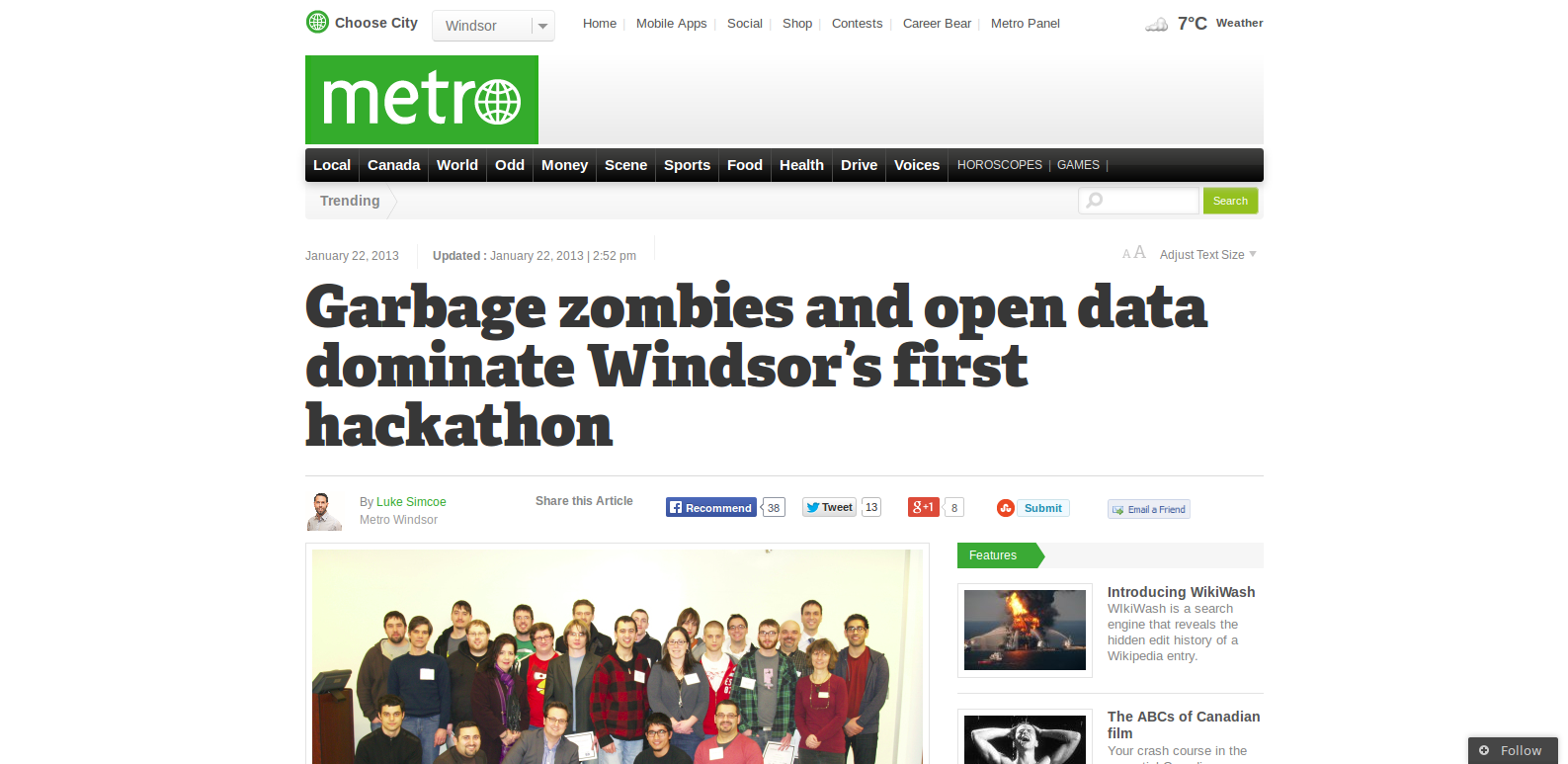
The first hackathon was called HackWE - and it lasted a weekend, was hosted at the University of Windsor and was based on the City of Windsor’s Open Data Catalogue.

HackWE 2.0 was a 24-hour hackathon based on residential energy data collected by Smart Meters and was part of a larger Ontario Apps for Energy Challenge.

And the third HackWE 3.0 - which happened just this past October - had events stretched over a week and based on open scientific data in celebration of Science and Technology week.

We’ve hosted our own independent hackathons as well. Last year Hackforge held a two week Summer Games event for people who wanted to try their hand at video game design. Everyone who completed a game won a trophy. My own video game won the prize for being the Most endearing.
But in general, our members are more engaged in the regular activities of Hackforge.

They include our bi-weekly Tech Talks that our members give to each other and the wider public, on such topics as Amazon Web Services, slide rules, writing Interactive fiction with JavaScript, and using technology in BioArt.
We have monthly Maptime events in the space. Maptime is an open learning environment for all levels related to digital map making but there is a definite an emphasis on support for the beginner.

This photo is from our first Windsor Maptime event which was dedicated to OpenStreetMap. There are Maptime chapters all around the world, and the next Maptime Toronto meeting is December 11th, if you are curious and if you near or in the GTA.

The Hackforge Software Guild meets weekly to work on personal projects as well as practicing pair programming on coding challenges called katas. For example, one of the first kata challenges was to write a program that would correctly write out the lyrics of 99 bottles of beer on the wall and one of more recent is how to code bowling scores.

We also have an Open Data Interest group and we are going to launch our own Open Data portal for Windsor’s non-profit community in 2015. We’re able to do this because this year we have received Trillium funding to hire a part-time coordinator and to small pay stipends to people to help with this work.

Our first dataset is likely going to be a community asset map that was compiled by the Ford City Renewal group. Ford City is one of several neighbourhoods in Windsor in which more than 30% of the population is have income levels that at poverty level. Average incomes of those from the the City of Windsor as a whole isn’t actually that much less than average for all of Canada - its just that we’re just the most economically polarized urban area in the country. That’s one of the reasons why, in January Hackforge is going to be working with Ford City Renewal to host a build your computer event for young people in the neighborhood.
As well, our 3 year Trillium grant also funds another part-time coordinator who matches individuals seeking technology experience with non-profits such as the Windsor Homeless Coalition who need technology work and support.

Hackforge has also collaborated with the Windsor Public Library to put on co-hosted events such as the Robot Sumo contest.

And we’ve worked with the City of Windsor to produce persistence of vision bicycle wheels for the their WAVES light and sound art festival. I know it’s difficult to see but in the photo on the screen is a bicycle wheel with a narrow set of lights that are strapped to three spokes on the wheel. When the wheel spins, the lights animate and give the impression that there’s an image in the wheel - it only works with the human eye - because of our persistence of vision - and it’s something that really come across in a photo very well.
[here's a video!]

Also, the City of Windsor commissioned us to build a Librarybox for their event which I thought was really cool!

And like most other Hackerspaces, we have 3D printers. We have robotic kits. We have soldering irons, and we have lots and lots of spare electronic and computer parts. But unlike most other hackerspaces who charge their members $30 to $50 a month to join and make use their space, our hackerspace is currently free to members who pay for their membership with volunteer work.
This brings us to today in the last days of 2014.

2014 is also the year that Aaron came back to us from California. He’s now my fellow board member at Hackforge. And, incidentally, so is Art Rhyno, who - if you don’t know - is a fellow librarian from the University of Windsor.

I was asked by Scholars Portal if I could share some of my experiences with Hackforge in light of today’s theme of building community. And that is what my talk will be about today: how to use a hackerspace to build community. And I will do so by expanding on five themes.
But as you know know - we are only 2 years old, and so - this talk is really about just the beginning steps we’ve been taking and those steps that we are still trying to take. We admittedly have a long way to go.
Helping out with Hackforge has been a very rich and rewarding experience and I’ve learned much from it. And it’s also been hard work and sometimes it has been very time consuming.
All those decisions we made as we started our hackerspace were the first ones we’ve ever had to make for our new organization. This process was exhilarating but it also was occasionally exhausting. Which brings us to our first theme:

Institutions reduce the choices available to their members
The reason why starting up an organization is so exhausting can be found in Ronald Coase’s work. Coase is famous for introducing the concept of transaction costs to explain the nature and limits of firms and that earned him the Nobel Prize in Economics in 1991. Now I haven’t read his Nobel prize winning work, myself. I was first introduced to Coase when I read a book last year called The org: the underlying logic of the office by Ray Fisman and Tim Sullivan.
I also read Coase being referenced in a blog post by media critic Clay Shirky that was about about the differences between new media and old media. It’s Shirky’s words on the screen right now:

Further on in his post Shirky explains what he means by this through an example of what happens at a daily newspaper:
When you are starting a new organization or any new venture, really, every small decision can sometime seem to bog you down. There is navel-gazing and random walks.
We got bogged down at the beginning of Hackforge. We actually received the keys to the space in the Windsor Public Library in October of 2012. Why the delay? We had decided that we would launch the opening of our space with a homemade keypass locking system for the doors because we thought it wouldn’t take much time at all.
And if we were considering how long it would take one talented person to build such a system by themselves, then maybe we would been right. But instead, we were very wrong. And looking back at it, now it seems obvious why this was the case:
We had a set of people who have never worked together before, who don’t necessarily even speak the same programming languages, working without an authority structure, in a scarcely born organization with no promise that we will succeed or survive, nor sure promise of reward.
Now it’s very important for me say that this so I'm absolutely clear - I am not complaining about our volunteers!!!

Hackforge would not have succeeded if it weren’t for those very first volunteers who made Hackforge happen in those early days when we were starting with nothing.
And the same holds to this day. When we say that Hackforge is made of volunteers, what we are really saying is that Hackforge = volunteers.

Our volunteers are especially remarkable because -- like all volunteers - they give up their own time that’s left over after their pre-existing commitments to work, school, family and friends. In volunteer work, every interaction is a gift. But, that being said, not every promise in a volunteer organization is one that is fulfilled. Sometimes you learn the hard way that first thing on Tuesday means 3pm.
But the delay wasn’t just from the building of the system. Once it was built, we then we had to make sure that the keypass system was okay with the library and that it was okay with the fire marshall. And we had to figure out how who was going to make the key cards, how they were going to be distributed and how we would use to decide who would get a keycard to the space and who would not. Ultimately, it took us 8 months to figure this all of this out.
I wanted to explicitly mention this observation because I’ve noticed that within our own institution of libraries that sometimes when a new group or committee is started up, there is the occasional individual who interprets the slow goings and long initial discussions of the first meetings as, at best, extreme inefficiency, and at worst, a sign of imminent failure.
When in fact, we should recognize that slow starts are normal.

Culture is to a organization as community is to a city
New organizations and new ventures happen slowly and furthermore, they should happen slowly because each decision made is one that further that defines the “how” of “what an organization is”. Are we, as an organization, formal or informal? Who takes the minutes at meetings? Do we need to give a notice of motion? Do we do our own books or do we hire an accountant? Do we provide food at our events? Do we sell swag or do we give it away? How should we fundraise? How do we deal with bad actors? Every decision further defines the work that we do.

It’s very important to take the time to take these steps slowly in order to make sure that the way you do things match up with the why you do things. As I think we can appreciate in libraryland, once institutions reduce choices of their members it is very difficult - although not impossible to open them up again for rethinking and refactoring.
One of reasons why Hackforge has been very successful in its brief existence - is that it was formed with clearly articulated reasons and clear guiding principles that continue to help us shape the form of our work. And I know this, because the vision of what Hackforge should be was told to be me when I was invited to serve of the board when Hackforge began and, I can attest to the fact, that it is the same the as the one we have now.

Now, there are many different types of hacker and makerspaces: some are dedicated to artists, others to entrepreneurs, while others are dedicated to the hobbyist. Hackforge - in less than 140 characters has been described as this: Hackforge supports capacity building in the community and supporting a culture of mentorship and inclusivity.
More specifically, we exist to help with youth retention in Windsor. We aim to be a place where individuals who work or want to work in technology can find support from each other.
I know it might sound strange to you that we believe that our local IT industry needs support, especially when we read about the excesses of Silicon Valley on a regular basis.
But in Windsor, there are not many options for those with a technology background to find work and so, despite of the impression we give to those pursuing a career in STEM, tech jobs in Windsor can be poorly paid and the working conditions can be very problematic.

Many of the provisions in the labour law - the ones that entitle employees to set working hours, to breaks between and within shifts, to overtime and even time to eat - have exemptions for those who work in IT. I’ve been told that the only way to get a raise while working in IT in this town is to find a better paying job.
The IT industry sometimes treats people as if they were machines themselves.
Hackforge was built as a response to this environment. It was build in hopes that it could help grow something better. At Hackforge we know our strength does not come from the machines that we have in our space, but our amazing members and the time and work that they give to others.
I mean, we love 3D printers because they are a honeypot that brings curious folks into our space, but the secret is we are not really about 3D printers.

And yet if you look at all of what our media coverage we receive, you would think we’re just another makerspace that loves 3D printers and robots.
This is why it is SO important to be visible with your values, which is our second theme.

Show your work
One of the challenges that we have at Hackforge is that we don’t have very many women in our ranks. Women make up half of our board of directors but our larger membership is not representative of the Windsor community and it’s likely not representative in the other aspects of identity, for that matter, either.

We know that if we wanted to change this situation, it would require sustained work on our part. And so when we had our official launch of Hackforge last year, we, as part of the event, hosted a Women in Technology Panel that featured four women who work in IT, including the very successful Girl Develop IT from Detroit, all of whom both shared their experiences and offer strategies to make the field of technology a more inclusive environment and better place for everyone.
In the audience for that panel discussion was a representative of WEST. WEST is a local non-profit group who works and stands for Women’s Enterprise Skills Training. Starting next year, with the support of another Ontario Trillium grant, Hackforge and WEST are going to be launching a project that will offer free computer skills training workshops for women as well as trying to create a community of support, and continue to advocate for women in the IT field.

So I can’t stress this enough. You have to do your work in public if you want your future collaborators to find you.
I have also another Women in Technology story to start our third theme.
So remember I told you about unconferences? Well, the Hackforge members who run the Software Guild do something similar. Sometimes instead of coding, the folks do something like this. They write down all thing the things they want to talk about, vote for the topics and then talk the most voted topics within strict time limits. But they don’t call it an unconference:

They call it LEAN COFFEE.
I love it. It’s so adorable.
Anyway, at one of these Lean Coffee sessions, our staff coordinator suggested the topic Women in Technology. And the response she received was this: We know there’s a problem because Hackforge doesn’t have enough women. But we are not sure how to fix this.
To me, I found this statement very encouraging.
Its sad, but in these these times, when people can admit that there’s a problem without any deflection or allocation of blame is actually very refreshing.
I mean, within librarianship - we have some organizations who consistently organize speaking events made up of mostly men. Whenever I raise this matter I usually told that if the speaking topic is not about gender, then it’s not about gender. In other words, they tell me that there is no problem.
But sometimes there is a problem.

Look at this photo: from this you would never guess that it was taken in a city that is over 80% African American. This photo from the first meeting of Maptime Detroit that I attended last month. One of the first things that was said during the evening’s introduction was a simple statement by the organizer. “I want to acknowledge who isn’t this in room” And what followed was a plan to hold the next Maptime meetings, not in the mid-town Tech Incubator, but within the various neighbourhoods in the city and alongside partner organizations already working with Detroiters where they live.
So before we can be more inclusive, we need to recognize when we are not.

We can start by acknowledging who isn’t in the room. It isn’t hard to do.
Quinn Norton wrote a lovely essay about this called Count. Speaking of counting, we are now at theme four.

A mailing list is not a community
What you might find surprising is that - for Hackforge being a gathering of people who generally love love love the Internet, is that we really don’t even have a strong online space for folks to hang out in, with the exception of our IRC channel. We used to have forum software, but is was so overwhelmed with spam on a daily basis it was almost immediately rendered unusable.
Also, Hackforge doesn’t even have a listserv mailing list.
And I would go as far to say that one of the reasons why Hackforge has been as successful as we have been is in part, because that we *don’t* have a mailing list.
There’s a website that’s called Running a Hackerspace that is a collection of animated gifs that metaphorically capture the essence of Running a hackerspace. I think it’s particularly telling that there are many recurrent topics that arise this Tumblr: like the complaints that folks don’t clean up after themselves.

(And this is when I confess that when I drop by Hackforge, I am also sometimes made sad).

But the most prevalent theme in the blog is mailing list rage.
You would think this would have been a solved problem by now: how do you support project work that is done asynchronously and dispersed over geography. Many open source communities are finding that the traditional tools of mailing lists, forum software, and IRC channels are not doing enough in helping their communities do good work together. More often than not, these technologies seem to be better than boosting the noise rather than the signal.

Distributed companies like Wordpress are moving from IRC to software platforms such as Slack. As I’ve mentioned before, I’m involved with a largely self-organized group called Maptime and we also make use of Slack, which is essentially user friendly IRC, chat, and messaging along with images, file sharing, archiving and social media capture.
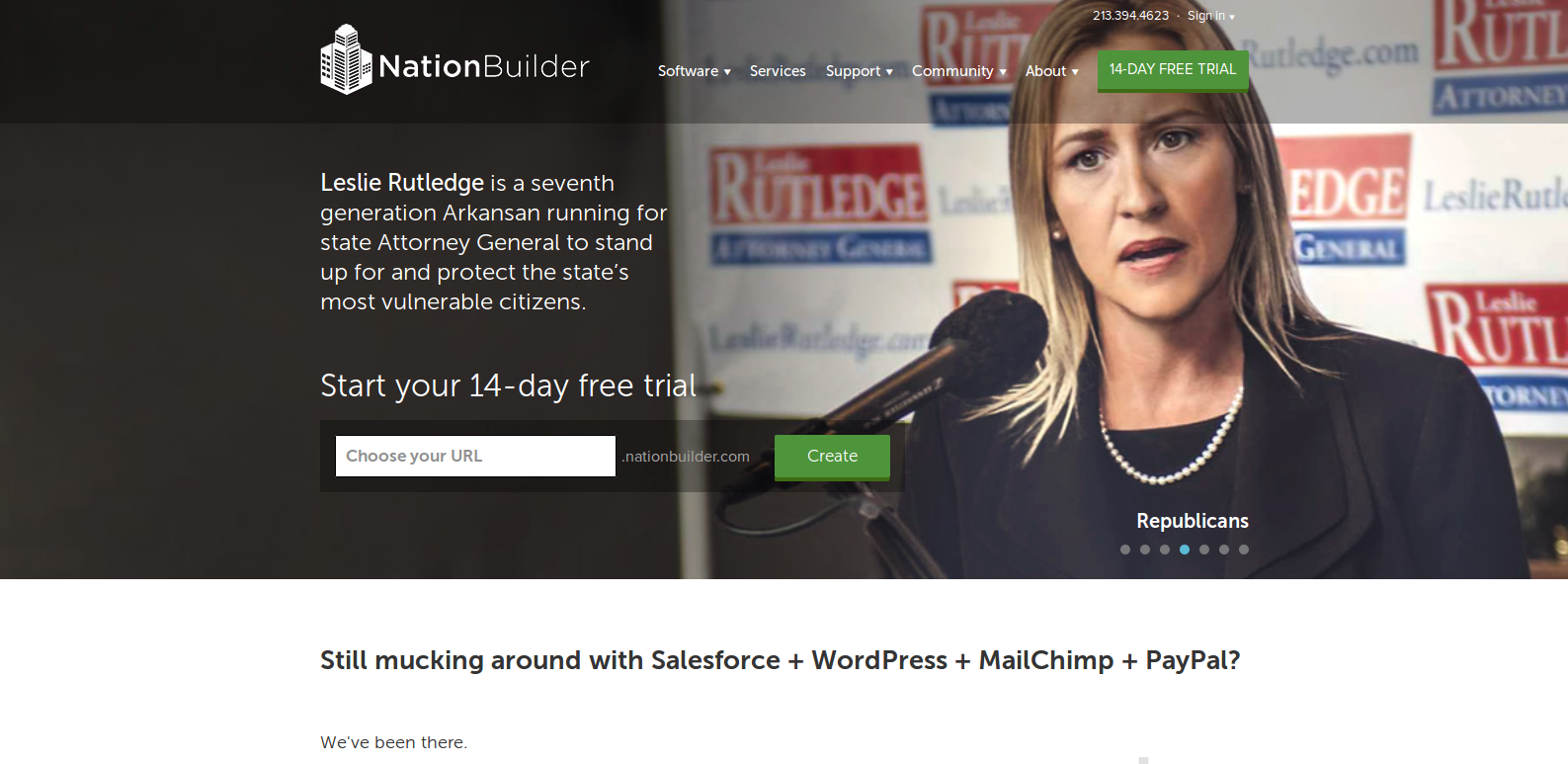
At Hackforge, we’ve recently decided to use the Jira issue tracker to manage the hacking work that we need to do in the space and we will be switching to Nation Builder software to manage our members and member communications. When activists, non-profits, and political parties are using software like Nation Builder to manage the contact info, the interests, and the fundraising of tens of thousands of people, it makes me wonder when libraries are going to start using similar software to manage the relationships it has with its community.
And at a time when my neighbours who rent the skating rink for collective use, use volunteer management software to figure out who’s turn it is to bring the hot chocolate, I would like to suggest that libraries perhaps could start using similar software to - at least - manage our internal work and communications as well. Good tools make great communication possible within organizations and our communities. They are are worth the investment.

Invest in but do not outsource community management
Before I end my presentation with this last theme, I do want to offer a caveat to everything I’ve said. If you asked all of the people who have been involved in Hackforge - those who have come by our events, spent time in the space, or even volunteered some mentoring at an event - if you asked them if they felt they were part of a community, I think most people asked would probably say, no. I think we have a wonderful group of people who have contributed to Hackforge and I think we have a group of people who have even found friends at Hackforge, but I think we still can’t call the whole of what we do "a community" - at least not yet.
Hackforge is approaching its 2nd birthday and this talk has been a wonderful excuse to reflect on what we do well and what we still need to work on.
What works for us are regular events, contests and Hackathons. We are well aware of the limitations of hackathons and how they produce imperfect work but, for us, it seems to be that that pre-defined limits and deadlines produce more work and generate more interest and excitement than unstructured free time seems to.
Unlike many hackerspaces, we don’t tend to have many group projects. The door project - as you have learned - was one of few group projects, and that one took longer than expected. In our early months, we also had a LED sign project that was never completed and actually resulted in some people leaving Hackforge in frustration.

We are a volunteer organization and as such, by the process of evolution, we are a place for the patient and the forgiving. Sometimes we have gotten our first impressions wrong.
One of the largest challenges I think we have as an organization is to be more accessible to beginners. In fact, that the feedback that we’ve been getting.
Aaron recently had a tech talk about tech talks and the message he received was that Hackforge should provide more sessions for beginners. And this is a particular challenge that we haven’t really addressed yet. We’re luckily that Hackforge has people who are both generous with their time and not afraid of public speaking and give tech talks. But many of our speakers don’t preface their talks with an introduction that a newbie could understand. They are so excited to have fellow experts in the crowd and they jump right into the code or electrical specs or what have you.
Likewise, it’s amazing and wonderful that we have regular supportive events like our member’s coding katas in which those who work with software can practice and share their coding practice with others. But at the moment, we don’t really have anything for those who want to learn how to code. And you might not be shocked to hear this, but Hackforge’s machines like our 3D printers - lack even the most basic documentation on how to use the machines.
Without expanding the work of communicating, documenting, explaining, and teaching, Hackforge won’t be able to attract new members.
Hackforge started as a top down organization. Our job as board has been to the build the systems that will allow more of the day to day work of the Hackforge to move from the board to our community and program managers. We were able to hire our managers in the middle of this year and already, they have made wonderful contributions to Hackforge. Our next challenge will be how to move more of the operational work of the managers to the members themselves.
In other words, the challenge for Hackforge is to ensure that the work that needs to be done - all of that communicating, documenting, explaining, teaching - needs to be embraced by all of its members as a community of practice. And through this practice, it’s hoped we can build a community.
So, those are my five themes for building community with a hackerspace:

Institutions reduce the choices available to their members (so choose carefully)
Show your work (so future collaborators can find you).
Acknowledge who isn’t in the room (Count is only the start).
A mailing list is not a community (Invest in tools that do better).
Invest but do not outsource community management.
The work of figuring how to get a bunch of people to come together and face a shared challenge isn’t just the way the build a community. This is also how political movements begin. It’s also how a game begins. I would like to thanks to Scholars Portal for giving me the opportunity to begin Scholars Portal Day with you all.


You can’t tell how many apples are in a seed.
In May of 2010, I, Art Rhyno, Nicole Noel and late and sorely missed Jean Foster hosted an unconference at the central branch of the Windsor Public Library.
Unconferences are seemingly no longer in vogue, so just in case you don’t know, an unconference is a conference where the topics of discussion are determined by those in the room who gather and disperse in conversation as their interests dictate.
The unconference was called WEChangeCamp and it was one several ChangeCamp unconferences that occurred across the country at that time.
At this particular unconference, 40 people from the community came together to answer this question: “How can we re-imagine Windsor-Essex as a stronger and more vibrant community?”
And on that day the topic of a Windsor Hackerspace was suggested by a young man who I later learned was working on his doctorate in electrical engineering. What I remember of that conversation four years ago was Aaron explaining the problem at hand: he and his friends needed regular infusions of money to rent a place to build a hackerspace so they needed a group of people who would pay monthly membership fees. But they couldn’t get paying members until they could attract them with a space.
Shortly thereafter, Aaron - like so many other young people in Windsor- left the city for work elsewhere. It’s a bit of an epidemic here. We have the second highest unemployment rate in Canada and it’s been said that youth unemployment rate in Windsor is at a staggering 20%.
In Aaron’s case, he moved to Palo Alto, California to do robotics work in an automotive R&D lab.
In the meantime back in Windsor, in May 2012, I helped host code4lib North at the University of Windsor. We had the pleasure to host librarians from many OCUL libraries over those two days as well as staff from the Windsor Public Library. Also in the audience was Doug Sartori. Doug had helped in the development of the WPL’s CanGuru mobile library application. He came to code4lib north because he was was curious about the first generation Raspberry pi that John Fink of McMaster had brought with him. You have to remember that in 2012 that the Raspberry Pi - the $40 computer card - was still never very new in the world.
A year later, in May 2013, Windsor got its first Hackerspace when Hackforge was officially opened. The Windsor Public Library graciously lent Hackforge the empty space in the front of their Central Branch that was previously a Woodcarver’s Museum.
When Hackforge launches, Doug Sartori is president and I’m on the board of directors.
In our 20 months of our existence, I’m proud to say that Hackforge has accomplished quite a lot for itself and for our community.
We’ve co-hosted three hackathons along with the local technology accelerator WETech Alliance.
The first hackathon was called HackWE - and it lasted a weekend, was hosted at the University of Windsor and was based on the City of Windsor’s Open Data Catalogue.
HackWE 2.0 was a 24-hour hackathon based on residential energy data collected by Smart Meters and was part of a larger Ontario Apps for Energy Challenge.
And the third HackWE 3.0 - which happened just this past October - had events stretched over a week and based on open scientific data in celebration of Science and Technology week.
We’ve hosted our own independent hackathons as well. Last year Hackforge held a two week Summer Games event for people who wanted to try their hand at video game design. Everyone who completed a game won a trophy. My own video game won the prize for being the Most endearing.
But in general, our members are more engaged in the regular activities of Hackforge.
They include our bi-weekly Tech Talks that our members give to each other and the wider public, on such topics as Amazon Web Services, slide rules, writing Interactive fiction with JavaScript, and using technology in BioArt.
We have monthly Maptime events in the space. Maptime is an open learning environment for all levels related to digital map making but there is a definite an emphasis on support for the beginner.
This photo is from our first Windsor Maptime event which was dedicated to OpenStreetMap. There are Maptime chapters all around the world, and the next Maptime Toronto meeting is December 11th, if you are curious and if you near or in the GTA.
The Hackforge Software Guild meets weekly to work on personal projects as well as practicing pair programming on coding challenges called katas. For example, one of the first kata challenges was to write a program that would correctly write out the lyrics of 99 bottles of beer on the wall and one of more recent is how to code bowling scores.
We also have an Open Data Interest group and we are going to launch our own Open Data portal for Windsor’s non-profit community in 2015. We’re able to do this because this year we have received Trillium funding to hire a part-time coordinator and to small pay stipends to people to help with this work.
Our first dataset is likely going to be a community asset map that was compiled by the Ford City Renewal group. Ford City is one of several neighbourhoods in Windsor in which more than 30% of the population is have income levels that at poverty level. Average incomes of those from the the City of Windsor as a whole isn’t actually that much less than average for all of Canada - its just that we’re just the most economically polarized urban area in the country. That’s one of the reasons why, in January Hackforge is going to be working with Ford City Renewal to host a build your computer event for young people in the neighborhood.
As well, our 3 year Trillium grant also funds another part-time coordinator who matches individuals seeking technology experience with non-profits such as the Windsor Homeless Coalition who need technology work and support.
Hackforge has also collaborated with the Windsor Public Library to put on co-hosted events such as the Robot Sumo contest.
And we’ve worked with the City of Windsor to produce persistence of vision bicycle wheels for the their WAVES light and sound art festival. I know it’s difficult to see but in the photo on the screen is a bicycle wheel with a narrow set of lights that are strapped to three spokes on the wheel. When the wheel spins, the lights animate and give the impression that there’s an image in the wheel - it only works with the human eye - because of our persistence of vision - and it’s something that really come across in a photo very well.
[here's a video!]
Also, the City of Windsor commissioned us to build a Librarybox for their event which I thought was really cool!
And like most other Hackerspaces, we have 3D printers. We have robotic kits. We have soldering irons, and we have lots and lots of spare electronic and computer parts. But unlike most other hackerspaces who charge their members $30 to $50 a month to join and make use their space, our hackerspace is currently free to members who pay for their membership with volunteer work.
This brings us to today in the last days of 2014.
2014 is also the year that Aaron came back to us from California. He’s now my fellow board member at Hackforge. And, incidentally, so is Art Rhyno, who - if you don’t know - is a fellow librarian from the University of Windsor.
I was asked by Scholars Portal if I could share some of my experiences with Hackforge in light of today’s theme of building community. And that is what my talk will be about today: how to use a hackerspace to build community. And I will do so by expanding on five themes.
But as you know know - we are only 2 years old, and so - this talk is really about just the beginning steps we’ve been taking and those steps that we are still trying to take. We admittedly have a long way to go.
Helping out with Hackforge has been a very rich and rewarding experience and I’ve learned much from it. And it’s also been hard work and sometimes it has been very time consuming.
All those decisions we made as we started our hackerspace were the first ones we’ve ever had to make for our new organization. This process was exhilarating but it also was occasionally exhausting. Which brings us to our first theme:
Institutions reduce the choices available to their members
The reason why starting up an organization is so exhausting can be found in Ronald Coase’s work. Coase is famous for introducing the concept of transaction costs to explain the nature and limits of firms and that earned him the Nobel Prize in Economics in 1991. Now I haven’t read his Nobel prize winning work, myself. I was first introduced to Coase when I read a book last year called The org: the underlying logic of the office by Ray Fisman and Tim Sullivan.
I also read Coase being referenced in a blog post by media critic Clay Shirky that was about about the differences between new media and old media. It’s Shirky’s words on the screen right now:
These frozen choices are what gives institutions their vitality — they are in fact what make them institutions. Freed of the twin dangers of navel-gazing and random walks, an institution can concentrate its efforts on some persistent, medium-sized, and tractable problem, working at a scale and longevity unavailable to its individual participants.
Further on in his post Shirky explains what he means by this through an example of what happens at a daily newspaper:
The editors meet every afternoon to discuss the front page. They have to decide whether to put the Mayor’s gaffe there or in Metro, whether to run the picture of the accused murderer or the kids running in the fountain, whether to put the Biker Grandma story above or below the fold. Here are some choices they don’t have to make at that meeting: Whether to have headlines. Whether to be a tabloid or a broadsheet. Whether to replace the entire front page with a single ad. Whether to drop the whole news-coverage thing and start selling ice cream. Every such meeting, in other words, involves a thousand choices, but not a billion, because most of the big choices have already been made.
When you are starting a new organization or any new venture, really, every small decision can sometime seem to bog you down. There is navel-gazing and random walks.
We got bogged down at the beginning of Hackforge. We actually received the keys to the space in the Windsor Public Library in October of 2012. Why the delay? We had decided that we would launch the opening of our space with a homemade keypass locking system for the doors because we thought it wouldn’t take much time at all.
And if we were considering how long it would take one talented person to build such a system by themselves, then maybe we would been right. But instead, we were very wrong. And looking back at it, now it seems obvious why this was the case:
We had a set of people who have never worked together before, who don’t necessarily even speak the same programming languages, working without an authority structure, in a scarcely born organization with no promise that we will succeed or survive, nor sure promise of reward.
Now it’s very important for me say that this so I'm absolutely clear - I am not complaining about our volunteers!!!
Hackforge would not have succeeded if it weren’t for those very first volunteers who made Hackforge happen in those early days when we were starting with nothing.
And the same holds to this day. When we say that Hackforge is made of volunteers, what we are really saying is that Hackforge = volunteers.
Our volunteers are especially remarkable because -- like all volunteers - they give up their own time that’s left over after their pre-existing commitments to work, school, family and friends. In volunteer work, every interaction is a gift. But, that being said, not every promise in a volunteer organization is one that is fulfilled. Sometimes you learn the hard way that first thing on Tuesday means 3pm.
But the delay wasn’t just from the building of the system. Once it was built, we then we had to make sure that the keypass system was okay with the library and that it was okay with the fire marshall. And we had to figure out how who was going to make the key cards, how they were going to be distributed and how we would use to decide who would get a keycard to the space and who would not. Ultimately, it took us 8 months to figure this all of this out.
I wanted to explicitly mention this observation because I’ve noticed that within our own institution of libraries that sometimes when a new group or committee is started up, there is the occasional individual who interprets the slow goings and long initial discussions of the first meetings as, at best, extreme inefficiency, and at worst, a sign of imminent failure.
When in fact, we should recognize that slow starts are normal.
Culture is to a organization as community is to a city
New organizations and new ventures happen slowly and furthermore, they should happen slowly because each decision made is one that further that defines the “how” of “what an organization is”. Are we, as an organization, formal or informal? Who takes the minutes at meetings? Do we need to give a notice of motion? Do we do our own books or do we hire an accountant? Do we provide food at our events? Do we sell swag or do we give it away? How should we fundraise? How do we deal with bad actors? Every decision further defines the work that we do.
It’s very important to take the time to take these steps slowly in order to make sure that the way you do things match up with the why you do things. As I think we can appreciate in libraryland, once institutions reduce choices of their members it is very difficult - although not impossible to open them up again for rethinking and refactoring.
One of reasons why Hackforge has been very successful in its brief existence - is that it was formed with clearly articulated reasons and clear guiding principles that continue to help us shape the form of our work. And I know this, because the vision of what Hackforge should be was told to be me when I was invited to serve of the board when Hackforge began and, I can attest to the fact, that it is the same the as the one we have now.
Now, there are many different types of hacker and makerspaces: some are dedicated to artists, others to entrepreneurs, while others are dedicated to the hobbyist. Hackforge - in less than 140 characters has been described as this: Hackforge supports capacity building in the community and supporting a culture of mentorship and inclusivity.
More specifically, we exist to help with youth retention in Windsor. We aim to be a place where individuals who work or want to work in technology can find support from each other.
I know it might sound strange to you that we believe that our local IT industry needs support, especially when we read about the excesses of Silicon Valley on a regular basis.
But in Windsor, there are not many options for those with a technology background to find work and so, despite of the impression we give to those pursuing a career in STEM, tech jobs in Windsor can be poorly paid and the working conditions can be very problematic.
Many of the provisions in the labour law - the ones that entitle employees to set working hours, to breaks between and within shifts, to overtime and even time to eat - have exemptions for those who work in IT. I’ve been told that the only way to get a raise while working in IT in this town is to find a better paying job.
The IT industry sometimes treats people as if they were machines themselves.
Hackforge was built as a response to this environment. It was build in hopes that it could help grow something better. At Hackforge we know our strength does not come from the machines that we have in our space, but our amazing members and the time and work that they give to others.
I mean, we love 3D printers because they are a honeypot that brings curious folks into our space, but the secret is we are not really about 3D printers.
And yet if you look at all of what our media coverage we receive, you would think we’re just another makerspace that loves 3D printers and robots.
This is why it is SO important to be visible with your values, which is our second theme.
Show your work
One of the challenges that we have at Hackforge is that we don’t have very many women in our ranks. Women make up half of our board of directors but our larger membership is not representative of the Windsor community and it’s likely not representative in the other aspects of identity, for that matter, either.
We know that if we wanted to change this situation, it would require sustained work on our part. And so when we had our official launch of Hackforge last year, we, as part of the event, hosted a Women in Technology Panel that featured four women who work in IT, including the very successful Girl Develop IT from Detroit, all of whom both shared their experiences and offer strategies to make the field of technology a more inclusive environment and better place for everyone.
In the audience for that panel discussion was a representative of WEST. WEST is a local non-profit group who works and stands for Women’s Enterprise Skills Training. Starting next year, with the support of another Ontario Trillium grant, Hackforge and WEST are going to be launching a project that will offer free computer skills training workshops for women as well as trying to create a community of support, and continue to advocate for women in the IT field.
So I can’t stress this enough. You have to do your work in public if you want your future collaborators to find you.
I have also another Women in Technology story to start our third theme.
So remember I told you about unconferences? Well, the Hackforge members who run the Software Guild do something similar. Sometimes instead of coding, the folks do something like this. They write down all thing the things they want to talk about, vote for the topics and then talk the most voted topics within strict time limits. But they don’t call it an unconference:
They call it LEAN COFFEE.
I love it. It’s so adorable.
Anyway, at one of these Lean Coffee sessions, our staff coordinator suggested the topic Women in Technology. And the response she received was this: We know there’s a problem because Hackforge doesn’t have enough women. But we are not sure how to fix this.
To me, I found this statement very encouraging.
Its sad, but in these these times, when people can admit that there’s a problem without any deflection or allocation of blame is actually very refreshing.
I mean, within librarianship - we have some organizations who consistently organize speaking events made up of mostly men. Whenever I raise this matter I usually told that if the speaking topic is not about gender, then it’s not about gender. In other words, they tell me that there is no problem.
But sometimes there is a problem.
Look at this photo: from this you would never guess that it was taken in a city that is over 80% African American. This photo from the first meeting of Maptime Detroit that I attended last month. One of the first things that was said during the evening’s introduction was a simple statement by the organizer. “I want to acknowledge who isn’t this in room” And what followed was a plan to hold the next Maptime meetings, not in the mid-town Tech Incubator, but within the various neighbourhoods in the city and alongside partner organizations already working with Detroiters where they live.
So before we can be more inclusive, we need to recognize when we are not.
We can start by acknowledging who isn’t in the room. It isn’t hard to do.
Quinn Norton wrote a lovely essay about this called Count. Speaking of counting, we are now at theme four.
A mailing list is not a community
What you might find surprising is that - for Hackforge being a gathering of people who generally love love love the Internet, is that we really don’t even have a strong online space for folks to hang out in, with the exception of our IRC channel. We used to have forum software, but is was so overwhelmed with spam on a daily basis it was almost immediately rendered unusable.
Also, Hackforge doesn’t even have a listserv mailing list.
And I would go as far to say that one of the reasons why Hackforge has been as successful as we have been is in part, because that we *don’t* have a mailing list.
There’s a website that’s called Running a Hackerspace that is a collection of animated gifs that metaphorically capture the essence of Running a hackerspace. I think it’s particularly telling that there are many recurrent topics that arise this Tumblr: like the complaints that folks don’t clean up after themselves.
(And this is when I confess that when I drop by Hackforge, I am also sometimes made sad).
But the most prevalent theme in the blog is mailing list rage.
You would think this would have been a solved problem by now: how do you support project work that is done asynchronously and dispersed over geography. Many open source communities are finding that the traditional tools of mailing lists, forum software, and IRC channels are not doing enough in helping their communities do good work together. More often than not, these technologies seem to be better than boosting the noise rather than the signal.
Distributed companies like Wordpress are moving from IRC to software platforms such as Slack. As I’ve mentioned before, I’m involved with a largely self-organized group called Maptime and we also make use of Slack, which is essentially user friendly IRC, chat, and messaging along with images, file sharing, archiving and social media capture.
At Hackforge, we’ve recently decided to use the Jira issue tracker to manage the hacking work that we need to do in the space and we will be switching to Nation Builder software to manage our members and member communications. When activists, non-profits, and political parties are using software like Nation Builder to manage the contact info, the interests, and the fundraising of tens of thousands of people, it makes me wonder when libraries are going to start using similar software to manage the relationships it has with its community.
And at a time when my neighbours who rent the skating rink for collective use, use volunteer management software to figure out who’s turn it is to bring the hot chocolate, I would like to suggest that libraries perhaps could start using similar software to - at least - manage our internal work and communications as well. Good tools make great communication possible within organizations and our communities. They are are worth the investment.
Invest in but do not outsource community management
Before I end my presentation with this last theme, I do want to offer a caveat to everything I’ve said. If you asked all of the people who have been involved in Hackforge - those who have come by our events, spent time in the space, or even volunteered some mentoring at an event - if you asked them if they felt they were part of a community, I think most people asked would probably say, no. I think we have a wonderful group of people who have contributed to Hackforge and I think we have a group of people who have even found friends at Hackforge, but I think we still can’t call the whole of what we do "a community" - at least not yet.
Hackforge is approaching its 2nd birthday and this talk has been a wonderful excuse to reflect on what we do well and what we still need to work on.
What works for us are regular events, contests and Hackathons. We are well aware of the limitations of hackathons and how they produce imperfect work but, for us, it seems to be that that pre-defined limits and deadlines produce more work and generate more interest and excitement than unstructured free time seems to.
Unlike many hackerspaces, we don’t tend to have many group projects. The door project - as you have learned - was one of few group projects, and that one took longer than expected. In our early months, we also had a LED sign project that was never completed and actually resulted in some people leaving Hackforge in frustration.
We are a volunteer organization and as such, by the process of evolution, we are a place for the patient and the forgiving. Sometimes we have gotten our first impressions wrong.
One of the largest challenges I think we have as an organization is to be more accessible to beginners. In fact, that the feedback that we’ve been getting.
Aaron recently had a tech talk about tech talks and the message he received was that Hackforge should provide more sessions for beginners. And this is a particular challenge that we haven’t really addressed yet. We’re luckily that Hackforge has people who are both generous with their time and not afraid of public speaking and give tech talks. But many of our speakers don’t preface their talks with an introduction that a newbie could understand. They are so excited to have fellow experts in the crowd and they jump right into the code or electrical specs or what have you.
Likewise, it’s amazing and wonderful that we have regular supportive events like our member’s coding katas in which those who work with software can practice and share their coding practice with others. But at the moment, we don’t really have anything for those who want to learn how to code. And you might not be shocked to hear this, but Hackforge’s machines like our 3D printers - lack even the most basic documentation on how to use the machines.
Without expanding the work of communicating, documenting, explaining, and teaching, Hackforge won’t be able to attract new members.
Hackforge started as a top down organization. Our job as board has been to the build the systems that will allow more of the day to day work of the Hackforge to move from the board to our community and program managers. We were able to hire our managers in the middle of this year and already, they have made wonderful contributions to Hackforge. Our next challenge will be how to move more of the operational work of the managers to the members themselves.
In other words, the challenge for Hackforge is to ensure that the work that needs to be done - all of that communicating, documenting, explaining, teaching - needs to be embraced by all of its members as a community of practice. And through this practice, it’s hoped we can build a community.
So, those are my five themes for building community with a hackerspace:
Institutions reduce the choices available to their members (so choose carefully)
Show your work (so future collaborators can find you).
Acknowledge who isn’t in the room (Count is only the start).
A mailing list is not a community (Invest in tools that do better).
Invest but do not outsource community management.
The work of figuring how to get a bunch of people to come together and face a shared challenge isn’t just the way the build a community. This is also how political movements begin. It’s also how a game begins. I would like to thanks to Scholars Portal for giving me the opportunity to begin Scholars Portal Day with you all.
Friday, April 13, 2012
The library as interface to public space and public self
The following are the words and pictures that I presented yesterday as part of the University of Windsor's Librarian Research Series for a talk entitled, The library as interface to public space and public self.


This speaking series was designed to provide those at the Leddy Library with an opportunity to share our research work -- work that we’ve done and work that we hope to do in the future. My presentation today is more about the former than the latter. But it’s worse than that.

You see, my intention is to apply for my first sabbatical -- filling in the paperwork this summer -- with the intention of starting it January 2014. At this point, I know what ground I’m interested in exploring but not necessary the particular path that I want to take. In other words, using a more appropriate metaphor, I feel like I’m at the stage in which I feel I have found a piece of glass that fits nicely in my hand, but I still need to grind it down into a lens. This presentation is my first grindstone.
Even without the external motivation of a deadline, I find that forcing yourself to articulate specifically what you really care about and what you want to learn more about is a very helpful exercise in the pursuit of meaningful work. I know this because in some ways I’ve gone through this process before. It happened almost two years ago now.

In 2010, I was paid to play a game. I was a game runner for a game called Evoke that was designed by Jane McGonigal and sponsored by the World Bank. Evoke was an alternative reality game designed to act as a curriculum for social entrepreneurism and during its 10 week run the game attracted almost 20,000 registered players from around the world and raised $30,000 for 25 projects developed by its players.

After the game was over, I was invited to go to Washington DC for a couple days to take part in was known as the Evoke Summit for the game’s winners and their mentors. One of the activities that occurred during the summit was dedicated to developing a short tagline to succinctly convey the essence of one’s project. Unlike the rest of participants in the room, I didn’t come to the summit with a particular project, but I did the exercise and eventually I came up with this for myself: public spaces need public events.

It has become the tagline that I use on my personal portfolio site and I think it does a pretty good job of capturing some of the work I have been doing inside the library and outside of it.
But, being just a tagline, “public spaces need public events” doesn’t explain *why* I think events are so important for libraries, library communities, and communities with and without libraries. I will do that now and I will start with libraries.
I believe that events held within libraries animate the space of the library and situates it as a place not just where knowledge is accessed but where it can be created, understood, and shared. Librarians are positioned as perfect hosts of events as we have access to cheap, accessible, and open public space and we are mandated to serve all sectors of our communities. Community events held within libraries embody the notion that libraries are a continual community-building exercise. Libraries, by their very nature, are a gathering of people and ideas mixed together.

These are some of the ideas that I shared last year in May when I was asked to give a talk at TEDxLibrariansTO. My address there was dedicated to libraries and community events and I entitled my talk Organizing is what librarians do. I will not make you - or me - suffer through the video of my talk, but I will re-read one passage from that day. It’s the call to action part (the genre of the TED talk requires such a call).
I am standing here to extend an invitation to all of you. I believe that we - our profession, our community, our country, our planet - need more collaborative events to bring us together. We need more opportunities to host conversations. We need more opportunities to change the conversation. And so my invitation that I am extending is not to a particular event - but a personal invitation to all of you to organize an event for others.
Now, In that one paragraph I tried to allude to several personal convictions. Today, I would like to articulate the specifics of what I was referring to that day: I believe we are obligated to conserve as much natural habitat and wildlife as possible, that we must continually strive to alleviate human suffering around the globe, and to do so, we need to be engaged in politics and we need to change politics.

To these ends, I’ve participated in a number of very different public events. I describe most of these events in detail in my TEDx talk, so I’ll give a quick summary here: in the last five years, I’ve helped form a neighbourhood residents association, hosted a Jane’s Walk, and organized an ChangeCamp unconference. I’ve also given a Talk20 pecca kucha presentation - which requires 20 slides at 20 seconds each. That presentation ended up being good practice for a later Ignite talk I gave last year which demands 20 slides at 15 seconds each. And then there’s the TEDx talk that I’ve already mentioned which strictly forbids a talk to go a second over 18 minutes. My enthusiasm for strange speaking formats is one of the reasons why I think it’s pretty funny that what I’ve never done until today is just read a presentation. (* makes checkmark*)

By the way, the theme of TEDxLibrariansTO was “Librarians as Thought Leaders” and that particular tagline was largely misunderstood. There were those when they first heard the theme, thought that the speakers that day were being put forward as “thought leaders”. And while that would be a personally flattering interpretation, I know through conversations I have had with the organizers of the event, that this was not their intention. The phrase of “librarians as thought leaders” was designed to challenge our all too common practice of sublimating our work as librarians by constantly to referring ourselves and our work -- in our professional literature, to our own institutions, and to outsiders - as “The Library”.
Now, that being said, one could also make the case that we don’t refer to our work -- “librarian and librarian staff work” as “The Library” enough. I like to refer to this particular debate as “The library is the building where the books are” versus “The library is the building where the librarian is”.

This conversation is just one of many that form the current re-negotiating and re-understanding of the relationships between librarians, the space the of the library, the collections that they hold and are connected to, and the communities that are served by these things. It might be too soon to say this, but I believe we are seeing a great change in librarianship and I want to speak briefly about this change because the work that I’ve done and that I want to do makes the most sense in this framework.

The change in question is just a change in perspective, but it’s a powerful one. Instead of the library bringing the world to the community, there are those who are already thinking and working towards how we can bring our communities to the world. The library becomes the community publisher and an incubator for writer and artists. The library recognizes other literacies and embraces the haptic by hosting hackerspaces where technology is taken apart and examined critically before re-purposed. The library recognizes that communities need to spend time together before it can work together. It provides game space where people can spend time instead of money as they play and learn together. Like the Internet, the library is increasingly seen as a means to communicate and engage instead of just being a locked platform for entertainment and product delivery.

I mentioned Jane McGonigal before. She is a proponent of using games to fix reality, because games make us happy while reality is broken. I love this quote of hers from Twitter and I think that it dovetails what something we sometimes forget about libraries. While libraries are associated with content, libraries were and are created with larger goals in mind: self-education and self-improvement, improving community capacity, and embodying and supporting scholarly communication. The content of libraries isn’t the exciting factor for us. We don’t just exist just to provide information. We strive for literacy, or more accurately in these times, literacies, including information literacy and transliteracy.

The Research for Citizenship Project by Lisa Sloniowski and Patti Ryan of York University is a great example of this re-interpretation of the library’s potential. So far, this project has involved hosting library based teach-ins and developing research guides dedicated to the Occupy Movement and another surrounding the issue of violence against women in conjunction with campus-based Montreal Massacre commemorative events. Many of you know Lisa Sloniowski from her time here at Leddy Library as Information Literacy Coordinator, when she drafted our Senate-approved Information Literacy Policy and initiated the curriculum integration with History Department and course integration with the English Department’s Composition class. This collaborative project of hers and Patti’s involves information literacy work *in the library* where it emphasizes the research needs of students beyond the classroom where they are not just students but citizens. In doing so, their work facilitates knowledge sharing between students from different disciplines and different communities while making visible the critical work of academic libraries.
Now, this all being said - I’m no longer completely satisfied with my tagline of “public spaces need public events”. I think it served its purpose by providing a conceptual space for what I’ve done but I now I find it too vague and that it doesn’t really capture the stand that I want to take. I want to articulate goals.

I spoke of lenses before. My husband Greg has recently got new glasses with “progressive lenses” - which is a more marketable and more forgiving term for bifocals. When he first got them, he found the two focal strengths terribly disorienting. And I have to admit, that at this particular moment, I’m feeling very disorientated myself, especially with my work. I’ve started to think it’s because I have gotten older, I have started to develop another focus. I’m interested in the same subjects, but I find that I’m interested in them at a different scale.

I’m still interested in the work of citizens who come together to improve their communities and their government, but I have found that I’ve been increasingly interested in those ways in which they are using the Internet to facilitate that work. While I have been thinking towards using the library a place for civic engagement and as a support system for democracy, I have been extending that line of thought to consider the library moving from a place where citizens can get information about and from their government, to a place where they can understand, engage and challenge that information.

I’ve realized - by preparing for this presentation - that in many ways, what I’m interested in is this interface between the digital and the analog; the bridge between the digital commons and the public common space. As a User-Experience Librarian, I am acutely aware of how important the interface is to an application and how it both demonstrates, embeds, and constrains a value-system.

Just the act of presenting the same content with a new interface can be a political act. For example in 2008, Peter Rukavina spidered the PEI’s Corporate Register and indexed it so that anyone could search the database by company shareholder. He did because he was concerned about a developer’s plan to build a tunnel in his neighbourhood and he wanted to learn more about other corporations that might be involved and there was no way to search the database this way, even though the information was available. The provincial government did not look kindly to this enhancement and quickly took steps to prevent Peter’s database to make regular updates, effectively ending the service.

Peter Rukavina’s work can be considered part of a larger movement usually called “Open Government”. This movement captures the emergence of non-partisan citizens coming together both online and in person, to find ways to make government more effective and responsive to all of us. It also can describe the emergence of a whole new category of non-profit organizations - organizations that I think have very interesting taglines. Some examples:
Code for America’s tagline is “a new kind of public service”. The longer version is “helping governments work better for everyone with the people and the power of the web”
CrisisCommons’ is “we connect people to help those in need”. Longer version: "connecting people, tools & resources to support crisis response"
Ushahidi: “we are a non-profit tech company that changes the way information flows in the world”. Part of the longer version: “We build tools for democratizing information, increasing transparency and lowering the barriers for individuals to share their stories."
Open government groups and organizations are dedicated to improving the wellbeing of all citizens, increasing community capacity, and reducing digital divides. Just like libraries.

And just as I’ve always been more inclined to host and participate in events rather than writing about how other people are hosting and participating in events, I find that I want to build up my computing skills so I can help code and connect the work of these organizations with that of libraries. In fact, I am beginning to think that I would love to spend a year learning and doing just that.
Speaking of events, I very much appreciate this opportunity to speak to you today and want to thank Selinda Berg for taking the initiative and making this possible. And I thank you for attention. I hope not too much of what work I have described was new to you as I try to capture my ideas and my work in my blog New Jack Librarian as I go along. If you have been reading my blog, you might be more aware of connections in my work and my interests that I’m not aware of. If so, I’d love to hear it because while this presentation has done much towards my goal of creating a new lens to see farther than I can today, the future is still a little blurry to me.
Subscribe to:
Posts (Atom)