Showing posts with label code. Show all posts

Sunday, March 29, 2015

The Setup

For this post, I’m going to pretend that the editors of the blog, The Setup (“a collection of nerdy interviews asking people from all walks of life what they use to get the job done”) asked me for a contribution. But in reality, I’m just following Bill Denton’s lead.

It feels a little self-indulgent to write about one’s technology purchases so before I describe my set up, let me explain why I’m sharing this information.

Some time back, in preparation for a session I was giving on Zotero for my university’s annual  technology conference, I realized that before going into the reasons how to use Zotero, I had to address the reasons why. I recognized that I was asking students and faculty who were likely already time-strapped and overburdened, to abandon long-standing practices that were already successfully working for them if they were going to switch to Zotero for their research work.

Before my presentation, I asked on Twitter when and why faculty would change their research practices.  Most of the answers were on the cynical side but there were some that gave me some room to maneuver, namely this one: “when I start a new project.”  And there’s a certain logic to this approach. If you were starting graduate school and know that you have to prepare for comps and generate a thesis at the end of the process, wouldn’t you want to conscientiously design your workflow at the start to capture what you learn in such a way that it’s searchable and reusable?

My own sabbatical is over and oddly enough, it is now at the end of my sabbatical in which I feel the most like I’m starting all over again in my professional work. So I’m using that New Project feeling to fuel some self-reflection in my own research process, bring some mindfulness to my online habits, and deliberate design into My Setup.

There’s another reason why I’m thinking about the deliberate design of research practice. As libraries start venturing into the space of research service consultation, I believe that librarians need to follow best practices for ourselves if we hope to develop expertise in this area.

As well, I think we need to more conscious of how and when our practices are not in line with our values. It’s simply not possible to live completely without hypocrisy in this complicated world but that doesn’t mean we can’t strive for praxis. It’s difficult for me to take seriously accusations that hackerspaces are neoliberal when it’s being stated by a person cradling a  Macbook or iPhone. That being said, I greatly rely on products from Microsoft, Amazon, and Google so I'm in no position to cast stones.

I just want to care about the infrastructures we’re building….
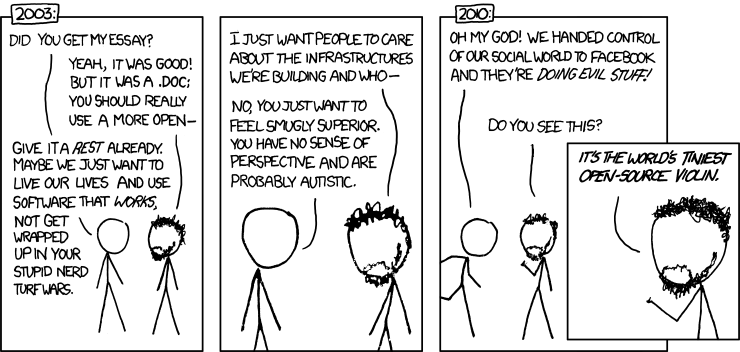


And with that, here’s my setup!

Hardware

There are three computers that I spend my time on: the family computer in the kitchen (a Dell desktop running Windows 7), my work computer (another Dell desktop running Windows 7), and my Thinkpad X1 Carbon laptop which I got earlier this year.  Grub turned my laptop into a dual boot machine that I can switch between Ubuntu and Windows 7. I feel I need a Windows environment so I can run any ESRI products and all those other Mac/Windows only products if need be.

I have a Nexus 4 Android phone made by LG and a Kindle DX as my ebook reader. I don’t own a tablet or an mp3 player.

Worldbackup Day is March 31st. I need to get myself an external drive for backups (Todo1).

Software

After getting my laptop, the first thing I did was investigated password managers to find which one would work best for me. I ended up choosing LastPass and I felt the benefits immediately. Using a password manager has saved me so much pain and aggravation and now my passwords are now (almost) all unique. Next, I need to set up two factor authentication for the services that I haven’t gotten around to yet (Todo2).  

With work being done on three computers, it’s not surprising that I have a tendency to work online. My browser of choice is Mozilla but I will flip to Chrome from time to time. I use the sync functionality on both so my bookmarks are the automatically updated and the same across devices. I use SublimeText for my text editor for code, GIMP as my graphics editor, and QGIS for my geospatial needs.

This draft, along with much of my other writing and presentations are on Google Drive. I spend much of my time in Gmail and Google Calendar. While years ago, I downloaded all my email using Mozilla Thunderbird, I have not set up a regular backup strategy for these documents (Todo3). I’ve toyed with using Dropbox to back up Drive but think I’m better with an external drive. I have a Dropbox account because people occasionally share documents with me through it but at the moment, I only use it to backup my kids Minecraft games.

From 2007 to 2013, I used delicious to capture and share the things I read online. Then delicious tried to be the new Pinterest and made itself unusable (although it has since reverted back to close to its original form) and so I switched to Evernote (somewhat reluctantly because I missed the public aspect of sharing bookmarks).   I’ve grown to be quite dependent on Evernote to save my outboard brain. I use IFTTT to post the links from my Twitter faves to delicious which are then imported automatically into Evernote.  I also use IFTTT to automatically backup my Tumblr posts to Evernote, my Foursquare check-ins saved to Evernote (and Google Calendar) and my Feedly saved posts to Evernote. Have I established a system to back up my Evernote notes on a regular basis? No, no I have not (Todo4).

The overarching idea that I have come up with is that the things I write are backed up on my Google Drive account and the library of things that I have read or saved to future reading (ha!) are saved on Evernote.  To this end, I use IFTTT to save my Tweets to a Google Spreadsheet and my Blogger and WordPress posts are automatically saved to Google Drive (still in a work in progress. Todo 5). My ISP is Dreamhost but I am tempted to jump ship to Digital Ocean.

My goal is to have at least one backup for the things I’ve created. So I use IFTTT to save my Instagram posts to Flickr. My Flickr posts are just a small subset of all the photos that are automatically captured and saved on Google Photos.  No, I have not backed up these photos  (Todo 6) but I have, since 2005, printed the best of my photos on an annual basis into beautiful softcover books using QOOP and then later, through Blurb.  My Facebook photos and status updates from 2006 to 2013 have been printed in a lovely hardcover book using MySocialBook.  One day I would like to print a book of the best of my blogged writings using Blurb, if just as a personal artifact.

Speaking of books, because I’m one of the proud and the few to own a KindleDX, I use it to read PDFs and most of my non-fiction reading. When I stumble upon a longread on the web, I use Readability’s Send to Kindle function so I can read it later without eyestrain. I’m inclined to buy the books that I used in my writing and research as Kindle ebooks because I can easily attach highlighted passages from these books to my Zotero account. My ebooks are backed up in my calibre library. I also use Goodreads to keep track of my reading because I love knowing what my friends are into.

I subscribe to Rdio and for those times that I actually spend money on owning music, I try to use Bandcamp. I’m an avid listener of podcasts and for this purpose use BeyondPod. Our Sonos system allows us to play music from all these services, as well as TuneIn, in the living room.  The music that I used to listen to on CD is now sitting on an unused computer running Windows XP and I know if I don’t get my act together and transfer those files to an external drive soon those files will be gone for good.. if they haven’t already become inaccessible (*gulp*) (Todo 8).

For my “Todo list” I use Google Keep, which also captures my stray thoughts when I’m away from paper or my computer. Google Keep has an awesome feature that will trigger reminders based on your location.


So that’s My Setup. Let me know if you have any suggestions or can see some weaknesses in my workflow. Also, I’d love to learn from your Setup.

And please please please call me out if I don’t have a sequel to this post called The Backup by the time of next year's World Backup Day.

Friday, April 13, 2012

The library as interface to public space and public self


The following are the words and pictures that I presented yesterday as part of the University of Windsor's Librarian Research Series for a talk entitled, The library as interface to public space and public self.

This is the first time - ever - that I’m reading a presentation. There are several reasons why I’m reading this one today and, according to what I've written down already, I’ll be sharing one of those reasons.

This speaking series was designed to provide those at the Leddy Library with an opportunity to share our research work -- work that we’ve done and work that we hope to do in the future. My presentation today is more about the former than the latter. But it’s worse than that.


You see, my intention is to apply for my first sabbatical -- filling in the paperwork this summer -- with the intention of starting it January 2014.  At this point, I know what ground I’m interested in exploring but not necessary the particular path that I want to take. In other words, using a more appropriate metaphor, I feel like I’m at the stage in which I feel I have found a piece of glass that fits nicely in my hand, but I still need to grind it down into a lens.  This presentation is my first grindstone.

Even without the external motivation of a deadline, I find that forcing yourself to articulate specifically what you really care about and what you want to learn more about is a very helpful exercise in the pursuit of meaningful work. I know this because in some ways I’ve gone through this process before. It happened almost two years ago now.


In 2010, I was paid to play a game. I was a game runner for a game called Evoke that was designed by Jane McGonigal and sponsored by the World Bank. Evoke was an alternative reality game designed to act as a curriculum for social entrepreneurism and during its 10 week run the game attracted almost 20,000 registered players from around the world and raised $30,000 for 25 projects developed by its players.


After the game was over, I was invited to go to Washington DC for a couple days to take part in was known as the Evoke Summit for the game’s winners and their mentors. One of the activities that occurred during the summit was dedicated to developing a short tagline to succinctly convey the essence of one’s project. Unlike the rest of participants in the room, I didn’t come to the summit  with a particular project, but I did the exercise and eventually I came up with this for myself: public spaces need public events.


It has become the tagline that I use on my personal portfolio site and I think it does a pretty good job of capturing some of the work I have been doing inside the library and outside of it. 

But, being just a tagline, “public spaces need public events” doesn’t explain *why* I think events are so important for libraries, library communities, and communities with and without libraries.  I will do that now and I will start with libraries. 

I believe that events held within libraries animate the space of the library and situates it as a place not just where knowledge is accessed but where it can be created, understood, and shared. Librarians are positioned as perfect hosts of events as we have access to cheap, accessible, and open public space and we are mandated to serve all sectors of our communities. Community events held within libraries embody the notion that libraries are a continual community-building exercise. Libraries, by their very nature, are a gathering of people and ideas mixed together.


These are some of the ideas that I shared last year in May when I was asked to give a talk at TEDxLibrariansTO. My address there was dedicated to libraries and community events and I entitled my talk Organizing is what librarians do.  I will not make you - or me - suffer through the video of my talk, but I will re-read one passage from that day. It’s the call to action part (the genre of the TED talk requires such a call).

I am standing here to extend an invitation to all of you. I believe that we - our profession, our community, our country, our planet - need more collaborative events to bring us together. We need more opportunities to host conversations. We need more opportunities to change the conversation. And so my invitation that I am extending is not to a particular event - but a personal invitation to all of you to organize an event for others.

Now, In that one paragraph I tried to allude to several personal convictions. Today, I would like to articulate the specifics of what I was referring to that day: I believe we are obligated to conserve as much natural habitat and wildlife as possible, that we must continually strive to alleviate human suffering around the globe, and to do so, we need to be engaged in politics and we need to change politics. 


To these ends, I’ve participated in a number of very different public events. I describe most of these events in detail in my TEDx talk, so I’ll give a quick summary here: in the last five years, I’ve helped form a neighbourhood residents association, hosted a Jane’s Walk, and organized an ChangeCamp unconference. I’ve also given a Talk20 pecca kucha presentation - which requires 20 slides at 20 seconds each. That presentation ended up being good practice for a later Ignite talk I gave last year which demands 20 slides at 15 seconds each. And then there’s the TEDx talk that I’ve already mentioned which strictly forbids a talk to go a second over 18 minutes. My enthusiasm for strange speaking formats is one of the reasons why I think it’s pretty funny that what I’ve never done until today is just read a presentation. (* makes checkmark*)


By the way, the theme of TEDxLibrariansTO was “Librarians as Thought Leaders” and that particular tagline was largely misunderstood. There were those when they first heard the theme, thought that the speakers that day were being put forward as “thought leaders”.  And while that would be a personally flattering interpretation, I know through conversations I have had with the organizers of the event, that this was not their intention. The phrase of “librarians as thought leaders” was designed to challenge our all too common practice of sublimating our work as librarians by constantly to referring ourselves and our work  -- in our professional literature, to our own institutions, and to outsiders - as “The Library”.  

Now, that being said, one could also make the case that we don’t refer to our work -- “librarian and librarian staff work” as “The Library” enough. I like to refer to this particular debate as “The library is the building where the books are” versus “The library is the building where the librarian is”.  


This conversation is just one of many that form the current re-negotiating and re-understanding of the relationships between librarians, the space the of the library, the collections that they hold and are connected to, and the communities that are served by these things. It might be too soon to say this, but I believe we are seeing a great change in librarianship and I want to speak briefly about this change because the work that I’ve done and that I want to do makes the most sense in this framework.

The change in question is just a change in perspective, but it’s a powerful one. Instead of the library bringing the world to the community, there are those who are already thinking and working towards how we can bring our communities to the world. The library becomes the community publisher and an incubator for writer and artists. The library recognizes other literacies and embraces the haptic by hosting hackerspaces where technology is taken apart and examined critically before re-purposed. The library recognizes that communities need to spend time together before it can work together. It provides game space where people can spend time instead of money as they play and learn together.  Like the Internet, the library is increasingly seen as a means to communicate and engage instead of just being a locked platform for entertainment and product delivery. 


I mentioned Jane McGonigal before. She is a proponent of using games to fix reality, because games make us happy while reality is broken.  I love this quote of hers from Twitter and I think that it dovetails what something we sometimes forget about libraries. While libraries are  associated with content, libraries were and are created with larger goals in mind: self-education and self-improvement, improving community capacity, and embodying and supporting scholarly communication. The content of libraries isn’t the exciting factor for us. We don’t just exist just to provide information. We strive for literacy, or more accurately in these times, literacies, including  information literacy and transliteracy.


The Research for Citizenship Project by Lisa Sloniowski and Patti Ryan of York University is a great example of this re-interpretation of the library’s potential. So far, this project has involved hosting library based teach-ins and developing research guides dedicated to the Occupy Movement and another surrounding the issue of violence against women in conjunction with campus-based Montreal Massacre commemorative events. Many of you know Lisa Sloniowski from her time here at Leddy Library as Information Literacy Coordinator, when she drafted our Senate-approved Information Literacy Policy and initiated the curriculum integration with History Department and course integration with the English Department’s Composition class.  This collaborative project of hers and Patti’s involves information literacy work *in the library* where it emphasizes the research needs of students beyond the classroom where they are not just students but citizens. In doing so, their work facilitates knowledge sharing between students from different disciplines and different communities while making visible the critical work of academic libraries. 

Now, this all being said -  I’m no longer completely satisfied with my tagline of “public spaces need public events”. I think it served its purpose by providing a conceptual space for what I’ve done but I now I find it too vague and that it doesn’t really capture the stand that I want to take. I want to articulate goals.


I spoke of lenses before. My husband Greg has recently got new glasses with “progressive lenses” - which is a more marketable and more forgiving term for bifocals. When he first got them, he found the two focal strengths terribly disorienting. And I have to admit, that at this particular moment, I’m feeling very disorientated myself, especially with my work. I’ve started to think it’s because I have gotten older, I have started to develop another focus. I’m interested in the same subjects, but I find that I’m interested in them at a different scale.


I’m still interested in the work of citizens who come together to improve their communities and their government, but I have found that I’ve been increasingly interested in those ways in which they are using the Internet to facilitate that work. While I have been thinking towards using the library a place for civic engagement and as a support system for democracy,  I have been extending that line of thought to consider the library moving from a place where citizens can get information about and from their government, to a place where they can understand, engage and challenge that information. 


I’ve realized - by preparing for this presentation - that in many ways, what I’m interested in is this interface between the digital and the analog; the bridge between the digital commons and the public common space.  As a User-Experience Librarian, I am acutely aware of how important the interface is to an application and how it both demonstrates, embeds, and constrains a value-system.


Just the act of presenting the same content with a new interface can be a political act.  For example in 2008, Peter Rukavina spidered the PEI’s Corporate Register and indexed it so that anyone could search the database by company shareholder. He did because he was concerned about a developer’s plan to build a tunnel in his neighbourhood and he wanted to learn more about other corporations that might be involved and there was no way to search the database this way, even though the information was available. The provincial government did not look kindly to this enhancement and quickly took steps to prevent Peter’s database to make regular updates, effectively ending the service.


Peter Rukavina’s work can be considered part of a larger movement usually called “Open Government”.  This movement captures the emergence of non-partisan citizens coming together both online and in person, to find ways to make government more effective and responsive to all of us. It also can describe the emergence of a whole new category of non-profit organizations - organizations that I think have very interesting taglines. Some examples:

Code for America’s tagline is “a new kind of public service”. The longer version is “helping governments work better for everyone with the people and the power of the web”

CrisisCommons’ is “we connect people to help those in need”. Longer version:  "connecting people, tools & resources to support crisis response"

Ushahidi: “we are a non-profit tech company that changes the way information flows in the world”.  Part of the longer version: “We build tools for democratizing information, increasing transparency and lowering the barriers for individuals to share their stories."

Open government groups and organizations are dedicated to improving the wellbeing of all citizens, increasing community capacity, and reducing digital divides. Just like libraries.


And just as I’ve always been more inclined to host and participate in events rather than writing about how other people are hosting and participating in events, I find that I want to build up my computing skills so I can help code and connect the work of these organizations with that of libraries. In fact, I am beginning to think that I  would love to spend a year learning and doing just that.

Speaking of events, I very much appreciate this opportunity to speak to you today and want to thank Selinda Berg for taking the initiative and making this possible. And I thank you for attention. I hope not too much of what work I have described was new to you as I try to capture my ideas and my work in my blog New Jack Librarian as I go along.  If you have been reading my blog, you might be more aware of connections in my work and my interests that I’m not aware of. If so, I’d love to hear it because while this presentation has done much towards my goal of creating a new lens to see farther than I can today, the future is still a little blurry to me. 

Sunday, March 04, 2012

Gender. Coding. Libraries. Digital Humanities. And Timelines

Gender. Coding. Libraries. Digital Humanities. Where to begin?

Let's start with a Timeline.

Yesterday, out of nowhere really, I came to a particular insight to why Facebook was transitioning its users to the Timeline profile format. It suddenly became clear to me that users will eventually find it very difficult to leave Facebook once they realize that a significant portion of their lives and the lives of their friends and family have been so well captured and expressed and - I suspect - made unexportable -- by Facebook.

I think of leaving Facebook myself from time to time. So I thought I should make my own Timeline outside of Facebook now in the present, so I could kill my Facebook self off in the future without losing the digital artifacts of my past. I remembered that Peter Rukavina had written about Timelines some months ago and went off to investigate whether the software that he recommended was out of closed beta...

This morning I received an unexpected email from memolane of a picture that I took five years ago. A surprise from my past from my personal timeline of pictures and words. It felt good.

At this point I'd like to point out something obvious: digital photography has completely transformed the nature of photography. In doing so, it has transformed how we represent ourselves and others, and you could arguably make the case that it has transformed who we are.

I like to say, "we are all librarians now"  but maybe it's a more powerful statement to say, "we are all archivists now."
Meanwhile, both Katherine Harris and Lauren Klein show how archives are often silent when it comes to the representation of minorities, and Lauren (in one of the most powerful instances of topic modeling I’ve found in recent criticism) shows how digital technology can think through those silences. 

The quote above is a quotation from a post titled, DH, Archival Silence, and Linked Open Data., a post that is begins with this:
I’m thinking through many of the interesting conversations occurring around Twitter and the DH blogosphere recently. First, Miriam Posner had a really powerful post about learning code and gender, where she argues that the broad exhortation to code covers up gender and diversity inequity. 

This post you are reading is, in essence, another response to Miriam's post but it didn't start with it. I've been thinking about re-visiting gender and technology ever since last week when a couple tweets and posts from libraryland struck a discordant chord within:


The "important blog post" referred to above exhorts librarians to be more like engineers in a start-up. While others evidently have critiqued this post using the lens of gender, my more immediate concern is that it guilelessly reduced the profession to "identify problem, test minimal viable product, find product-market fit, validate business model, grow."

So.... illiteracy === opportunity!!!

The best response I have heard to this line of thinking comes from Bret Victor and he addresses the paucity of problem solving in engineering/computers/design in this recent keynote:


Bret Victor - Inventing on Principle from CUSEC on Vimeo.

If you are unable or unwilling to spend an hour on this remarkable video, here's the short version from Bret Victor's bio:

"There is no 'Technology'. There is no 'Design'. There is only a vision of how mankind should be and the relentless resolve to make it so. The rest is details."

(Mankind? Who uses that word anymore? Ah, yes, let's get back to the matter of gender, technologies, libraries, and digital humanities.)

Bethany Nowviskie wrote a wonderfully humane post called "don't circle the wagons" partly in response to the outpouring of response to Posner's "Some things to think about before you exhort everyone to code".

I bring attention to that humanity, because these days when the conversation turns to technology and libraries,  it's not always there :

At this point I'd like to point out something obvious: digital text has completely transformed the nature of libraries. In doing so, it has transformed how librarians represent ourselves and others, and you could arguably make the case that it has transformed who we are. 

While the tensions within/betwixt /between the humanities and the digital humanities are real and worth concern, I would make the case that they are, dare I say it?, are academic compared to what is currently being played out within libraries and librarianship. Simply put, we may not survive.

Or, on the other hand, we might be at the beginning of a golden age of librarians.  Even so,.

But what I fear it represents is a sense that we cannot stop doing all of the things that our librarians are currently doing in order to address the challenges of dealing with digital materials, so we are going to create one position and get some smart and energetic librarian who can handle everything associated with digital. And then the rest of us can continue doing the essential jobs that we are doing and not have to worry about all that weird stuff.

But if we are not all thinking of ourselves as digital services librarians, we are in trouble.

We are in trouble. Too many of my colleagues think that you can just hire and boss around a programmer to do all the necessary grunt work to support and visualize their theoretical aspirations. But, as Bethany Nowviskie has repeatedly had to point out: digital work is theory in manifest.  Also,

DH is slightly uncomfortable territory for programmers, as I've written in the past, at least it is for people like me who mostly program rather than academics who write code to accomplish their ends. I speak in generalities, and there are good local exceptions, but we don't get adequate (or often any) professional development funding, we don't get research time, we don't get credit for academic stuff we may do (like writing papers, presenting at conferences, etc.), we don't get to lead projects, and our jobs are very often contingent on funding. All this in exchange for about a 30% pay cut over what we could be earning in industry [Scripto Continua: A spot of mansplaining].  

On a local listserv, a colleague from another university asked a question that has been sitting with me like a splinter beneath the skin, "Are those with web skills obliged by management to do the digital work of colleagues with no skills?" (my paraphrasing).

My friends, this is the crux of what I am trying to reconcile.

Do I exhort my colleagues to learn how to code? Do I tell them, it's a program or be programmed world? Do I tell them that it's our responsibility to create online services and spaces that embody and extend the highest values of our profession and of citizenship? Do I try to make the case that we need to pass on a proficiency with tools that handle data deluge rather than paper-bound scarcity? Do I warn them that general purpose computing is at stake? That those without their own server space will be forever be second class citizens of the web?

No, I do not.

Sometimes I find - especially when the conversation turns to gender, or class, or race and culture, that speaking in generalizations just isn't useful. Sometimes I find times when conservations need to leave the level of abstraction and to come honestly from the individual and the personal.

Let me tell you why I am learning how to code.

I want to learn to program because of people like Peter Rukavina. I'm inspired by his civic data projects, by his PEI Wind Energy Dashboard, and for his experiments in curiosity such as "How much do I cost the health system"?  There are so many other people I know and respect who also have a relentless resolve to understand, to celebrate, and to make the world better. They share a generosity of time and spirit and I want to live up to their examples.

I want to make it clear that gender issues in relation to computing and relating to power is very important and it's still very important to me.

It's still on my Timeline.

Friday, October 07, 2011

Finding Ada is is Losing Loneliness

And in answer to the question "How does it feel to be be the only woman on the court?" she answers simply, "Lonely."

With the exception of spending two hours at the reference desk, I spent my working day trying to figure out how to add missing user information to a staff directory I was building in Drupal. By the time I had to leave work so I could pick my daughter up from daycare, I still hadn't figured it out. Once home and the kids were settled, I flipped open my laptop and kept searching for answers. About a half-hour later, I happen to stumble upon a workaround that just might work...

I don't have a computer science degree - I'm just learning as I go. It's hard work that is mostly insanely frustrating punctured with brief feelings of feeling supremely gratified. I'm lucky because I know that I have friends and an community that I can go to if I really get stuck. And I'm very grateful for this.

Still, the work is... well, it's lonely.

I'm not really up to unpacking that statement so I'm going leave it as it is.

Today is Ada Lovelace Day and I want to introduce you to two women that I recently heard speak at DrupalCamp Montreal.

Jen Simmons starting designing websites in 1996 and is best known for designing the default theme of Drupal 7. Her presentation -- "It's Not Your Father's Web Anymore" -- about HTML5 melted my brain. She is 42. I am 40. I mention this because it's hard for me to explain how profoundly re-assuring it was for me to hear her to give a brief history of the web that was filled with personal and historical touchstones that resonated with my own past.

The other woman I'd like to introduce you to is webchick aka Angie Byron. Her presentation "Getting Started in the Drupal Community" was the kick in the ass I needed to actually get involved in the do-ocracy of the open-source community. To hear that from the person who now is the co-maintainer of Drupal 7 admit that it took her ten years to go from 'open source cheerleader' to 'open source contributor' and that she herself couldn't explain why it took her so long... well, it made my own ten year journey to getting to the same point -- feel much less lonely.

Monday, May 09, 2011

code4lib north presentation: we're jamun and we hope that you like jamun too

On Friday, May 6th, I had the pleasure to present a project called that we are working on my place of work to the fine folks at Code4Lib North.

Jamun is the work of Art Rhyno and it is at the proof of concept stage. That being said, I'm hopeful that it will develop into our library's $100 discovery layer...


There was one point that didn't make it into the presentation slides that I regret not including: Our current version of Jamun doesn't include a pane search results from the text of the library website results but it is intended that we would prominently include one. As the results for a search for "primary source documents" from NCSU library nicely illustrates, such results can act as de facto *in context* help.

I'd like to also note that during the Q and A after my talk, there was a connection between my plea to libraries to stop throwing out course reading lists and Dan Cohen's recent release of million syllabus data set.

Much thanks to McMaster University for hosting Code4Lib and mad props to Nick Ruest and John Fink who were kind enough to host the wonderful event.

Thursday, February 24, 2011

Learning to code. On doing it and not worrying about doing it wrong

Some weeks ago I let you all know that I was trying to learn how to code by doing a little bit of hacking with the Head First series of books every night after I do the dishes.

The bad news is that's not I have been doing what I said I would be doing. But the good news is that I'm happily hacking with OpenStreetMap and OpenLayers with help from P2PU. (Lookie! I made this! )

Sure, I would be more pragmatic if I spent my nights working on improving my Drupal skills for our ongoing website migration at MPOW or (in support of the same ends) I worked on expanding my understanding of PHP and MySQL, but I'm much happier at the moment making maps.

I'm happier learning and hacking maps because I want to eventually contribute work to CrisisCommons. I'm happier because learning a little bit everyday gets me closer to the day that I am able to launch a map-related website using open government data for my community. And I'm much happier because I know someone who is also interested in maps and my work has inspired her work and her work inspires mine.

I have the tried the formal route of learning computer science. I took first year Algebra while I was on maternity leave so I would have the prerequisites to enroll at the University of Windsor's one year Bachelor of Computer Science (General) for University Graduates program. And I took my first computer science course of that program when I returned from maternity leave, but I found that the coursework and studying were taking too much away from time with my family. It also was not particularly enjoyable.

So I'm blazing my own path. I'm not worried that I'm "doing it wrong" (I'm not inclined to learn Python for the sheer beautiful purity of the language and I'm not going to apologize for that). As long as I put in the time, the work, and the mindfulness I will get to where I need to be.

Monday, January 03, 2011

Leddy By Design

If you are in libraryland and you have a hand in web design, then you might be interested in my workplace blog dedicated to MPOW's new library migration and re-design. We are moving from a Lotus Notes environment to Drupal.

I've been collecting similar work-in-progress blogs in this post and if you know of any that I've missed, please let me know via a comment.

Sunday, January 02, 2011

OnFocus! OnBlur! OnChange! How I am going to learn how to code

I've been meaning to learn how to code beyond HTML for years now, but never have managed to do much more than borrow other people's cryptic code and, by trial and error, swap out variables until things worked for the situation at hand. But this year, I have a DEADLINE and this deadline is as fierce and as frightening as a tiger.

I'm not going to dwell on the fact that I should have started my learning earlier. There's no time for that. Instead, I'm going to roll out my plan on learning how to code.

I've already completed the essential first step: I've found my learning community.

I've also got the second step under control: I've collected a selection of books that fit my style of learning. I'm a huge fan of O'Reilly's Head First series as it recognizes that most folks find it difficult to learn from technical manuals and so they structure their books on these learning principles:


And now all I have to do is the business of *doing* what I need to do.

A couple years ago, I was so inspired by this talk by Matt Webb that I resolved to find and dedicate 100 hours to learning Ancient Greek history. I did and the 100 hours passed faster than I had imagined and I found my life so much richer. Now while I do dishes, I listen to the most excellent History of Rome podcast. I'll be listening to episode 92 tonight.

And doing the dishes is the key to how I am going to learn how to code.

I am going to build a new habit into my existing daily routine. After my kids are put to bed and the rest of the dishes are put away (I have a difficult time resisting my kids persistent request to play with them after supper), I am going to sit down and spend at least 15 minutes learning to code. I'm actually hoping to put in 40 minutes a day, but right now the most important thing is get the "Kids. Dishes. Code" routine in place.

At 40 minutes a day, it will take me 150 days to reach the 100 hour mark which should bring me to June 1st. And that's a date that's much more inspiring than a deadline.

Friday, June 25, 2010

Information tool literacy

The program for Access 2010 ("the premier library technology conference in Canada") is now available. It looks like there will be lots of good things in store for those going to Winnipeg. Oh, and while you are looking at the program, why not check out the description for the session, After Launching Search and Discovery, Who Is Mission Control? Here's a snippet:

How should we (reference librarians, systems people, and users) work together to better exploit the possibilities of open source systems so we can focus on discovery and understanding instead of the mechanics of searching?

I mention this because I think it's not only a good question, it's a very important question. How indeed should reference librarians get involved in systems work so that we build systems of understanding and not just search?
 
As if on cue, Eric Lease Morgan presented some possible answers to this question in a piece called The Next Next-Generation Catalog:

Instead of focusing on find, the profession needs to focus on the next steps in the process. After a person does a search and gets back a list of results, what do they want to do? First, they will want to peruse the items in the list. After identifying items of interest, they will want to acquire them. Once the selected items are in hand users may want to print, but at the very least they will want to read. During the course of this reading the user may be doing any number of things. Ranking. Reviewing. Annotating. Summarizing. Evaluating. Looking for a specific fact. Extracting the essence of the author’s message. Comparing & contrasting the text to other texts. Looking for sets of themes. Tracing ideas both inside and outside the texts. In other words, find and acquire are just a means to greater ends. Find and acquire are library goals, not the goals of users.

I also want to bring attention to Eric's specific call to those engaged in information literacy.

People want to perform actions against the content they acquire. They want to use the content. They want to do stuff with it. By expanding our definition of “information literacy” to include things beyond metadata and bibliography, and by combining it with the power of computers, librarianship can further “save the time of the reader” and thus remain relevant in the current information environment. Focusing on the use and evaluation of information represents a growth opportunity for librarianship. 

In response to Eric's promotion of indexing tools, Kathryn Greenhill commented:

I think librarians need to look toward using textual analysis tools from the disciplines they serve and incorporate it into their “beyond discovery” layers.

It’s a pity that often subject liaison librarians in universities do this job because they are not so interested in “techie things”….How to get them to understand that this is their role will be interesting.

[I'm assuming that her last comment is missing a "not do" so that it reads, "It’s a pity that often subject liaison librarians in universities do not do this job because they are not so interested in “techie things” - I'm going to send her an email to clarify this matter.]

I think there is an significant reluctance by Information Literacy librarians to introduce genuinely useful tools (such as Zotero) to users because after years of teaching users just how to use the catalogue, many teaching librarians refuse to do any teaching of tools. Add to this scenario that an information librarian generally has only a very brief period of time to introduce large and hairy concepts to students such as genre theory, critical reading, and transliteracy, and you have librarians who will refuse to teach students textual tools on principle.

But "tool choice" is not the same as "teaching a tool".

So let us recognize that a reader's choice of information tool fundamentally affects that user's "use of information". Let us embrace information tool choice and use as a inherent component of Information Literacy. Let us ask ourselves why we promote the use of CINAHL instead of PubMed, WorldCat instead of OpenLibrary, RefWorks instead of Zotero...

OK, I admit that doesn't sound very poetic. Let's try that again:


I know I'm not alone here. While still in the minority, I believe that there are many librarians who believe that tool choice and development should be a fundamental component of our profession's work. In face, there are librarians who hold that tool creation is essential for our profession's survival. Also published yesterday, here is K. G. Schneider:


The fundamental problem with the proprietary software model is not one of evil ownership or grasping vendors. I’ve seen both of those occur in the open source software community. The problem with proprietary library management software–from a high-level perspective, profession-wide–is that it makes us stupid. It deprofessionalizes who we are and disengages us from tool creation.

Conversely, every librarian who engages in tool creation to any degree improves the state of librarianship for all of us. This has been true since some guy in a toga put holes in a wall to store the papyrus, and it was true in the 19th century when we agreed as a profession on the size of catalog cards (which led to our early adoption of standards and network-level records), and it  is true in the open source community today.

And her conclusions about why librarianship needs open source dovetails nicely with why I think librarianship needs to embrace tool choice and development, so I'll end with her words from the same post

If librarianship will survive the Big Shift, it will do so by reinventing itself. To reinvent itself will require many muscles of invention. And that, in the end, is why we need open source.