Sunday, April 15, 2012

Anatomy of a tag-line

[So after Friday's teal deer of a post that I worked on and off for weeks, I feel like writing down something quickly. In my mind, I have some ideas that are folding together nicely, but until I get them down, I'm not sure whether I am going to end up with origami or a paper boulder.]

As I was editing my Friday talk on Wednesday (tl;dr version: I try and fail to summarise the last five years of work in a tagline in preparation for a sabbatical application), I checked in on my twitter stream to find this recommendation

Intrigued, I followed a link and found someone writing about libraries, cities as software and a connection to the open government movement... which was something I was just doing in my own talk/post!

[the so-called joy of serendipity that comes from browsing adjacent books on a library's bookshelf can't hold a candle to the blow torch that spot-welds us together on the Internet]

It felt good, as it always does, to find a fellow traveller. Even better, I found that another post from Hugh Rundle's ("Return to the Coffeehouse") connected nicely to something I was trying to get across and so I added a screenshot and linked to it to make evident the connection. In that post, Hugh applies possible lessons from  Steven Johnson’s Where good ideas come from: the natural history of innovation that libraries could do well to learn from.

I had also read and enjoyed Where good ideas come from and have been meaning to put some of Johnson's recommendations into personal practice. While I keep my own Commonplace book, as Johnson recommends, I had not yet made a habit of returning to my older notes to pick up the threads of thought that I had put down which Johnson believes is almost necessary for long hunches to be developed.

Or so I thought. But on Saturday, I received this email from myself - or more accurately, my one-year-ago-self:


I had completely forgotten that I had come up with that title for myself and I realized that this title was closer to a personal mission statement than my the current tag-line on my portfolio site, public spaces need public events - the one that I just spent on thinking about improving over the last few weeks.

But "changing the rules so more can play" wasn't quite right because I thought too many people would think I was just talking about games. So, yesterday, Saturday morning, I kept trying to swap out words to something better but couldn't come up with anything. So I asked Twitter:


And shortly, I got this response which - as soon as I read it - I knew it was the answer:

I had been introduced to Vinay through the game of Evoke which had set me on the path of developing a tag-line in the first place.

[aside: Vinay Gupta's work both inspires me and terrifies me]

So. "Changing the rules so more can win" is my new mantra, my new mission, and shortly, my new tagline. It captures the work that I want to pursue in the contexts of social justice, environmental justice, local governance, gaming, and even librarianship.

Which isn't really the point of this (another!) self-indulgent post.

My point is this (from Steven Johnson's "Anatomy of an idea"):

1. The discovery process is remarkably social, and the social interactions come in amazingly diverse forms. Sometimes it's overhearing a conversation on Twitter between two complete strangers; sometimes it's the virtual book club of something like Findings; sometimes it's going out to lunch with a friend and bouncing new ideas off them. It's the social life of information, in John Seely Brown and Paul Duguid's wonderful phrase -- we just have so many more ways of being social now.

2. I find it interesting that there are certain kinds of questions that I now send out by default to Twitter, not Google. The more subtle and complex the question, the more likely it'll go to Twitter. But if it's simply trying to find a citation or source, I'll use Google...
3. Priming is everything. All these new tools are incredible for making rapid-fire discoveries and associations, but you need a broad background of knowledge to prime you for those discoveries...

4. Very few of the key links came from the traditional approach of reading a work and then following the citations included in the endnotes. The reading was still critical, of course, but the connective branches turned out to lie in the social layer of commentary outside of the work.
5. It’s been said it a thousand times before, by me and many others, but it's worth repeating again: people who think the Web is killing off serendipity are not using it correctly.
6.  Finally, this simple, but amazing fact: almost none of this--Twitter, blogs, PDFs, eBooks, Google, Findings--would have been intelligible to a writer fifteen years ago.

If it isn't already clear, here's some evidence: By linking to his work into my post, I *may* have introduced Hugh to R. David Lankes. From this comment from Amy Buckland, I found another fellow traveller in Char Booth. All of the above have one degree of separation to Nate Hill whose LibraryLab is the setting the groundwork for the physical manifestation of Dan Chudnov's own personal mission "help people build their own libraries"  and it was his post - from 2006 - that set me on my own journey to find my own personal mission/tagline.

Which leads us to today.

Thank you all.

Friday, April 13, 2012

The library as interface to public space and public self


The following are the words and pictures that I presented yesterday as part of the University of Windsor's Librarian Research Series for a talk entitled, The library as interface to public space and public self.

This is the first time - ever - that I’m reading a presentation. There are several reasons why I’m reading this one today and, according to what I've written down already, I’ll be sharing one of those reasons.

This speaking series was designed to provide those at the Leddy Library with an opportunity to share our research work -- work that we’ve done and work that we hope to do in the future. My presentation today is more about the former than the latter. But it’s worse than that.


You see, my intention is to apply for my first sabbatical -- filling in the paperwork this summer -- with the intention of starting it January 2014.  At this point, I know what ground I’m interested in exploring but not necessary the particular path that I want to take. In other words, using a more appropriate metaphor, I feel like I’m at the stage in which I feel I have found a piece of glass that fits nicely in my hand, but I still need to grind it down into a lens.  This presentation is my first grindstone.

Even without the external motivation of a deadline, I find that forcing yourself to articulate specifically what you really care about and what you want to learn more about is a very helpful exercise in the pursuit of meaningful work. I know this because in some ways I’ve gone through this process before. It happened almost two years ago now.


In 2010, I was paid to play a game. I was a game runner for a game called Evoke that was designed by Jane McGonigal and sponsored by the World Bank. Evoke was an alternative reality game designed to act as a curriculum for social entrepreneurism and during its 10 week run the game attracted almost 20,000 registered players from around the world and raised $30,000 for 25 projects developed by its players.


After the game was over, I was invited to go to Washington DC for a couple days to take part in was known as the Evoke Summit for the game’s winners and their mentors. One of the activities that occurred during the summit was dedicated to developing a short tagline to succinctly convey the essence of one’s project. Unlike the rest of participants in the room, I didn’t come to the summit  with a particular project, but I did the exercise and eventually I came up with this for myself: public spaces need public events.


It has become the tagline that I use on my personal portfolio site and I think it does a pretty good job of capturing some of the work I have been doing inside the library and outside of it. 

But, being just a tagline, “public spaces need public events” doesn’t explain *why* I think events are so important for libraries, library communities, and communities with and without libraries.  I will do that now and I will start with libraries. 

I believe that events held within libraries animate the space of the library and situates it as a place not just where knowledge is accessed but where it can be created, understood, and shared. Librarians are positioned as perfect hosts of events as we have access to cheap, accessible, and open public space and we are mandated to serve all sectors of our communities. Community events held within libraries embody the notion that libraries are a continual community-building exercise. Libraries, by their very nature, are a gathering of people and ideas mixed together.


These are some of the ideas that I shared last year in May when I was asked to give a talk at TEDxLibrariansTO. My address there was dedicated to libraries and community events and I entitled my talk Organizing is what librarians do.  I will not make you - or me - suffer through the video of my talk, but I will re-read one passage from that day. It’s the call to action part (the genre of the TED talk requires such a call).

I am standing here to extend an invitation to all of you. I believe that we - our profession, our community, our country, our planet - need more collaborative events to bring us together. We need more opportunities to host conversations. We need more opportunities to change the conversation. And so my invitation that I am extending is not to a particular event - but a personal invitation to all of you to organize an event for others.

Now, In that one paragraph I tried to allude to several personal convictions. Today, I would like to articulate the specifics of what I was referring to that day: I believe we are obligated to conserve as much natural habitat and wildlife as possible, that we must continually strive to alleviate human suffering around the globe, and to do so, we need to be engaged in politics and we need to change politics. 


To these ends, I’ve participated in a number of very different public events. I describe most of these events in detail in my TEDx talk, so I’ll give a quick summary here: in the last five years, I’ve helped form a neighbourhood residents association, hosted a Jane’s Walk, and organized an ChangeCamp unconference. I’ve also given a Talk20 pecca kucha presentation - which requires 20 slides at 20 seconds each. That presentation ended up being good practice for a later Ignite talk I gave last year which demands 20 slides at 15 seconds each. And then there’s the TEDx talk that I’ve already mentioned which strictly forbids a talk to go a second over 18 minutes. My enthusiasm for strange speaking formats is one of the reasons why I think it’s pretty funny that what I’ve never done until today is just read a presentation. (* makes checkmark*)


By the way, the theme of TEDxLibrariansTO was “Librarians as Thought Leaders” and that particular tagline was largely misunderstood. There were those when they first heard the theme, thought that the speakers that day were being put forward as “thought leaders”.  And while that would be a personally flattering interpretation, I know through conversations I have had with the organizers of the event, that this was not their intention. The phrase of “librarians as thought leaders” was designed to challenge our all too common practice of sublimating our work as librarians by constantly to referring ourselves and our work  -- in our professional literature, to our own institutions, and to outsiders - as “The Library”.  

Now, that being said, one could also make the case that we don’t refer to our work -- “librarian and librarian staff work” as “The Library” enough. I like to refer to this particular debate as “The library is the building where the books are” versus “The library is the building where the librarian is”.  


This conversation is just one of many that form the current re-negotiating and re-understanding of the relationships between librarians, the space the of the library, the collections that they hold and are connected to, and the communities that are served by these things. It might be too soon to say this, but I believe we are seeing a great change in librarianship and I want to speak briefly about this change because the work that I’ve done and that I want to do makes the most sense in this framework.

The change in question is just a change in perspective, but it’s a powerful one. Instead of the library bringing the world to the community, there are those who are already thinking and working towards how we can bring our communities to the world. The library becomes the community publisher and an incubator for writer and artists. The library recognizes other literacies and embraces the haptic by hosting hackerspaces where technology is taken apart and examined critically before re-purposed. The library recognizes that communities need to spend time together before it can work together. It provides game space where people can spend time instead of money as they play and learn together.  Like the Internet, the library is increasingly seen as a means to communicate and engage instead of just being a locked platform for entertainment and product delivery. 


I mentioned Jane McGonigal before. She is a proponent of using games to fix reality, because games make us happy while reality is broken.  I love this quote of hers from Twitter and I think that it dovetails what something we sometimes forget about libraries. While libraries are  associated with content, libraries were and are created with larger goals in mind: self-education and self-improvement, improving community capacity, and embodying and supporting scholarly communication. The content of libraries isn’t the exciting factor for us. We don’t just exist just to provide information. We strive for literacy, or more accurately in these times, literacies, including  information literacy and transliteracy.


The Research for Citizenship Project by Lisa Sloniowski and Patti Ryan of York University is a great example of this re-interpretation of the library’s potential. So far, this project has involved hosting library based teach-ins and developing research guides dedicated to the Occupy Movement and another surrounding the issue of violence against women in conjunction with campus-based Montreal Massacre commemorative events. Many of you know Lisa Sloniowski from her time here at Leddy Library as Information Literacy Coordinator, when she drafted our Senate-approved Information Literacy Policy and initiated the curriculum integration with History Department and course integration with the English Department’s Composition class.  This collaborative project of hers and Patti’s involves information literacy work *in the library* where it emphasizes the research needs of students beyond the classroom where they are not just students but citizens. In doing so, their work facilitates knowledge sharing between students from different disciplines and different communities while making visible the critical work of academic libraries. 

Now, this all being said -  I’m no longer completely satisfied with my tagline of “public spaces need public events”. I think it served its purpose by providing a conceptual space for what I’ve done but I now I find it too vague and that it doesn’t really capture the stand that I want to take. I want to articulate goals.


I spoke of lenses before. My husband Greg has recently got new glasses with “progressive lenses” - which is a more marketable and more forgiving term for bifocals. When he first got them, he found the two focal strengths terribly disorienting. And I have to admit, that at this particular moment, I’m feeling very disorientated myself, especially with my work. I’ve started to think it’s because I have gotten older, I have started to develop another focus. I’m interested in the same subjects, but I find that I’m interested in them at a different scale.


I’m still interested in the work of citizens who come together to improve their communities and their government, but I have found that I’ve been increasingly interested in those ways in which they are using the Internet to facilitate that work. While I have been thinking towards using the library a place for civic engagement and as a support system for democracy,  I have been extending that line of thought to consider the library moving from a place where citizens can get information about and from their government, to a place where they can understand, engage and challenge that information. 


I’ve realized - by preparing for this presentation - that in many ways, what I’m interested in is this interface between the digital and the analog; the bridge between the digital commons and the public common space.  As a User-Experience Librarian, I am acutely aware of how important the interface is to an application and how it both demonstrates, embeds, and constrains a value-system.


Just the act of presenting the same content with a new interface can be a political act.  For example in 2008, Peter Rukavina spidered the PEI’s Corporate Register and indexed it so that anyone could search the database by company shareholder. He did because he was concerned about a developer’s plan to build a tunnel in his neighbourhood and he wanted to learn more about other corporations that might be involved and there was no way to search the database this way, even though the information was available. The provincial government did not look kindly to this enhancement and quickly took steps to prevent Peter’s database to make regular updates, effectively ending the service.


Peter Rukavina’s work can be considered part of a larger movement usually called “Open Government”.  This movement captures the emergence of non-partisan citizens coming together both online and in person, to find ways to make government more effective and responsive to all of us. It also can describe the emergence of a whole new category of non-profit organizations - organizations that I think have very interesting taglines. Some examples:

Code for America’s tagline is “a new kind of public service”. The longer version is “helping governments work better for everyone with the people and the power of the web”

CrisisCommons’ is “we connect people to help those in need”. Longer version:  "connecting people, tools & resources to support crisis response"

Ushahidi: “we are a non-profit tech company that changes the way information flows in the world”.  Part of the longer version: “We build tools for democratizing information, increasing transparency and lowering the barriers for individuals to share their stories."

Open government groups and organizations are dedicated to improving the wellbeing of all citizens, increasing community capacity, and reducing digital divides. Just like libraries.


And just as I’ve always been more inclined to host and participate in events rather than writing about how other people are hosting and participating in events, I find that I want to build up my computing skills so I can help code and connect the work of these organizations with that of libraries. In fact, I am beginning to think that I  would love to spend a year learning and doing just that.

Speaking of events, I very much appreciate this opportunity to speak to you today and want to thank Selinda Berg for taking the initiative and making this possible. And I thank you for attention. I hope not too much of what work I have described was new to you as I try to capture my ideas and my work in my blog New Jack Librarian as I go along.  If you have been reading my blog, you might be more aware of connections in my work and my interests that I’m not aware of. If so, I’d love to hear it because while this presentation has done much towards my goal of creating a new lens to see farther than I can today, the future is still a little blurry to me. 

Sunday, March 04, 2012

Gender. Coding. Libraries. Digital Humanities. And Timelines

Gender. Coding. Libraries. Digital Humanities. Where to begin?

Let's start with a Timeline.

Yesterday, out of nowhere really, I came to a particular insight to why Facebook was transitioning its users to the Timeline profile format. It suddenly became clear to me that users will eventually find it very difficult to leave Facebook once they realize that a significant portion of their lives and the lives of their friends and family have been so well captured and expressed and - I suspect - made unexportable -- by Facebook.

I think of leaving Facebook myself from time to time. So I thought I should make my own Timeline outside of Facebook now in the present, so I could kill my Facebook self off in the future without losing the digital artifacts of my past. I remembered that Peter Rukavina had written about Timelines some months ago and went off to investigate whether the software that he recommended was out of closed beta...

This morning I received an unexpected email from memolane of a picture that I took five years ago. A surprise from my past from my personal timeline of pictures and words. It felt good.

At this point I'd like to point out something obvious: digital photography has completely transformed the nature of photography. In doing so, it has transformed how we represent ourselves and others, and you could arguably make the case that it has transformed who we are.

I like to say, "we are all librarians now"  but maybe it's a more powerful statement to say, "we are all archivists now."
Meanwhile, both Katherine Harris and Lauren Klein show how archives are often silent when it comes to the representation of minorities, and Lauren (in one of the most powerful instances of topic modeling I’ve found in recent criticism) shows how digital technology can think through those silences. 

The quote above is a quotation from a post titled, DH, Archival Silence, and Linked Open Data., a post that is begins with this:
I’m thinking through many of the interesting conversations occurring around Twitter and the DH blogosphere recently. First, Miriam Posner had a really powerful post about learning code and gender, where she argues that the broad exhortation to code covers up gender and diversity inequity. 

This post you are reading is, in essence, another response to Miriam's post but it didn't start with it. I've been thinking about re-visiting gender and technology ever since last week when a couple tweets and posts from libraryland struck a discordant chord within:


The "important blog post" referred to above exhorts librarians to be more like engineers in a start-up. While others evidently have critiqued this post using the lens of gender, my more immediate concern is that it guilelessly reduced the profession to "identify problem, test minimal viable product, find product-market fit, validate business model, grow."

So.... illiteracy === opportunity!!!

The best response I have heard to this line of thinking comes from Bret Victor and he addresses the paucity of problem solving in engineering/computers/design in this recent keynote:


Bret Victor - Inventing on Principle from CUSEC on Vimeo.

If you are unable or unwilling to spend an hour on this remarkable video, here's the short version from Bret Victor's bio:

"There is no 'Technology'. There is no 'Design'. There is only a vision of how mankind should be and the relentless resolve to make it so. The rest is details."

(Mankind? Who uses that word anymore? Ah, yes, let's get back to the matter of gender, technologies, libraries, and digital humanities.)

Bethany Nowviskie wrote a wonderfully humane post called "don't circle the wagons" partly in response to the outpouring of response to Posner's "Some things to think about before you exhort everyone to code".

I bring attention to that humanity, because these days when the conversation turns to technology and libraries,  it's not always there :

At this point I'd like to point out something obvious: digital text has completely transformed the nature of libraries. In doing so, it has transformed how librarians represent ourselves and others, and you could arguably make the case that it has transformed who we are. 

While the tensions within/betwixt /between the humanities and the digital humanities are real and worth concern, I would make the case that they are, dare I say it?, are academic compared to what is currently being played out within libraries and librarianship. Simply put, we may not survive.

Or, on the other hand, we might be at the beginning of a golden age of librarians.  Even so,.

But what I fear it represents is a sense that we cannot stop doing all of the things that our librarians are currently doing in order to address the challenges of dealing with digital materials, so we are going to create one position and get some smart and energetic librarian who can handle everything associated with digital. And then the rest of us can continue doing the essential jobs that we are doing and not have to worry about all that weird stuff.

But if we are not all thinking of ourselves as digital services librarians, we are in trouble.

We are in trouble. Too many of my colleagues think that you can just hire and boss around a programmer to do all the necessary grunt work to support and visualize their theoretical aspirations. But, as Bethany Nowviskie has repeatedly had to point out: digital work is theory in manifest.  Also,

DH is slightly uncomfortable territory for programmers, as I've written in the past, at least it is for people like me who mostly program rather than academics who write code to accomplish their ends. I speak in generalities, and there are good local exceptions, but we don't get adequate (or often any) professional development funding, we don't get research time, we don't get credit for academic stuff we may do (like writing papers, presenting at conferences, etc.), we don't get to lead projects, and our jobs are very often contingent on funding. All this in exchange for about a 30% pay cut over what we could be earning in industry [Scripto Continua: A spot of mansplaining].  

On a local listserv, a colleague from another university asked a question that has been sitting with me like a splinter beneath the skin, "Are those with web skills obliged by management to do the digital work of colleagues with no skills?" (my paraphrasing).

My friends, this is the crux of what I am trying to reconcile.

Do I exhort my colleagues to learn how to code? Do I tell them, it's a program or be programmed world? Do I tell them that it's our responsibility to create online services and spaces that embody and extend the highest values of our profession and of citizenship? Do I try to make the case that we need to pass on a proficiency with tools that handle data deluge rather than paper-bound scarcity? Do I warn them that general purpose computing is at stake? That those without their own server space will be forever be second class citizens of the web?

No, I do not.

Sometimes I find - especially when the conversation turns to gender, or class, or race and culture, that speaking in generalizations just isn't useful. Sometimes I find times when conservations need to leave the level of abstraction and to come honestly from the individual and the personal.

Let me tell you why I am learning how to code.

I want to learn to program because of people like Peter Rukavina. I'm inspired by his civic data projects, by his PEI Wind Energy Dashboard, and for his experiments in curiosity such as "How much do I cost the health system"?  There are so many other people I know and respect who also have a relentless resolve to understand, to celebrate, and to make the world better. They share a generosity of time and spirit and I want to live up to their examples.

I want to make it clear that gender issues in relation to computing and relating to power is very important and it's still very important to me.

It's still on my Timeline.

Friday, February 24, 2012

An editorial board is not a scholarly community

A couple nights ago I spent the better part of an hour talking with a family friend who is a lawyer that works in the trenches of intellectual property and copyright. He was interested in the Research Works Act and was trying to find out exactly why this one sentence act is so troubling to scholars and librarians.

I probably got more out the exchange than he did because there's nothing like being grilled by a lawyer to force you to articulate how and where you stand on a issue. In the end, we were able to pinpoint what is egregious in this act: it gives all rights to "network dissemination" to the publisher instead of the copyright holder

But before we reached that point, I had to answer a lot of difficult questions about scholarly publishing, and I found that, to my lawyer friend, all the stories that I was telling about The Big Deal, the intractable pricing levels based on the historic spend and the entrenchment of citation impact factors as a measure of merit in the advancement and tenure processes ... well, they were all very interesting but off-topic.  Again and again, he pressed me with this: "If scholars continue to submit their work to  journals provided by commercial publishers, then clearly the publisher provides additional value, no?"

It may not have been the best answer, or even my best answer, but this was my answer I gave to him:

Yes, I concede that there are commercial publishers, like Nature, who have, over the years, invested in their publication to justify their standing as an important journal. But most commercial publishers have not made this type of investment. You see, journals historically were produced by scholarly societies for themselves with prices largely set as cost-recovery. But after World War II, it was recognised that scholarly communication was a viable commercial product and commercial publishers made attractive offers to scholarly societies to sell their journals so they wouldn't have to worry about the costs of the distribution, editorial communication and co-ordination any more. But now with the Internet, the costs of distribution and co-ordination have come down to almost zero, which is why this act is in place: to prevent scholars from building new systems of "network dissemination."

And so here we are.  I've signed the petition not to publish in, not to referee, or not to do editorial work for Elsevier.  Now what?

Well, I think we are not as far from a post-Elsevier world than some may think. We are already developing new forms of practice to recognize "non-traditional" evaluation of scholarly work.  It was at last year's Great Lakes THATCamp when I heard about a great way to evaluate the scholarly merit of a scholar's blog: you ask other scholar bloggers to evaluate the work. It's called peer review! How novel!

By the way, the opportunity to share and learn from these kind of stories and strategies is just one of many good reasons to join us at this year's Great Lakes THATCamp.

And while I'm shilling unconferences, I'd like to mention that I will be helping host the next code4lib North that is tentatively scheduled for May 24/25.

Actually, I think that this announcement just might relate to this post in a more more ways than one...


That exchange led to this...

Sunday, February 19, 2012

Too long ; Don`t read

Librarians, has this ever happened to you?

Have you ever introduced a student to a particular search interface, pointed out the various ways to how one can narrow one's search results by type of publication, subject matter, peer-review, author, language and various other facets, only to be stumped by the request, "So, how can I find a five page paper? All the articles I have already found are, like, twenty pages long."

What we have on our hands here is particular form of teal deer, otherwise known as "too long; didn't read" - a phrase in itself is considered too long to bother with so it's frequently shortened to tl;dr.

I thought of all the times this particular scenario had unfolded before me as I was reading Aimée Morrison's post "They still hate the textbook" which I personally read less as an indictment against textbooks and more of a confirmation of my own hunch that even our best students find long-form and/or scholarly reading difficult to do.

I'm beginning to think that this might be an issue that libraryland should be concerned about.  If our students can't read articles that are twenty pages long, then our buildings filled with books may as well be filled with teal deer.

And while I don't think I should have to say to this, I will: I (still) think the kids are alright. This post is not a diatribe about how kids today lack moral fibre. I just think they just have poor reading habits.

And I distinctly remember having the same.

I'm not sure what this says about my own higher education experience but immediately after I had graduated from library school, I know my ability to concentrate on long form reading was dismal.  I distinctly remember one of these first nights without schoolwork or sports practise and without room-mates or TV.  I found myself staring at the ceiling because I was too tired to read any further but not tired enough to go to sleep. I finally had time to read only to find that couldn't even get through a single Harper's Magazine folio article.

But, in time, I did become a person able to read an entire issue of Harper's Magazine in one sitting. And then some. And then a lot more. I became a voracious reader.

So I believe that it's not right to say that the Internet, video games and texting have destroyed the brains of our students but I think it's quite apparent that these particular technologies do, on an almost hourly basis, set and reinforce the particular habit to pursue and experience instant gratification. But the good news is that reading is a just a habit of mind and habits can be changed if the will and the work is there.

I've been thinking about how librarians could take on the cause of long, slow and deliberate reading and how to make its case to our students. I know one way not to go about it. I remember being in my second year of my undergraduate program and being assigned a particular dense scholarly article called something along the lines of  "How to read (a dense scholarly article)." I remember this episode clearly because I felt insulted that our professor didn't think we knew how to read. So, yeah, I missed the point. But years later I did learn this: assigning a long dense article on the merits of reading long dense articles is setting yourself up for fail.

Do I have any better ideas? Not at this point. But if I was to look into the matter seriously, I'd start with a couple avenues of thought to explore as leads.

The first would be encouraging the development of deep reading through  peer-sharing of reading improvement strategies. I doubt YoungMe would listen to NowMe lecture on good reading habits, but maybe, just maybe she would listen to what sage advice reddit, LifeHacker, AskMefilter, or even Wikipedia would have to say about improving one's reading skills. Maybe students would make use of a self-tracking applications like Level Me Up as they try to improve their reading stamina. Introducing them to tools like Instapaper might be fruitful as well, if just to demonstrate that most of us require being in 'another state of mind' before doing long form reading and these 'read later' apps are generally used to separate out this reading for us while we are caught in the undertow of status updates and tweets.

The other tact I'd pursue would be through the use of tools - like highlighters, post-it notes and whatever their digital equivalent are - to mark-up and take apart, destroy and reassemble a text as a means to force an engagement with words.

Before I finish this post - which I admit is beginning to feel like a forced engagement, I want to address something that seems tangential, but I believe relates somehow.

Recently I attended a library conference where I listened to a colleague speak editorially on the very delicate matter of labour issues within librarianship and, as such, had decided to read her statement. A twitter response that floated up during her talk was that it was 'too dense to follow.' This, I guess, shouldn't have been too surprising because at library conferences it is generally frowned upon to read one's presentation to an audience. And I understand the reasons why: the lecture is now generally understood to ill-suited to the retention of facts - if that is, indeed, the purpose of the talk.

But recently, I've come to understand that at many scholarly conferences, it is accepted practice that papers are read out loud because conference papers are presented as a means to workshop one's argument before peers before an the piece has been strengthened and refined enough for publication. And while the attentive listening of conference papers is challenging, this activity is understood to be the difficult and necessary work of scholars. What does it mean when this sort of presentation is actively discouraged at library conferences?

Long form reading takes concentration and scholarly reading is difficult work but the challenging work through challenging works can and does make it all worthwhile. 

So says the woman who writes blog posts? Ummm....  Look! A teal deer!

Monday, January 16, 2012

my top tech lens

you don't need a weatherman
to know which way the wind blows

The chosen few are set to announce their lists of the top tech trends that we should all be embracing or bracing for.  The following isn't such a list. Mine is more of a list of things that I hope more people will pay more attention to.  Which is why I wrote this list.

MY TOP TECH BENDS

1. Free as in library

If you are part of a library or other not-for-profit that takes historical material and then places that material behind a paywall or makes the works available but with copyright restrictions, be prepared to feel a little less gratitude and a little more wrath for your labour.  Better have an answer ready to this question: why didn't you add the material to the Internet Archive or to Wikimedia instead?


2. More is different

Regular folk have been reading books on their e-readers for a handful of years now. How much longer will it be before these e-readers start adding new features that take fuller advantages of what digital text is capable of?  I'm thinking of strange new features like  Amazon's Daily Review.

I was talking with a friend last week about music and he told me a story about how he uses his iPad for his collection of music scores. Not only does it store and makes available all this music collection, the software act as a metronome, can transcribe a score into a different key, offer hands-free page turning, and even play the score so you can know what the piece is supposed to sound like. Paper scores no longer sound so wonderful to me.


3. Make Everything Digital

If you are reading this blog post then you are probably old and if you are old then you probably have much of your own work and past reading material written in ink, embedded in paper, and sitting on shelves. The amount of effort required for the digitizing of your artifacts is probably too daunting to consider seriously. But if you were starting your scholarly career all over again, would you take the time to make just one corpus of material and make everything digital? When scanning a document more often than not requires a camera or even just a camera phone, why wouldn't you?

Academic library systems are able to acquire and make available access to a large number of ebooks - largely because they have accepted many of the publishers' conditional terms for access: DRM, pdf format, and very strict downloading and printing limits. With these restrictions in place, scholars can read works but are not able to copy significant amounts of text for analysis or to manipulate the texts digitally. This raises the question: how soon will it be before we will regularly see scholars scanning their screens with their iPhones in order to make a copy of text?


4. Adding a layer over the web

Discovery layers are a cargo cult for library administrators: build something that looks like Google (but is not Google) and the good times will return as our communities will leave the internet for the promised land of the library website. At my place of work, the use of Web of Science is an order of magnitude over most other databases. Why? Web of Science presents a small, understandable set of the most important journals that cover a long period of time, along with strong linking to full-text, meaningful connections between items, and adds the ability to download, sort and parse results sets. Discovery Layers do the opposite in every way.

NCSU recently presented the results of a study of How Users Search the Library from a Single Search Box and the most frequent query of their library system- encompassing more than one percent of the total number of searches - was web+of+science.  Discovery Layers: qui bono?


5.   The network divide

map-of-a-tweet

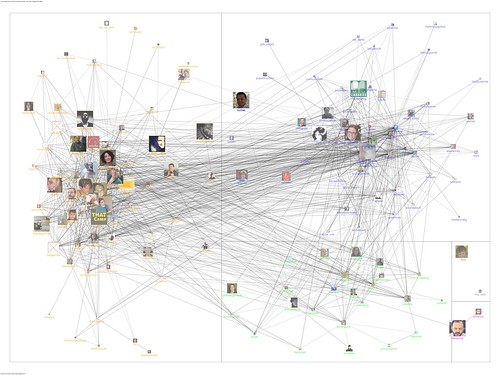
The image above is a map of all the metadata associated of just one tweet.  The image below is a map of the connections among the Twitter users who tweeted the word THATCamp, queried on April 30, 2011:

20110430-NodeXL-Twitter-THATCamp


Network analysis and visualizations are of great interest and importance because what they can reveal goes far beyond what we can intuit without machines. Network analysis and visualizations requires a whole set of new competencies that I have not seen much of in libraryland, with the exception of those on Team LODLAM, who enjoyed a breakthrough season last year.

My message here is that we need to be creating data, not records, and that we need to create the data first, then build records with it for those applications where records are needed. Those records will operate internally to library systems, while the data has the potential to make connections in linked data space.


Meanwhile, librarians are still teaching Boolean logic. That's a disconnect that I'm finding difficult to ignore.


Speaking of disconnecting, I need to that now. There is much work to be done. This is what we can all agree on.

Wednesday, January 11, 2012

A glut. A library. A flood. A review.

I've started reading again.

I try to put in a chapter before bed and it's done wonders, not only for all the good things associated with what learning news things bring, but doing so settles my monkey-mind down so that I've been sleeping better.

I read three related books in succession: one about the history of categorization, one about the history of libraries and the last about the history of information.


While reading these particular books in quick succession will no doubt mess up my ability to recall which particular book contained which particular antidote, the upside is that I've had the opportunity to notice where they contradict each other and where they tell the same story but from different perspectives.
The first categories may have emerged as outward expressions of existing social relationships: an attempt to make visible otherwise invisible relationships like “parent,” “sibling,” or higher-level abstractions like “family.” As Hobart and Schiffman write, “Genealogy provides the ideal classificatory tool, for it narrates a sequence of actions. It thus sustains the tradition while, at the same time, subjecting it to a hierarchical ordering that clarifies the nature of various figures. When gods are considered, genealogy becomes a means of understanding the cosmos … when mortals are considered, it becomes an encyclopedic framework for historical and geographical as well as social information.”9
Highlighted by Mita in Glut

Or as a more eloquent writer like James Gleick puts it:
For the Yaunde, the elephant is always “the great awkward one.”♦ The resemblance to Homeric formulas—not merely Zeus, but Zeus the cloud-gatherer; not just the sea, but the wine-dark sea—is no accident. In an oral culture, inspiration has to serve clarity and memory first. The Muses are the daughters of Mnemosyne.
Highlighted by Mita in The Information: A History, a Theory, a Flood


Glut (a horribly named book; a book about food is not called Stomach Pangs) - is the weakest in terms of scholarship, but just like the work of Howard Bloom which he cites frequently in the early chapters, it is still very interesting...
We do not have to accept Bloom’s theory as hard science, however, to appreciate it as a metaphor. As Alfred North Whitehead put it, “It is more important that a proposition be interesting than that it be true. But of course a true theory is more apt to be interesting than a false one.”
Highlighted by Mita in Glut

Information: A History, A Theory, a Flood is a drier read, largely because it is a history of information that has nothing to do with meaning. As such, there is scarce mention of libraries in Gleick's book. For that, you will have to read Mathew Battle's work. Be warned: Library: An unquiet history mostly reads as a history of the destruction of libraries over the course of civilization. It's hard not to conclude the cost of centralizing texts in one space is that you've created a single point of failure. It is just a matter of time before that price is paid; libraries fall with the empires that built them.

But I recommend the book just for it's fifth chapter "Books for all" alone. It is the best encapsulation I've read of the inherent conflicts within the profession of librarianship. I would re-type it in it's entirety if I could. This excerpt will have to do instead:

These images of the librarian bring to mind Prometheus, the Titan who presented mankind with the gift of fire. Two things are worth remembering about Prometheus: first, that he is moved by one emotion, pity, and his gift ultimately inspires another emotion, hubris, in the hearts of human beings. The tragic flaws of the Promethean impulse, pity and hubris, are the emotional poles of the librarian in the nineteenth century as well: pity for the low station of the reader, and hubris for the possibilities the library offers for the reformation of culture and society. The second thing to remember about the myth is the punishment of Prometheus. For his transgression against the power of the gods, Zeus chains the Titan to a wave-battered rock by the sea and sends down vultures to eat his immortal liver forever.
Highlighted by Mita in Library: An Unquiet History

Actually there's another passage I think I'd like to mention. Chapter five also contains a reading of the history of the first public libraries that I haven't read elsewhere: while the radical Chartists did much to start the public library movement through the creation of  reading rooms that were accessible to the working classes, it was actually the efforts of capitalist utilitarians who brought about the first public libraries paid by the state.
When the Manchester Public Library opened in 1852, it occupied a former Chartist hall, and speakers at the opening ceremony couched their comments in the language of class war and reconciliation. The library promoter Joseph Brotherton hoped that all classes “would learn how necessary they were to each other—how labour and capital were bound together by a link, and how the interests of all classes, rich and poor, were intertwined, like the ivy and the oak.” No less a light than Charles Dickens, who spoke as well, was confident that libraries would teach “that capital and labour are not opposed, but mutually dependant and mutually supporting.”
Highlighted by Mita in Library: An Unquiet History

While this particular history is fascinating in it's own right, I find it especially useful in understanding the current position of the public library in our society. For example, I think it helps me understand why hackerspaces in libraries are being so well received.

Like Chartist reading rooms, the original hackerspaces began in Europe and were established by anti-capitalist "radicals" (I'm still waiting for Fiacre to write the article that I need to cite here). In North America, the hackerspace or Maker Culture movement is much less grounded in politics, although it does have it's own manifesto. One of the reasons why I think the partnership of Public Libraries and Hackerspaces have been so well-received is that hackerspaces are now being re-cast as technology/business incubators. It's not exactly history repeating itself, but it does sound like a rhyme to me.

Actually, I'm not too worried about getting all the stories from these three books mixed up. I've got them all, indexed and searchable on my Kindle DX. I've got them backed up in my Calibre library, and I've got my favourite quotes on Amazon and in Readmill.

And I have these words here. Stories get stronger with their re-telling.

Friday, January 06, 2012

Academic publishers acting badly

Over the last two weeks, I've been following many worried online conversations about SOPA and the newly hatched Research Works Act. One place where I hadn't read much about it was from my place of work so just now, I uncharacteristically spammed all my colleagues about it.

If you would like to spam your own colleagues about these diabolical plans, feel free to use the text below as a starting or ending point.

I don't mean to spam you all, but there are two pieces of pending legislature in the US that I think should be of interest to all of us.

The first is SOPA, or the Stop Online Piracy Act, which is being described as having the power to "break the internet"
A number of academic publishers are on record supporting SOPA including: Macmillan (parent company of Nature Publishing), Pearson Educational, and Elsevier.

The second piece of legislation is "The Research Works Act" and it's backed by the American Association of Publishers. This act seeks to circumvent open access publishing guidelines from organizations such as the NIH. The AAP/PSP membership includes many scholarly societies: American Association for the Advancement of Science, American Geophysical Union... as well as The Library of Congress, Ithaka (JSTOR),  and the MLA.
The legislators supporting this act receive considerable campaign funding from Elsevier.

There are librarians working on trying to craft some sort of formal response to these acts. One activity in particular that I happen to support, is actively encouraging librarians to stop contributing their research and the labour to Elsevier titles such as the Journal of Academic Librarianship.

Saturday, December 24, 2011

A future, fast, cheap and out of control

The end of the year is upon us, and so, like Janus, it's time to take a look backward and take a look forward and see what we can see.

And as if on cue, this week I received two things in the mail that I would say are from our future.

quiet please uni bumpersticker and postcards

The first package contained a bumper sticker and postcards that I had received because I was a Kickstarter backer of The Uni: a portable, open-air reading room for public space.

One of the reasons why I happily supported Uni, was because those responsible for its being were the folks behind the Store Front Library experiment. Like Eric Hellman, also I think the future of public libraries are going to be found within smaller spaces. In fact, I already use my library as a point, instead of a space.

I frequently thought about the Uni this year as I followed the rise and fall (and rise and fall) of the Occupy Wall Street Library. I don't think it was coincidence that the first book to be catalogued in The People's Library was Hakim Bey's T.A.Z : The Temporary Autonomous Zone, Ontological Anarchy, Poetic Terrorism.

The book on The People's Library is still unwritten (but you can help publish it if you donate by the end of 2011) and while much can be said about libraries and the occupy movement, I just want to briefly touch on one particular aspect at the moment: the politics of self-archiving.

My personal interest in this topic is largely about the technology of self-archiving but since a good friend of mine is involved in a really interesting archive project, I'm becoming more aware of the politics of self-archiving and what it might mean in a larger context.

By 2006, there were already several substantial collections of girl zines that had been donated to university libraries, including the collections housed at Duke University and Barnard College . I decided to visit these collections. It was quite amazing to me that a zine produced by fifteen-year-old queer girl in 1994 in a print run of 30 or so copies could find its way, only a decade later, to a rare book library half way across the continent. There’s no history of such girls’ voices being remembered or valued, so how were their zines suddenly showing up in rare book libraries and archives? That’s where this project begins—I was interested in exploring why women of my generation, women who grew up during the second wave feminist movement—had not only carefully collected the documentary traces of their activism and cultural production but were, only a decade later, donating their collections to established archives (The Scholarly Feminist: Archiving with Kate Eichhorn).

After the OWS Library was destroyed by the NYPD, the question of how the library should re-build was raised. This concern was most pointedly raised by  this stream of tweets from Jason Scott of Textfiles, so I decided to capture it in a Storify stream:


I felt obligated to capture that conversation in the moment because I knew that if I didn't I'd never find those lines again due to Twitter's poor capacity to find particular tweets even in the very recent past.


My inability to find my own words prompted me to install a version of ThinkUp months back and I highly recommend it to all. Without it, I wouldn't be able to find the tweet that will lead us to the end of this post.


In July, I shared the fact that I have an affection for the game, Nine-Men's-Morris, otherwise known as Mill. That post was read by Josh Judkins, someone who I've never met, but I have worked with as we were both game-runners for Jane McGongial's Evoke. Mr. Judkins is a Community Manager at Ponoko, a site that hosts "host tens of thousands of user generated product designs, ready to be customized and made into real things with the click of a mouse."  This is the necessary context that explains Josh's response to my post:

(I was able to display this conversation using Aaron's Twitter Viewer. Thanks Aaron!)


Six months later, just in time for Yuletide, I received this in the mail:


nine mens morris


The postal service is transportation; 3-D printing is teleportation.

The future is here and it's in distribution.

Sunday, December 18, 2011

My Little Pony: Libraries are Magic

Here's my biggest #firstworldproblem I've experienced today: I accidentally deleted my daughter's favourite My Little Pony episode from our DVR which just happens to lack an undelete, recover from trash or undo option. The emotional fallout from this simple slip of the finger is going to be epic.

So this morning I had a little rant over coffee about how the User Design of this cable-company supplied DVR machine had deliberately made deleting shows easy to do because they really didn't want these machines to save shows forever.

My husband very gently challenged my conspiracy theory: "Then why does the DVR have so much memory and can store so many programs?"

And my reply was that while our DVR could sort of act like a family's library of favourite TV episodes and movies, we should remember that our DVR was really just a walled-garden of cable-company provided content. If it was something like a library (like Boxee) it would have the option to add shows from other sources, like from DVDs purchased elsewhere. And because it would put viewers needs first, it would have an undelete function.

Then, for a brief moment this morning, I curled up on the sofa with my Kindle DX and resumed my reading of The Information: A History, A Theory of Flood, happily highlighting passages that I would, late that day, synch up with my Readmill bookmarklet.

Can you see where I'm going with this?

The ebook services academic libraries offer up at the moment - MyiLibrary, SpringerLink, EBCSO eBrary - are just like my DVR - they possess some of the functionalities of a library, but they are really just a glorified subset of ebooks that never leave the confines of the parent company and are never joined by other books from other sources.

I'm convinced that libraries have to start making, or sponsoring, or commissioning library software for readers.

Because if don't, others will.
 

I'll tell you this, if I had to read and know fifty books, as Ph.D students are asked to do, I would seriously consider buying them all from Amazon just to make use of their Daily Review feature:


This a feature that puts the readers needs and personal goals first.

Not that such work is in my future. What's more likely is that I'm probably going to be getting My Little Pony on DVD from Amazon.

Sunday, December 11, 2011

The Internet is like Detroit

If you only know me from my blog, then I suspect it's not particular obvious to you that I am actually a person of the book.

Books have shaped me such a way that I'm unable to even imagine who I would be without them. On class trips to Toronto (during the eighties), when my classmates would disperse to record or clothing shops during our too-brief "free time", I would make my pilgrimage to Pages where I would stock up on books that our local bookstore, while admirable in its own way, would never carry. I bought graphic novels, Whole Earth Catalogs, zines, and books from RE/search.

Kids these days don't have to go to the Big City in order to experience thrilling and potentially dangerous ideas. They have the Internet. As David Bowie told Avi Lewis (in the nineties) during an interview: "The Internet is New York City."

Or, as Roger McNamee puts it: "The Internet is like Detroit. If you look hard there are really compelling things in there but if you're not careful, you'll get mugged."

The above quote is from his TED Talk, "Six Ways to Save the Internet" and I think it's worth watching if just for the point that he was making with that not nice thing he said about Detroit: the overwhelming popularity of the gated Apple app-iTunes experience exists because most people prefer safe licensed content from corporations than from the Weird Wild West of the Internet.

And I mention all this because I've been thinking a particular future of the library in which the Big Six media companies decide that they would rather not deal with libraries at all. Combine that future with our present when austerity budgets prompt politicians to challenge libraries on the matter of lending popular materials like magazines, video games, and first run movies and it looks like libraries of the future might have to operate at the edges of media, instead of from its centre.

I mention this all because I have realized that - for much of my reading life - I have felt most comfortable about the edges of our culture. I like the left-of-center and the fringes. I love the first-person weirdness of the Internet. And I don't want to be all hipster about it, but it's the local and "authentic" of the Web that moves me - as I know it moves many of us.

So, I just might be okay with this particular future of libraries. 

To beat my metaphor to death: Maybe the library can become the New York City of the small town. Maybe it can be the place that brings forward the most interesting aspects of Detroit to all of us.

That is, if we don't get mugged first.

Thursday, December 01, 2011

Who decides what a library should be? Those who use it or those who pay for it?

Within a week I've read that two our finest public library systems are confronting challenges to their very being by the very bodies that fund them.

On Tuesday it was reported that Toronto's Budget Chief questioned whether the the Toronto Public Library should be lending out movies or non-English materials and suggested that by cutting these collections, the TPL could maintain it's hours of service. Presumedly, the mission of the library is just to serve up books in English, because according to the budget chief, it's a bad thing if a library is a community centre.

This is how the City of Toronto rewards the TPL for being the second-most used library system in the world.

Meanwhile, the focus of the New York Public System is currently in flux as it appears that the board of trustees is investing in future that serves less books to scholars and provides more space to the public.

Here's the sad tale from my own backyard: the building that houses the central branch of the public library is deemed no longer "modern enough" for a library, but strangely, modern enough to host a call-center that was threatening to leave the City of Windsor if it's needs were not subsidized by the city.

Of course, it's all more complicated than that and I do recognize this. A building filled with books never read is a crypt, not a library. And on the other end of the spectrum, if you are spending all your time looking for sponsors for events and content that will attract the widest number of people, then you are probably in the entertainment business.

Still, there's a commonality to these three stores. Those who are paying for the library are trying to call the tune; what's inside the library is no longer the domain of the librarian.

I think I would prefer the library to be shaped by those who use it... if just for the reason that they are more likely to see us as a community centre than a cost centre... or call centre.