Friday, June 25, 2010

Information tool literacy

The program for Access 2010 ("the premier library technology conference in Canada") is now available. It looks like there will be lots of good things in store for those going to Winnipeg. Oh, and while you are looking at the program, why not check out the description for the session, After Launching Search and Discovery, Who Is Mission Control? Here's a snippet:

How should we (reference librarians, systems people, and users) work together to better exploit the possibilities of open source systems so we can focus on discovery and understanding instead of the mechanics of searching?

I mention this because I think it's not only a good question, it's a very important question. How indeed should reference librarians get involved in systems work so that we build systems of understanding and not just search?
 
As if on cue, Eric Lease Morgan presented some possible answers to this question in a piece called The Next Next-Generation Catalog:

Instead of focusing on find, the profession needs to focus on the next steps in the process. After a person does a search and gets back a list of results, what do they want to do? First, they will want to peruse the items in the list. After identifying items of interest, they will want to acquire them. Once the selected items are in hand users may want to print, but at the very least they will want to read. During the course of this reading the user may be doing any number of things. Ranking. Reviewing. Annotating. Summarizing. Evaluating. Looking for a specific fact. Extracting the essence of the author’s message. Comparing & contrasting the text to other texts. Looking for sets of themes. Tracing ideas both inside and outside the texts. In other words, find and acquire are just a means to greater ends. Find and acquire are library goals, not the goals of users.

I also want to bring attention to Eric's specific call to those engaged in information literacy.

People want to perform actions against the content they acquire. They want to use the content. They want to do stuff with it. By expanding our definition of “information literacy” to include things beyond metadata and bibliography, and by combining it with the power of computers, librarianship can further “save the time of the reader” and thus remain relevant in the current information environment. Focusing on the use and evaluation of information represents a growth opportunity for librarianship. 

In response to Eric's promotion of indexing tools, Kathryn Greenhill commented:

I think librarians need to look toward using textual analysis tools from the disciplines they serve and incorporate it into their “beyond discovery” layers.

It’s a pity that often subject liaison librarians in universities do this job because they are not so interested in “techie things”….How to get them to understand that this is their role will be interesting.

[I'm assuming that her last comment is missing a "not do" so that it reads, "It’s a pity that often subject liaison librarians in universities do not do this job because they are not so interested in “techie things” - I'm going to send her an email to clarify this matter.]

I think there is an significant reluctance by Information Literacy librarians to introduce genuinely useful tools (such as Zotero) to users because after years of teaching users just how to use the catalogue, many teaching librarians refuse to do any teaching of tools. Add to this scenario that an information librarian generally has only a very brief period of time to introduce large and hairy concepts to students such as genre theory, critical reading, and transliteracy, and you have librarians who will refuse to teach students textual tools on principle.

But "tool choice" is not the same as "teaching a tool".

So let us recognize that a reader's choice of information tool fundamentally affects that user's "use of information". Let us embrace information tool choice and use as a inherent component of Information Literacy. Let us ask ourselves why we promote the use of CINAHL instead of PubMed, WorldCat instead of OpenLibrary, RefWorks instead of Zotero...

OK, I admit that doesn't sound very poetic. Let's try that again:
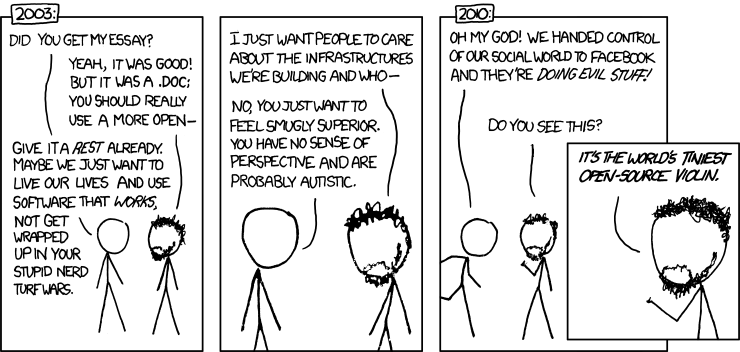


I know I'm not alone here. While still in the minority, I believe that there are many librarians who believe that tool choice and development should be a fundamental component of our profession's work. In face, there are librarians who hold that tool creation is essential for our profession's survival. Also published yesterday, here is K. G. Schneider:


The fundamental problem with the proprietary software model is not one of evil ownership or grasping vendors. I’ve seen both of those occur in the open source software community. The problem with proprietary library management software–from a high-level perspective, profession-wide–is that it makes us stupid. It deprofessionalizes who we are and disengages us from tool creation.

Conversely, every librarian who engages in tool creation to any degree improves the state of librarianship for all of us. This has been true since some guy in a toga put holes in a wall to store the papyrus, and it was true in the 19th century when we agreed as a profession on the size of catalog cards (which led to our early adoption of standards and network-level records), and it  is true in the open source community today.

And her conclusions about why librarianship needs open source dovetails nicely with why I think librarianship needs to embrace tool choice and development, so I'll end with her words from the same post

If librarianship will survive the Big Shift, it will do so by reinventing itself. To reinvent itself will require many muscles of invention. And that, in the end, is why we need open source.

Thursday, June 17, 2010

Open Endorsements

My favourite response to the federal government's Digital Economic Strategy came from David Eaves in a piece written some weeks ago called Why we risk asking the wrong question. Its a wonderfully concise and insightful piece. My pullquotes of choice:

I think we need to stop talking about a digital as the future.

This whole conversation isn’t about being a digital country. It isn't about a future where everything is going to be digitized. That isn't the challenge. It is already happening. It's done. It's over. Canada is already well on its way to becoming digital...
The dirty truth is that Canada's digital future isn't about digital. What is special isn't that everything is being digitized. It's that everything is being connected....

So if a digital economy strategy is really about a networked economy strategy, and what makes a networked economy work better is stronger and more effective connectivity, then the challenge isn’t about what happens when something shifts from physical to digital. It is about how we promote the connectivity of everything to everything in a fair manner. How do we make ourselves the most networked country, in the physical, legally and policy terms. This is the challenge.

And today, Eaves specifically brought attention to three citizen-suggested proposals that are worth supporting. I think they are worth supporting too, so here are their links:


Eaves also supports Michael Geist's recent recommendations of proposals to support - which are the same as David's but with an addition of an proposal to support Open Access to Canadian research.


To register your support for these and/or other proposals, you need to register with the website and then, seconds later, you are able to comment and vote on these issues.

Wednesday, June 16, 2010

Why How What Now

At MPOW (my place of work), we are about to embark on another round of strategic planning. Before it starts, I wanted to work through my own thoughts on the matter before my simple brain gets too clouded with competing visions of our collective future.

I've been through enough of these planning exercises to know that the matter can be described in a fairly straight-forward manner: first you establish values and from these and an environmental scan, you (being either the management  or the entire organization) set the strategic priorities. Then, if you are keen, you determine what variables you will pay attention to when you get to the point when you are able reflect on the exercise and determine if you have been successful in the tactics that you established to achieve your priorities.

The best organizations are those who embed their values into such a clear mission that it informs all of the decisions made by that organization. Those are the findings of Jim Collins in his seminal book, Good to Great.

Making things simple is hard work. This is why so planning documents are long, ambiguous, and cumbersome. Instead of a core value, they come up with eight. Instead of one priority, they come up with 12.

Now I'm considering the possibility that it might just not be possible to distill the complexities of an organization into one core concept. But even if we are able to boil down the understanding of our work into something distilled, we can come up with powerful magic. Case in point: generations of work in libraries and library science can be described in 24 words, broken into 5 short, memorable laws.

Simon Sinek has tried to distill the lessons of great leaders into a model that he calls the golden circle: in the centre of the circle is why, the circle is how and the outer circle is what. Notice how this model maps quite nicely with the strategic planning process: why=values; how=strategies, what=tactics. And like Jim Collin's, Sinek's conclusion is that great companies and great leaders are those who are able to convey a clear why they do things.

In 2006, Dan Chudnov put down these thoughts in a post called, Because this is the business we've chosen:

If so, then what's the mission of the librarian in 2006? It's not an easy question. I've been stewing over it for two months, and think I've come up with the only answer that works for me. Yours might be different, but this describes what I'm here for, and the thread runs through every disparate bit of work I'm involved in one way or another... My professional mission as a librarian is this: Help people build their own libraries.

I too have been thinking about what's the mission of the librarian and I haven't come up with anything as clear and as powerful as Dan's statement. But I think I'm getting to something that is getting closer to where I would like such a statement to be. Here's what I've come up for our own strategic exercise:

Turn local problems into global solutions.

What I mean by this statement (and the fact that I feel that the statement needs some explanation tells me how weak it is as a mission statement) is that I would like to see libraries break out of the "special snowflake" syndrome and recognize that many small problems that we tackle in an ad hoc basis can be redrawn as larger problems faced by many readers and many libraries and thus, could be met with shareable solutions. It would remind us that we have a duty to make all of our work (research, software development, innovation) open and accessible to all for use, re-use, and re-mixing. It could make our work more meaningful and more important. It could inspire us to tackle important problems so that we can help others as we try to help ourselves.

The odds that this suggestion is going to survive the first stages of our planning process are slim to none.

But there is a good chance that this mission might end up as the work that I have chosen.

Wednesday, June 09, 2010

Go to Go to Hellman

One of my favourite blogs is Eric Hellman's Go To Hellman. I've been recommending his recent post on understanding eBook messes to my colleagues and for you, well, I think you should read his Are Public Libraries in a Death Spiral?

In this essay, Eric Hellman laments how library directors are opting to reduce library hours when faced with budget cuts. In one painfully honest sentence:

A library that reduces its hours is just training its public to meet information needs elsewhere, and that public isn't going to rush back. 

The alternative that stops the death spiral?

The public library of the future has to stop being about collections and start being about helping people and communities.

I love the clarity of that call.

What if the libraries who are facing cuts, decided to slash book and DVD budgets instead of hours?  What if, instead of asking their community to act as political lobbyists on their behalf, these libraries asked community groups and individuals to donate their own collections into the community library? Ironically, by asking the community to help the library, connections between the community and the library could even be strengthened. Building a library builds community.

We need the community to help the library so that the library can help the community.

Saturday, June 05, 2010

Points do not a game make

In the last week or so, Jane McGonigal recommended a couple presentations that address point systems and games with both making the case that adding point system to an activity does NOT transform that activity into a game.

Just add points? What UX can (and cannot) learn from games from Sebastian Deterding tackles this issue directly and it sounds pretty much note perfect to me.

Amy Jo Kim makes the case in her presentation MetaGame Design: Reward Systems That Drive Engagement that point systems aren't games but meta-games. Furthermore, she suggests that that meta-game systems already exist in many of our offline activities in some obvious areas such as sports (e.g. martial arts) and also in other less obvious activities such as scouting  (heck - they even use badges!). Amy seems more optimistic than Sebastian that game elements can be integrated into UX and she outlines under what conditions where she believes where they work best.

The only library application that I know of that uses a point system is Bibliocommon's Community Credit system.


At this point, I believe that most of the libraries who have chosen to implement the system have only used the lists for draws of small prizes. But with a point system, meta-games for the library catalogue *are* possible. That is, if we choose to play.

Saturday, May 29, 2010

What we can learn from Nike’s Persuasive Technology

[This is an older post of mine that was on a now-retired community blog called tech-ink.net.] 

The cover story of the latest issue of WIRED Magazine is dedicated to the success of the Nike+ sensor system. Nike+ allows users to track and share the time, speed, and distance of their runs using an iPod or Nike+ wristband. I can personally attest to the motivational power of such feedback. I ran fairly regularly when I used it but when my wristband sensor died, I used its untimely death as an excuse to stop running. (I’m waiting for a free replacement of a next gen model. The WIRED article fails to mention the high failure rate of the first batch of the system’s technology.)

My friend who runs marathons doesn’t need a Nike+ system to help her keep track of her runs – shes uses a pen and paper. But I, like most people, find that just this extra bit of little work feels like a huge burden. Like Nike, libraries need to strive to create systems that feel as effortless as possible (just one example: writing down a 20 digit call number isn’t hard but it feels hard).

I think there are other things we can distill from the Nike+ experience. Its worth noting how rich an experience Nike+ is able to generate for its 1.2 million users with just three data points.  We should consider what information we could capture to help motivate our students. Privacy advocates tells us that no one likes to be watched but that’s not exactly the case. “The gist of the idea is that people change their behavior – often for the better – when they are being observed (which is why it’s sometimes called the observer effect).”

Visual feedback helps reinforce positive behaviour. From the above WIRED article, “a 2001 study in the American Journal of Health Behavior showed that personalized feedback increased the effectiveness of everything from smoking-cessation to interventions for problem drinkers to exercise programs.” The Prius dashboard encourages better driving for high fuel efficiency. Recently there’s been some folks creating library dashboards but they haven’t been developed yet to provide individual user feedback of their borrowing or reading habits.

Video game designers are masters at presenting user data and creating rewards for user behaviour and Jane McGonigal thinks we can use what they’ve learned to improve our happiness and our future in the real world. In her IGDA Education Keynote 2009, McGonigal makes a number of book recommendations including Persuasive Technology by B. J. Fogg (2003) in order to learn more about the ramifications of using computers to try to change user behaviour. I’ve got the book on my lap right now at a page in which Fogg describes a hypothetical library-related example of persuasive technology:
Because she’s serious about school, Pamela runs an application on her device called Study Buddy. Here’s what the application does: As Pamela begins her evening study session, she launches the Study Buddy system and views the display. Study Buddy congratulates her for studying for the third time that day, meeting the goal she set at the beginning of the academic quarter. The device suggests that Pamela start her study session with a five-minute review of her biology vocabulary words, then read two chapters assigned for tomorrow’s sociology lecture.

As Pamela reviews biology, the Study Buddy screen shows a cluster of shapes, which represents her classmates who are currently studying. This motivates her to continue studying.
Later that evening, as Pamela wraps up her work, she’s curious about her mentor, Jean so she turns to Study Buddy for information. Jean also subscribes to the Study Buddy system and has invited Pamela into her “awareness group” (1). Pamela sees a symbol on the display that indicates that Jean in currently in one of the campus libraries. Jean is a good role model; she’s a senior who was recently admitted to a top graduate school. Being a study mentor means that Jean has agreed to let Pamela remotely view Jean’s studying habits. Using Study Buddy, Jean can send simple sounds and tactile cues such as vibration patterns to Pamela to encourage her to study.

I should note that I haven’t actually read the rest of this book. I’m hoping by posting writing about it I’ll shame motivate myself to do so.

My new fave search engine is Zotero

[This is an older post of mine that was on a now-retired community blog called tech-ink.net]

While Zotero – “the free, easy-to-use Firefox extension to help you collect, manage, and cite your research sources” – isn’t exactly new, the program recently made the jump from 1.0 to 2.0 (beta) and with in doing so, has become social software and something more: it’s becoming a favourite search engine of mine.
But let me back it up a bit so I can say a little bit about custom or personalized search engines. I think they’re great and I wish more people would find them so they could enjoy their greatness too.

For example, I use LISZEN to search the library blogosphere and search my own homemade Google Custom Search Engine of OCUL libraries whenever I wonder if someone up the highway has some insight on the matter at hand. The University of Winnipeg uses a Custom Google Search Engine for its Canadian Art Library Guide, which I think is a brilliant application and breathes new life into the traditional library subject guide. And at one time, I entertained the notion that libraries could use Google Custom Search Engines as an alternative to the proprietary indexes that we offer, but after trying out The Economics Search Engine of 23 000 economics web sites  its pretty clear that this technology doesn’t scale. That’s too bad because I think we need a prominent index of the open access journal content out there.

OK. Back to Zotero.

I had waited to try out Zotero properly only after Zotero turned 2.0 because I was waiting for its automatic backup and synch features. And in the last handful of weeks, I’ve been slowly adding material into my Zotero library as a way to get a feel for the software. And then it just today that I realized that Zotero was indexing not just the metadata of the websites and journal articles I was planting into it – it was indexing the fulltext of the saved snapshots as well as and the text in the saved pdfs.

So, I plunked in the annual literature reviews dedicated to Library Instruction and Information Literacy from Reference Services Review and voila! I had myself my own little Information Literacy Research Index in my browser!

If you haven’t tried out Zotero yet, I wholeheartedly encourage you to do so. Zotero has some big plans they are working on including a partnership with the Internet Archive. That’s the project that really intrigues me. Not only will scholars be able to add material from the Internet Archive into their personal Zotero libraries but they will also be able to contribute their own digital work contributions into its commons.

When I think I of the future of libraries, I can’t help but think our future dovetailing into Zotero somehow.

Sunday, May 23, 2010

Freebasing the University

(This is an expanded version this previous post that I'm submitting to Hacking the Academy)

If you ran the zoo, how would you redesign your presence on your university website?

I wasn't looking for the answer to this question but a couple weeks ago I was reading up on the nascent Open Government movement in Canada when I stumbled upon a website that immediately struck me with its grace and power. And ever since I've been repeatedly asking myself, "How can I make my library's website more like openparliament.ca?"

openparliament.ca is the volunteer, spare-time creation of Michael Mulley, who is the one man of a one-man web development shop based in Montreal, Quebec. He developed the site to make political information easier for citizens to find and follow as well as to encourage transparency in government. But it's not so much the information on the site that I want to draw attention to. Instead, I would like to praise how openparliament.ca so elegantly links politicians to the words they say, to the bills that they vote on, to the media coverage that they have received, and to the populations that they represent.

And so, I have been re-imaging The University as Parliament. Parliament has reports, bills, laws, committees, parties, departments, a House, a Senate, rules of order, Members of Parliament, transcripts and media coverage. The University has courses, programs, departments, faculties, a Senate, rules of order, research groups, committees, reports, research articles, and media coverage. They seem more alike than not.

So imagine your university website with a front page like openparliament.ca with a set of keywords taken from the day's seminars, speaking events, as well as nouns from research papers just published and even from course descriptions of classes being taught that day. Each event, paper or class would be automagically linked to the people involved with the work. These people would be, in turn, linked to all their various campus affiliations (faculties, committees, departments, research groups) as well as to the courses that they are presently teaching. Each course would be linked to a description to that course and would be further associated with matching library resources....

In short, if you had to build a university web presence from scratch, you would be mad not to build linked data into its foundation.

And yet, after looking and asking around I have only found one institution of higher education that describes its organization, the people of that organization and their work using the recommended RDF framework for computer mediated linking. At this point in time, this is understandable: Tim Berner's Lee campaign for linked data is only just over a year old and at this stage, the instructions on How to Publish Linked Data On The Web are still quite daunting to those not already familiar with the language of the Semantic Web. But there are new tools being developed to help build this new scaffolding of the Internet. At the moment, my tool of choice is Freebase, which aims to be the Wikipedia of linked data. My university, among many others, is already there as a Freebase topic.

Incidentally, I'm well aware that you might not be as enamored with the prospect of your university's website being replaced with a search box and keywords just like openparliament.ca  That's okay. In fact, your displeasure actually supports another reason why academic institutions need to embrace linked data: the information within our institutions need be able to be re-mixed and re-presented in a multitude of ways to fulfill the multitude of different research, teaching, institutional, and promotional needs that are currently not being met.

For example, I've been trying to figure out how to link library-licensed  research databases to particular courses being taught on campus and, more importantly, trying to determine how we can have links from course websites go to a set of relevant library resources. Making such connections are important because undergraduates lack an understanding of an academic discipline which makes their search for research (and even their search for research help) a difficult one. At the moment, it is near impossible to make such links because some faculty have their course material within course management systems, while other instructors have gone edupunk and have found their own ways to share and communicate with their students online. A publicly available linked data schema for our course catalogue would make my library-linking project possible because it would generate links that are not dependent on platforms.

"Public information should be meaningfully public, which today means shareable and computer-readable". That's from openparliament.ca today but it very well may be from our students, our surrounding communities, and perhaps even our politicians tomorrow.

Wednesday, May 19, 2010

University Websites, Linked Data and Giants

Finding out about what your member of Parliament is up to takes work - but web sites such as openparliament.ca have been wonderfully built and elegantly designed to make this work much, much easier.

Our library's web team has been recently activated and as chair, I've been casting around ideas on how we might re-build the foundation of our website as we move from a Lotus Notes Domino environment to a Drupal one. And the question that I keep coming back to is how can our website be more like openparliament.ca?

And so I've been re-imaging The University as Parliament. Parliament has bills, laws, committees, parties, departments, MPs, transcripts and media coverage. The University has courses, departments, committees, instructors, transcripts, research articles, and media coverage. Hmmm.. sounds somewhat similar.

So imagine your university website with a front page like openparliament.ca with the day's research and learning topics filling the page. Each topic would be associated with a class or research paper. Each paper or class would be associated with a researcher or instructor who would in tun be linked to all their various campus affiliations and the courses they are presently teaching. Each course would be associated with matching library resources...

If you had build a university website from scratch, it would be mad not to build linked data into its foundation.

But the trouble is, once I start browsing the Guides and Tutorials about Linked Data, I become so overwhelmed with the terminology of semantic linking and frightened of the enormity of the task before me that I promptly flee in terror.

So I am at a loss. I can see a conceptual structure that we can build our library website upon. I can see the opportunity to show others on campus (and on other campuses) what can be possible with linked, open data. Except I would much rather find a giant who's shoulders I can stand on so I see how this may be done.

But I have no giant. All I have is this handful of beans.

Monday, May 17, 2010

Reflections on #WILU2010 Re:learn

One of the largest concerns within Information Literacy (IL) is the matter of scalability. This is understandable if you hold that the mandate of IL means that the librarians of an academic institution are responsible to ensure that every student of that school should graduate with information literacy skills even when the librarians don't have an institutional mandate to teach those students.

So we're still trying to figure out how to reach more students with IL. Some are slowly integrating IL into the various curriculum on campus. Some are teaching faculty, teaching instructors and mentors so that they can pass on IL to their students on our behalf. Other schools are developing online tutorials and even games to reach the widest number of students, and some of them are doing this work reluctantly.

It was this reluctance that I picked up on at WILU 2010, as a number of presenters let the audience know that they were pursing an online IL strategy because budget cuts meant they had little option to do something face to face. Some people almost sounded apologetic about their online creations.

But it was also at WILU where I also saw signs of another means to address IL in a scalable manner. Instead of pursuing "one to many" avenues of teaching, one can see the start of "many to many" learning platforms.

Indeed, I very much enjoyed Dr. James Paul Gee's opening keynote address to WILU. While Dr. Gee spoke a little bit about games, the primary focus of his attention was online learning communities which he feels represents a new paradigm of learning that outperforms traditional classroom experiences.

I very much share Dr. Gee's enthusiasm for online learning communities having been part of a 10 week crash course in changing the world called Evoke. Scaling is actually also an issue with these new type of environments: within the first 24 hours of the Evoke, players submitted more than 2000 blog posts, videos and photos as evidence and in the first 15 days of the network, more than 10,500 players registered to play from more than 120 counties (slides 57,58).

But back to the conference. I did see other hopeful signs that many-to-many learning systems are starting to find a place within academia. There are more and more examples of courses and assignments that require students to publish their work so that they can learn from the peer's work and the assessment of their peers and not just their own experiences.

There was another example of the power of group learning spaces at WILU: the birds of a feather sessions. Not entirely unlike an unconference, attendees were asked to write down topics of interest and sit at designated tables where these topics would be discussed. I decided to sit at the table dedicated to addressing student motivations and there was a great conversation at the table that brought out a flurry of different ideas and perspectives on the topic, with a breadth and depth that is difficult to summarize

(On a somewhat related note, it appears that the summaries of the Birds of the Feather sessions are no longer on the WILU 2010 blog. That's too bad. I like the idea of making adding each conference session into a blog post so that speakers can add links and addendum as necessary and so that questions and conversations about the topic can continue even after the conference has passed. Actually what I would really love is if each conference I attended followed the template of the THAT conference in which each attendee was given their own blog - with the sum of each making up the conference site - as a means to facilitate sharing of ideas before, during and after the event.)

The power of that BoF session reminds me of the keynote address at WILU 2007 done by Rick Salutin in which he surprised me with his preference for the complex and ever shifting conversations of our oral tradition over the paucity and mechanical tyranny of the written word.

And isn't this what is a conference is or should be: a means to host conversations at both large and small scales?

Sunday, May 16, 2010

Reflections on #WILU2010 Re:design

On Friday I returned from attending my second WILU conference. It was a well-hosted event and I thank the organizers for the experience.

When I introduced my own talk at WILU, I stressed that my opinions tend to be strongly stated but they are not necessarily strongly held. I want to repeat this disclaimer as I share some of the reflections of what I've learned from the three-day conference.

I tend to divide work in Information Literacy (IL) into two broad camps. The first camp spends their efforts directing students to use library websites, research guides and indexes for approved sources to meet their research needs. The second camp opts to instead teach students how to recognize sources that they might find and how they might fit these into their own research work.

It's my perception that most of our profession's IL work falls in the first camp and most of the sessions that are in the program of WILU 2010 fell in this category.

And, if you know me at all, its shouldn't surprise you that I place myself in that other camp.

All my favourite WILU talks have all come from this second perspective: Rochelle Mazar's Making Coursework Matter, Joel Burkholder's The Information Seeking Habits of Students: Are They Really That Bad?, and John Willinsky's keynote address come to mind. And my favourite talk from WILU 2010 also is from this perspective: Joel Burkholder's (again!) Sources as Social Acts: Using Genre Theory to Transform Information Literacy Instruction.

For myself, the perspective that IL should not preoccupy itself with indexes that only academic libraries can afford, allows librarians to fully pursue the end goals of the Open Access movement and of supporting lifelong learning in our students, without contradiction.

More reflections later. I think about the notion of 'scaling'...

Saturday, May 15, 2010

My #WILU2010 Talk - Not library games. Libraries *in* games Re:Play

Yesterday, I gave a talk entitled Not Library Games. Libraries in Games at WILU 2010.

My slides and text of my slides are available on the WILU 2010 website. The ppt file contains my speakers notes as does this Google Presentation under the bottom Actions menu.


Before the talk, we played a game using slides that I put into Prezi - but I accessed the files in edit mode so I could move the game pieces around the board. You can see the pre-talk pre-game board.